There are four situations where the honest answer is that you do not need an underwater pelletizer. Rigid, clean regrind that goes straight into an injection moulder does not need 1.2 mm spheres. A plant with 150 kg/h of throughput cannot amortise the machine. A material that cannot hold a melt window together will not improve because the cut is rounder. And a buyer who wants cubes with a visible cut face will reject spherical pellets as easily as the other way round.
The middle ground is usually the right answer. A water ring pelletizer gives die-face cut pellets at 100–1,000 kg/h from US$18,500, uses 40% less floor space than a strand line, and needs no cutter service. A strand line at US$16,800 gives cubes that are easy to inspect and easy to sell.
Four honest reasons to say no
- Rigid, clean regrind for injection moulding does not need spherical pellets at all.
- Below roughly 150 kg/h the capital and the cutter service do not pay for themselves.
- A material with no stable melt window will not be rescued by a better cut.
- The water ring at US$18,500 and the strand line at US$16,800 cover most cases where underwater is overkill.
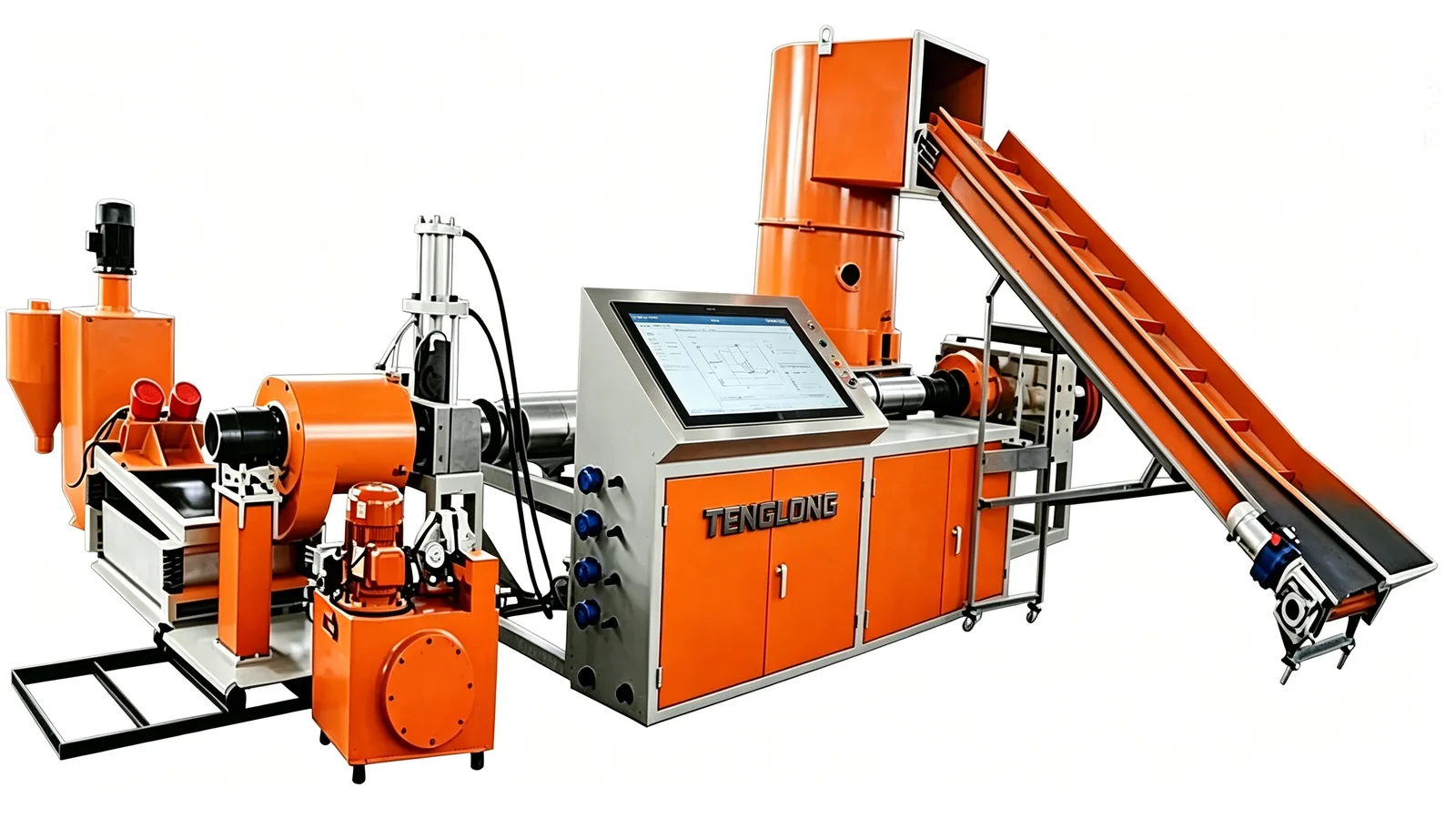
Four situations where the answer is no
We sell underwater pelletizers, and they are the right answer for PET, PA and masterbatch. There are four situations where we tell a buyer to choose something else, and it is worth setting them out plainly.
Your material is clean regrind and nobody is complaining about appearance. A single screw with a hydraulic screen changer and a strand cutter produces a consistent pellet at a fraction of the capital. Underwater solves oxidation, and clean regrind has very little oxidation to solve.
Your tonnage is small. Below roughly 100 kg/h, the water loop, the cutter chamber and the extra footprint do not earn their keep. Our smallest platform is the TL-PM-80 at 100–150 kg/h with a 37 kW motor, and the TL-MB-35 masterbatch line goes down to 20 kg/h. Below those sizes the batch is too small to fill the barrel and the material loss exceeds the value of the batch.
Your customer specifies cube pellets. Cable and film buyers often specify a cube and check it visually on arrival. A sphere is a better pellet for dosing, but it is not what was ordered, and fighting the specification costs more than the machine saves.
You have no water treatment and no intention of adding any. An underwater system circulates water through filtration, and that filtration has to go somewhere. In a plant that has never handled a water system, that is a real installation cost that does not appear in the machine quotation.
The three questions that settle it in one call

If you can answer these three, the decision is straightforward, and you can work it out before contacting any supplier.
What is the polymer? PET, PA and masterbatch need the protection of underwater cutting. PP and PE generally do not. This one question eliminates most of the market.
What is the contamination level? Below about 2% non-melting contamination, a single screw at 60–80 mesh handles it. Above 8%, washing is the priority and filtration is secondary.
Who buys the pellet and what do they check? A bottle-to-bottle converter checks IV, colour and contamination. A fibre producer checks consistency and price. The customer’s checklist is the real specification, and it decides which machine belongs on your floor.
What the simpler options actually give you
It is worth being clear about what a straightforward line delivers, because the underwater specification is often compared against an unrealistic benchmark.
The TL-SJ single screw granulator runs 150–700 kg/h of clean PP, PE and ABS regrind with a 90–150 mm nitrided screw, and starts at US$12,500. The TL-ST strand pelletizing line runs 150–800 kg/h at US$16,800 and produces cubic pellets of 2–4 mm with the simplest possible visual quality check. The TL-WR water ring pelletizer runs 100–1,000 kg/h at US$18,500, with die-face cutting and about 40% less floor space than strand.
For a plant whose material is clean, whose customer wants cubes and whose tonnage is moderate, those three machines are a complete and correct answer. The TL-UW at US$62,000 and 300–2,000 kg/h is the right answer for a different plant.
The honest middle ground
There is a third option that is often the best one: a line that starts simpler and can take the underwater stage later, if the customer changes.
This is not always possible — the water loop and the cutter chamber are integrated into the extruder arrangement rather than added beside it — but it is worth asking, because it changes the capital timing rather than the capability. Our own turnkey approach is to specify the line around the material and the customer rather than around the highest specification available.
And it is worth asking the same question in the other direction: if your customer is a food-grade converter and you are planning to supply them in eighteen months, specifying for underwater now is cheaper than retrofitting it later.
The clearest case for caution is retrofitting. Hot wash needs heat exchangers, insulated tanks and caustic handling that a cold-wash line does not have, and retrofitting costs more than building it in. The same logic applies to underwater cutting on a line that was laid out for strand.
Which platform matches which material and customer
The platform that matches the material and the customer, including the cases where the simplest machine is the right one.
| Situation | Recommended platform | Starting price |
|---|---|---|
| Clean regrind, moderate tonnage, cube pellets wanted | TL-ST strand pelletizing line | US$16,800 |
| Polyolefins, limited floor space | TL-WR water ring pelletizer | US$18,500 |
| PET or PA, appearance-critical, IV-driven | TL-UW underwater pelletizer | US$62,000 |
| Food-contact PET with crystallisation and drying | TL-PET pelletizing line | US$120,000 |
| Small workshop, in-house scrap only | TL-PM plastic pellet mill | US$6,800 |
Common questions, with short answers
Q1: Is an underwater pelletizer always better quality?
No, and better is the wrong word. It produces a specific result: spherical pellets with minimal oxidation and the least dust of the three cutting methods. If your customer needs cubes, or your material is clean and nobody is inspecting colour, a strand line is the correct specification and the better investment.
Q2: What is the smallest practical underwater pelletizer?
Around 100 kg/h of finished output. Our smallest platform overall is the TL-PM-80 at 100–150 kg/h with a 37 kW motor, and the masterbatch line goes to 20 kg/h. Below that, the batch is too small to fill the barrel and the material loss exceeds the value of the batch.
Q3: Can I upgrade a strand line to underwater cutting later?
Not practically. The water loop, the cutter chamber and the pellet handling are integrated into the extruder arrangement rather than added beside it, and the retrofit costs more than specifying it at the start. The same is true of hot wash on a cold-wash line — the heat exchangers, insulation and caustic handling are not bolt-ons.
Q4: How do I know which one my business needs?
Three questions: what is the polymer, what is the contamination level, and what does your customer actually check. Send us the polymer, the contamination level and the target output, and you will get a model recommendation, a power estimate and a price range within one working day.
Also worth reading: the 12-platform comparison.
Three more notes from the same test floor: Underwater Pelletizer vs Strand and Water Ring Cutting, Underwater Pelletizer: Pellet Quality and Oxidation Control, Underwater Pelletizer Sizing: Throughput and Floor Space and Underwater Pelletizer Commissioning and Acceptance.
About the author
Zhou Gong (周工) is the recycling machinery engineer at TENGLONG Plastic Machinery in Linyi, Shandong — a plant of 18,000 m² with 30-plus staff, 12 platforms and 820-plus installations across 46 export markets. The question I put to a customer before quoting an underwater machine is who buys the pellets and what they said they wanted. The answer usually settles the platform in one call. Where a figure is quoted here it has been measured or published with a date attached; nothing in this article is an estimate.
The quickest way to a real answer is to send the feed form, the contamination level and the throughput you need. A model and a price range come back within one working day, the trial on 10–20 kg of your material is free, and a result that misses the agreed output by more than 5% leaves the deposit refundable.