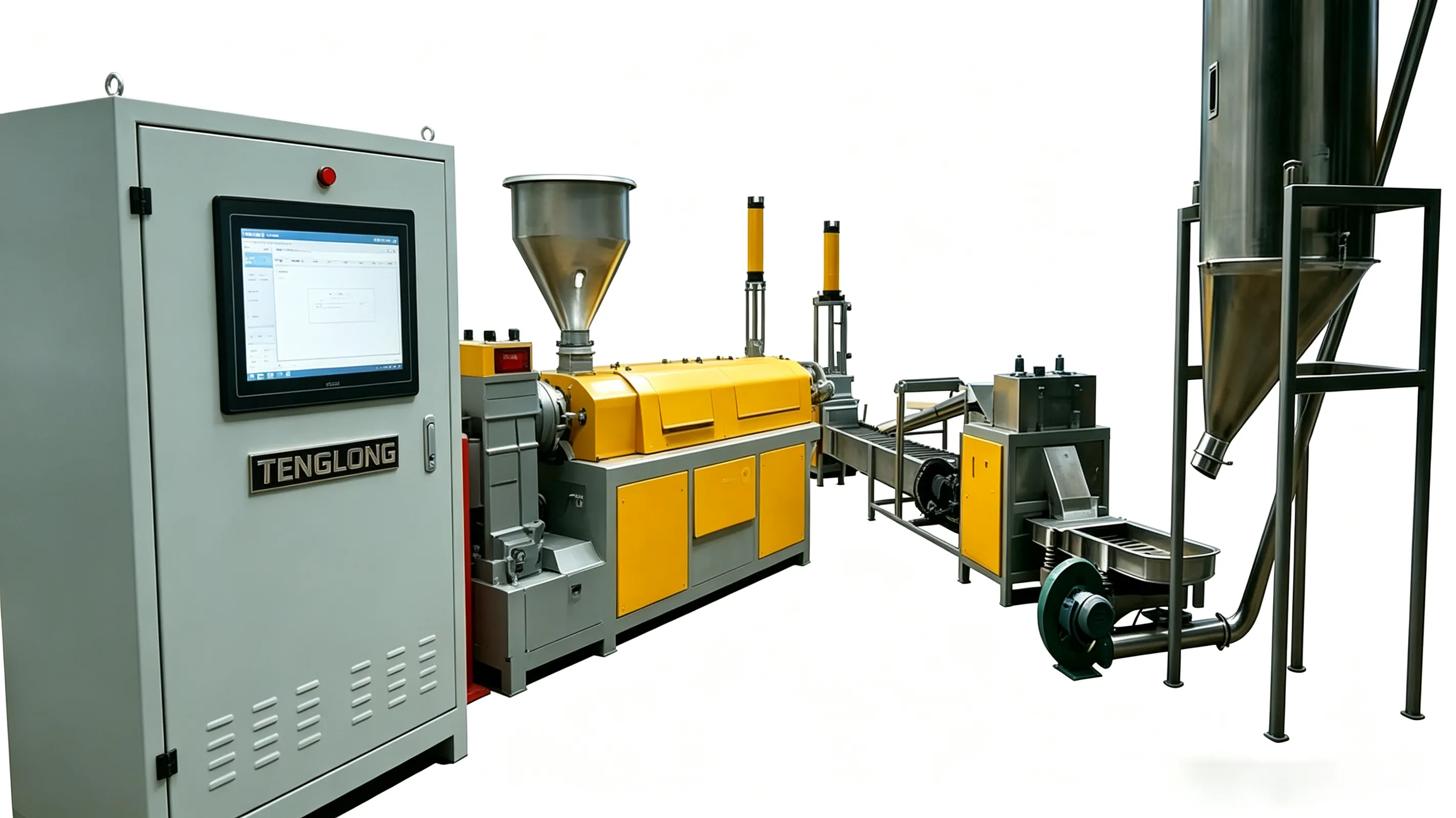
TL-UW · Pelletizing systems
Underwater Pelletizer
Shear-cut pellets in a pressurised water chamber — 300 to 2,000 kg/h with spherical, dust-free pellets.
- Output
- 300–2,000 kg/h
- Screw diameter
- —
- Feedstock
- PET, PA, PBAT/PLA, masterbatch and filled compounds
- Indicative price
- US$62,000 – 160,000
What this machine does
Underwater pelletizing exists because some polymers cannot be cut in air. PET crystallizes as it cools, PA absorbs moisture within seconds, and highly filled compounds smear on a knife. Sealing the die face inside pressurised water solves all three: the pellet is quenched within milliseconds of being cut, so the surface stays glassy and dust generation drops below 0.2%.
The TL-UW uses a hydraulic die clamp and a quick-release water chamber, so the die plate can be changed in 20 minutes for a product switch. Die holes are 1.2–3 mm and typically 60–400 in number; the cutter runs 1,500–4,000 rpm. Water temperature is held by a plate heat exchanger at 40–90 °C depending on the polymer — PET runs hot to avoid thermal shock, PE runs cool.
Pellets leave with the process water into a centrifugal dryer that spins off surface water in under two seconds. From there a pneumatic system moves them to a silo or bagging station. Because the whole path is enclosed, the line is the cleanest option for food-contact and medical-grade compounds.
Models and output
| Model | Output | Main motor | Pellet size | Cooling | Footprint | Weight |
|---|---|---|---|---|---|---|
| TL-UW-300 | 300–500 kg/h | 11 kW + 5.5 kW | 1.5–3 mm | 18 m³/h | 3.4 × 1.9 × 2.2 m | 2.8 t |
| TL-UW-600 | 700–1,100 kg/h | 22 kW + 7.5 kW | 1.2–3 mm | 26 m³/h | 4.0 × 2.1 × 2.4 m | 3.9 t |
| TL-UW-1000 | 1,400–2,000 kg/h | 45 kW + 15 kW | 2–3 mm | 35 m³/h | 4.6 × 2.3 × 2.6 m | 5.4 t |
Output figures refer to LDPE film at 85% bulk density with 3% moisture. Actual output depends on feedstock, flake size and filtration.
Engineering highlights
- Pressurised water chamber (3–8 bar) for spherical, dust-free pellets
- Hydraulic die clamp and quick-release chamber: 20-minute product change
- Die-hole blockage detection with automatic cutter retraction
- Plate heat exchanger holds water at 40–90 °C per polymer recipe
- Centrifugal dryer: surface moisture below 0.1%, no thermal degradation
- Closed-loop water with 60 mesh filtration, under 0.5 m³/h make-up
How the line works
Pressurise
The water chamber fills and holds 3–8 bar before the melt valve opens.
Cut at the face
Knives pass the die plate at 1,500–4,000 rpm, shearing strands into 1.2–3 mm pellets.
Quench and transport
Water carries pellets to the dryer, cooling them to below 45 °C on the way.
Dry and convey
A centrifugal dryer removes surface water; pneumatic conveying moves pellets to the silo.
Where it runs
- PET bottle-to-bottle recycling
- PA6 and PA66 compounding
- Colour and additive masterbatch
- Glass-fibre reinforced compounds
- Medical and food-contact grades
- Biodegradable PBAT / PLA compounds
Options and upgrades
- Melt pump for die pressure stability within ±0.3%
- Screen changer with 100–200 mesh for optical-grade pellets
- Stainless steel water circuit for food-contact production
- Pneumatic conveying to silo with metal detection
- Cryogenic or water-cooled die plate for heat-sensitive grades
Questions buyers ask
Do I need a melt pump with an underwater pelletizer?
Not strictly, but it pays back quickly. Without a pump, die pressure follows screen condition and pellet size drifts by 0.1–0.2 mm; with a pump, pressure holds within 0.3% and screen changes no longer disturb the cut.
What water temperature should PET run at?
70–85 °C for bottle-grade PET. Cold water shocks the surface and produces amorphous, sticky pellets that block the dryer; too hot and the pellets deform in the silo.
What is the maintenance interval?
Knives are checked every 500 hours and rotated every 1,000; the die plate is polished every 2,000 hours. Water filters are cleaned weekly. A full seal kit change is a two-hour job once a year.
Related machines
Other platforms in the range
 TL-PET
Specialised lines
PET Pelletizing Line
Crystallize, dry, extrude and underwater-cut bottle flake — 500 to 2,000 kg/h with IV loss under 0.03 dl/g.
- Output
- 500–2,000 kg/h
- Indicative price
- US$120,000 – 380,000
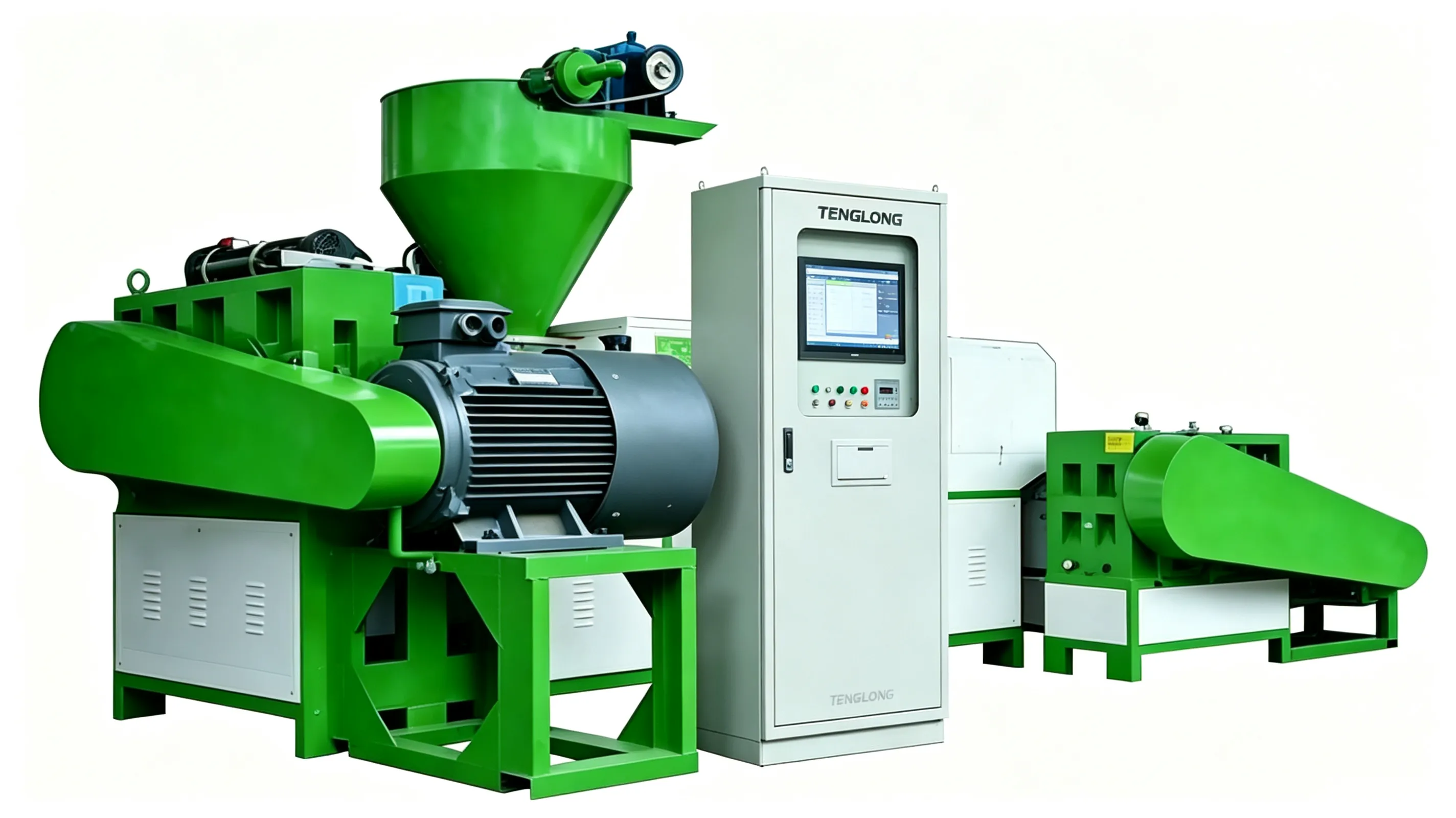 TL-WR
Pelletizing systems
Water Ring Pelletizer
Die-face cutting inside a water ring — 100 to 1,000 kg/h in 6 m of floor space, no strand bath.
- Output
- 100–1,000 kg/h
- Indicative price
- US$18,500 – 52,000
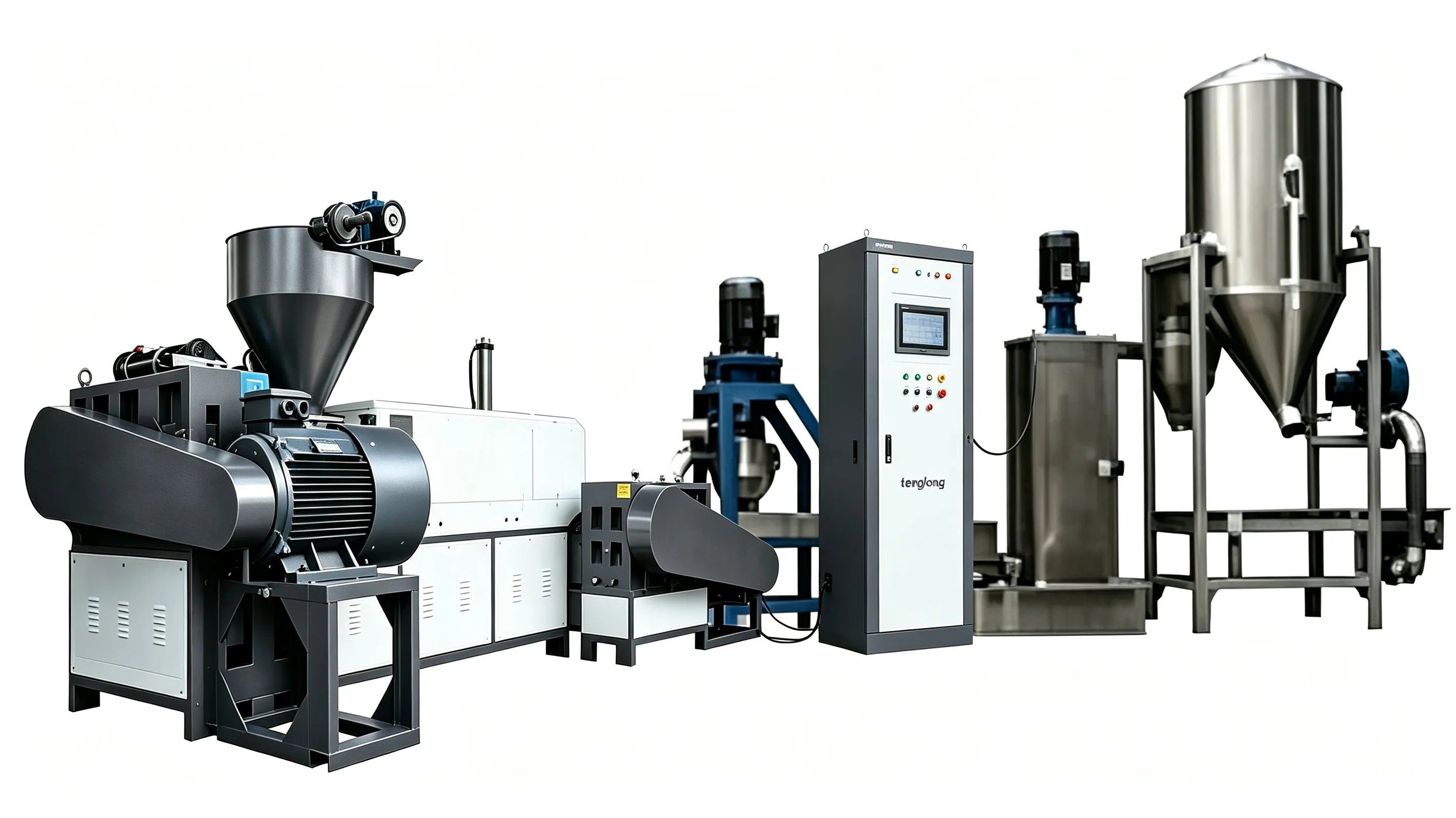 TL-TS
Extrusion granulating
Twin Screw Extruder Granulating Line
Co-rotating 65–95 mm screws for filled, reinforced and alloyed compounds — 300 to 1,500 kg/h.
- Output
- 300–1,500 kg/h
- Indicative price
- US$38,000 – 128,000
Need a line sized to your material?
Underwater Pelletizer
Send the polymer, contamination level and target output. You get a model recommendation, power estimate and price range within one working day.
- Reply within 1 working day
- Sample test before you commit
- Factory visits and live video trials by appointment.
Tell us what you need to granulate
Six fields is enough for a first recommendation. Drawings, layout and a firm price follow after the material sample is tested.