
TL-FL · Recycling lines
Film Granulating Line
Compactor-fed line for LDPE, LLDPE and stretch film — 200 to 800 kg/h without pre-crushing.
- Output
- 200–800 kg/h
- Screw diameter
- 100 / 120 / 150 mm
- Feedstock
- LDPE, LLDPE, stretch film, agricultural film, bags
- Indicative price
- US$42,000 – 98,000
What this machine does
Film is 90% air. A standard hopper cannot feed it, and a crusher only makes it fluffier. That is why film lines start with a cutter compactor: a vertical drum with rotating blades that cuts, mixes and friction-heats the film into a dense agglomerate, then feeds it into the screw through a forced channel. Bulk density goes from 40–80 kg/m³ to 300–450 kg/m³, so the extruder finally has something to bite.
The compactor also does the first drying step. Friction heat drives off 3–5% of surface moisture, and the 80 mesh screen lasts three to four hours on greenhouse film. For heavily contaminated film, we recommend the TL-2S two-stage line instead: this line assumes the film has already been washed and mechanically dewatered.
Control is deliberately simple. The compactor motor current is the master signal: when the drum loads up, the screw speeds up to clear it; when the drum runs light, the screw slows. That single loop removes the most common failure on film lines — the compactor choking because the extruder was set to a fixed speed.
Models and output
| Model | Output | Screw diameter | Main motor | Filtration | Footprint | Weight |
|---|---|---|---|---|---|---|
| TL-FL-100 | 200–300 kg/h | 100 mm | 75 kW | 80 mesh | 7.5 × 1.8 × 2.4 m | 5.2 t |
| TL-FL-120 | 400–550 kg/h | 120 mm | 132 kW | 80 mesh | 9.0 × 2.0 × 2.6 m | 7.4 t |
| TL-FL-150 | 650–800 kg/h | 150 mm | 200 kW | 60–80 mesh | 10.5 × 2.3 × 2.8 m | 10.8 t |
Output figures refer to LDPE film at 85% bulk density with 3% moisture. Actual output depends on feedstock, flake size and filtration.
Engineering highlights
- Cutter compactor accepts whole film and bags: no crusher, no silo, no fluff
- Bulk density raised to 300–450 kg/m³ for stable screw feed
- Friction pre-drying removes 3–5% surface moisture before the melt
- Compactor-current feedback controls screw speed, preventing choke
- Grooved feed section with 30:1 screw for high-friction polyolefins
- Blades resharpenable in place, 8-hour replacement without removing the drum
How the line works
Compacting
A conveyor drops film into the drum; blades cut and densify it while water spray controls temperature.
Forced feed
The agglomerate is pushed into a grooved feed section by a rotating screw flight, not gravity.
Melt and filter
Six zones melt at 190–230 °C; an 80 mesh double-piston changer catches paper and sand.
Pelletize
A water ring cutter turns the melt into 2–4 mm pellets, dewatered on a slotted screen.
Where it runs
- Agricultural and greenhouse film
- Stretch and shrink wrap
- LDPE shopping bags and liners
- Silage and mulch film
- Printed film with up to 5% ink
Options and upgrades
- Second vacuum vent for heavily printed film
- Automatic back-flush screen changer for 100 mesh
- Upstream washing and dewatering module
- Metal detector and magnet before the compactor
- Centrifugal dryer and pneumatic conveying to silo
Questions buyers ask
Can the line run printed film with 10% ink?
It will run, but pellets will be dark and smell. At 10% ink you need two-stage venting plus a melt filter fine enough to hold pigment agglomerates, and the pellet is usually only saleable as a dark-grade compound. Most buyers blend printed film at 30–50% with clean film.
What is the difference between this line and a two stage line?
One extruder here, two there. The film line handles washed film up to 5% contamination at 200–800 kg/h with lower capex; the two-stage line handles unwashed, heavily contaminated film at 300–1,200 kg/h with far longer screen life.
How much water and power does it use per ton?
Power 300–450 kWh per ton of pellets; water make-up 0.4–0.6 m³ per hour on a closed ring. Compactor blades consume the most wear parts: budget one set per 800–1,200 tons.
Related machines
Other platforms in the range
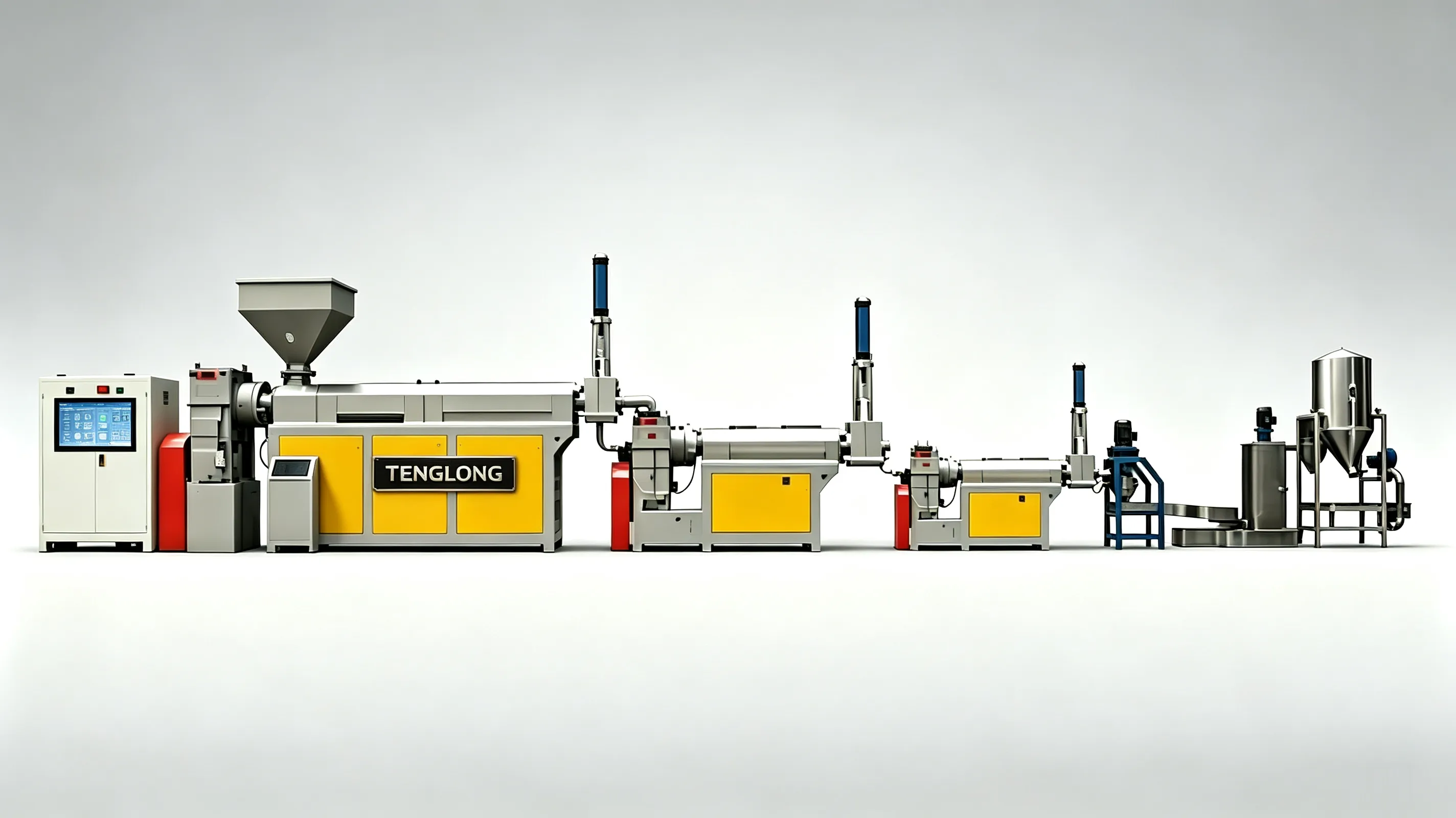 TL-2S
Recycling lines
Two Stage Granulating Line
First stage melts and filters heavy contamination, second stage pelletizes — 300 to 1,200 kg/h of dirty waste plastic.
- Output
- 300–1,200 kg/h
- Indicative price
- US$46,000 – 135,000
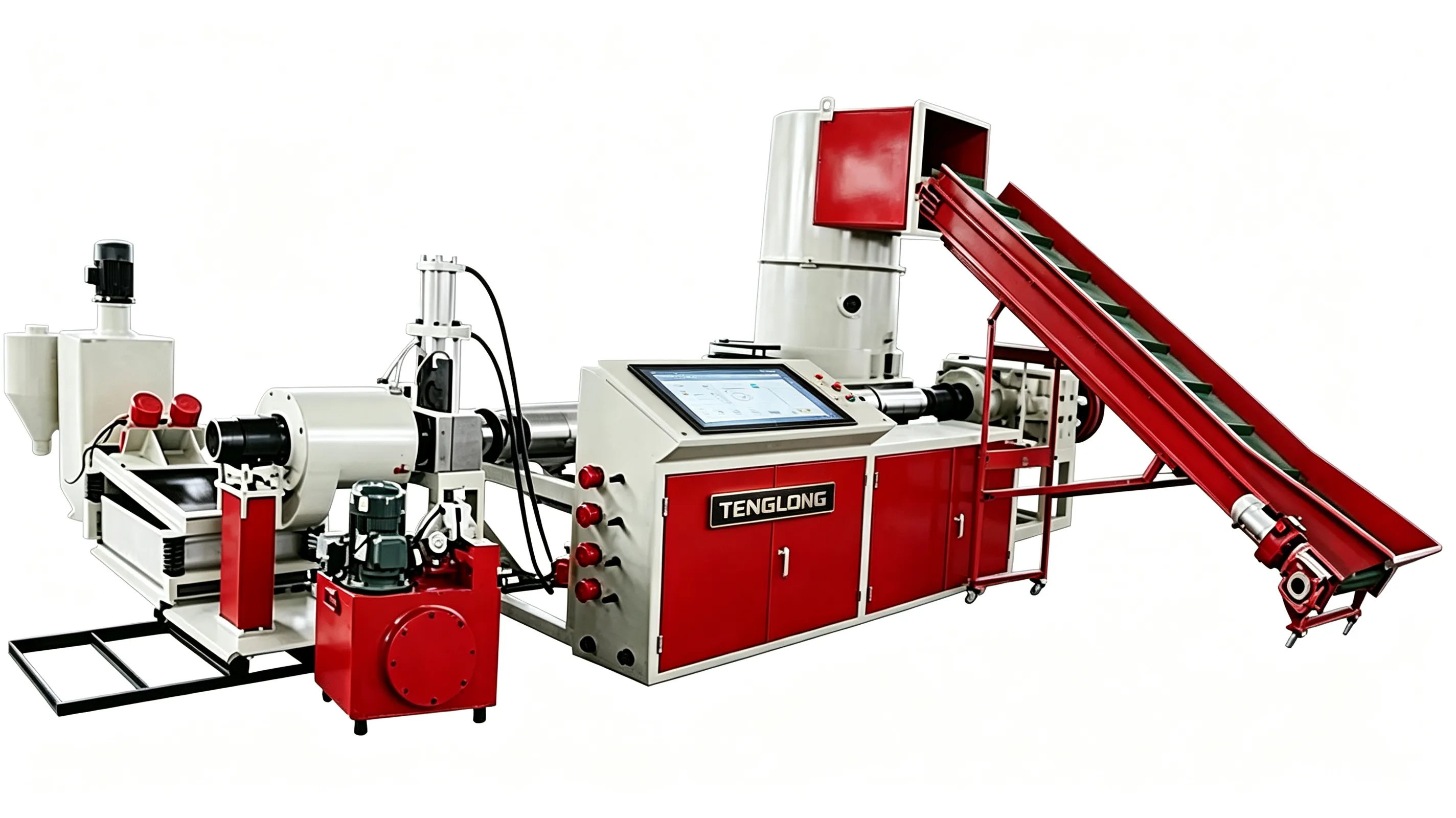 TL-FK
Recycling lines
Flakes Pelletizing Machine
Force-fed single screw for washed HDPE and PP flake — 300 to 1,000 kg/h at 0.26–0.36 kWh/kg.
- Output
- 300–1,000 kg/h
- Indicative price
- US$28,000 – 72,000
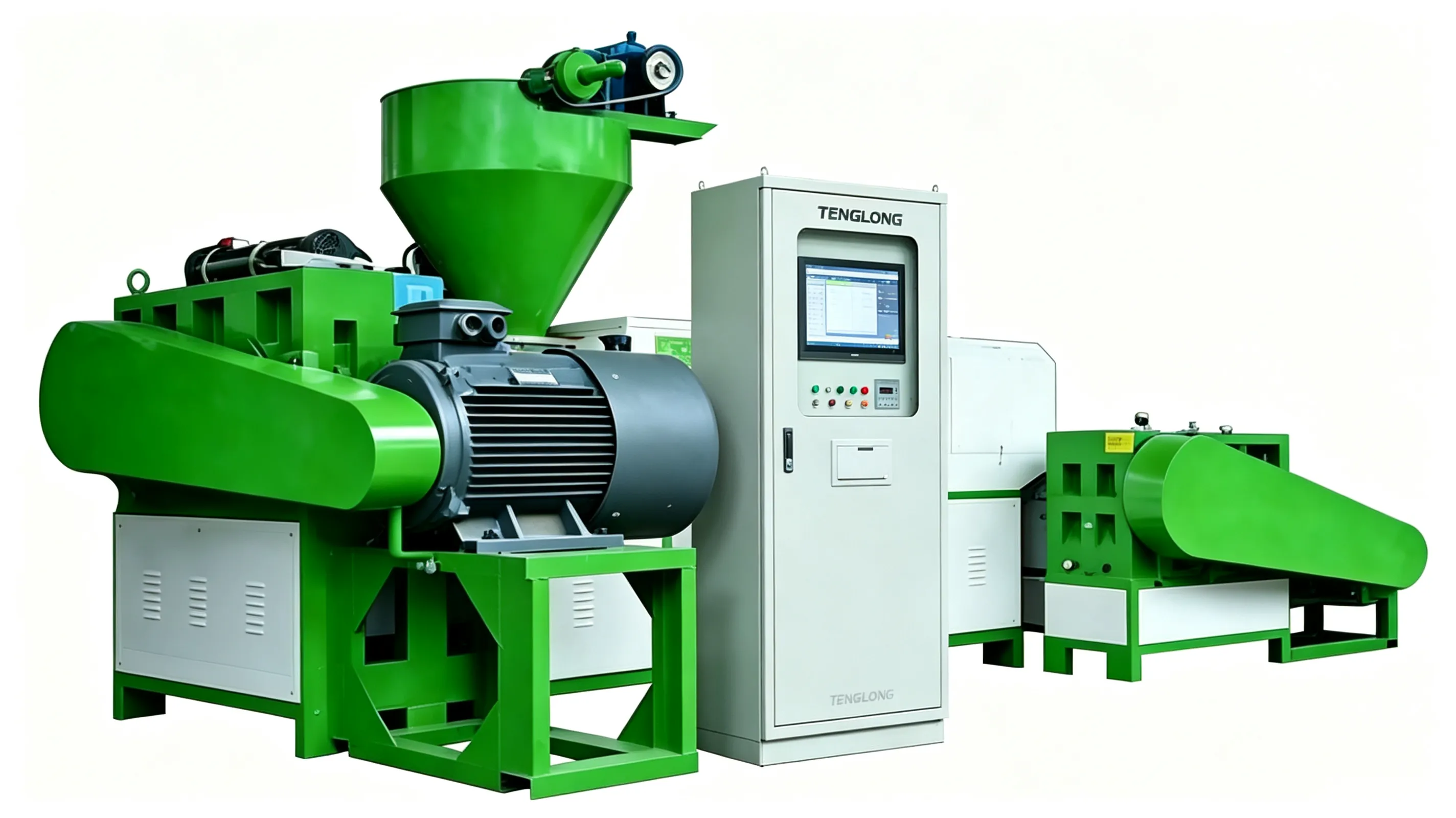 TL-WR
Pelletizing systems
Water Ring Pelletizer
Die-face cutting inside a water ring — 100 to 1,000 kg/h in 6 m of floor space, no strand bath.
- Output
- 100–1,000 kg/h
- Indicative price
- US$18,500 – 52,000
Need a line sized to your material?
Film Granulating Line
Send the polymer, contamination level and target output. You get a model recommendation, power estimate and price range within one working day.
- Reply within 1 working day
- Sample test before you commit
- Factory visits and live video trials by appointment.
Tell us what you need to granulate
Six fields is enough for a first recommendation. Drawings, layout and a firm price follow after the material sample is tested.