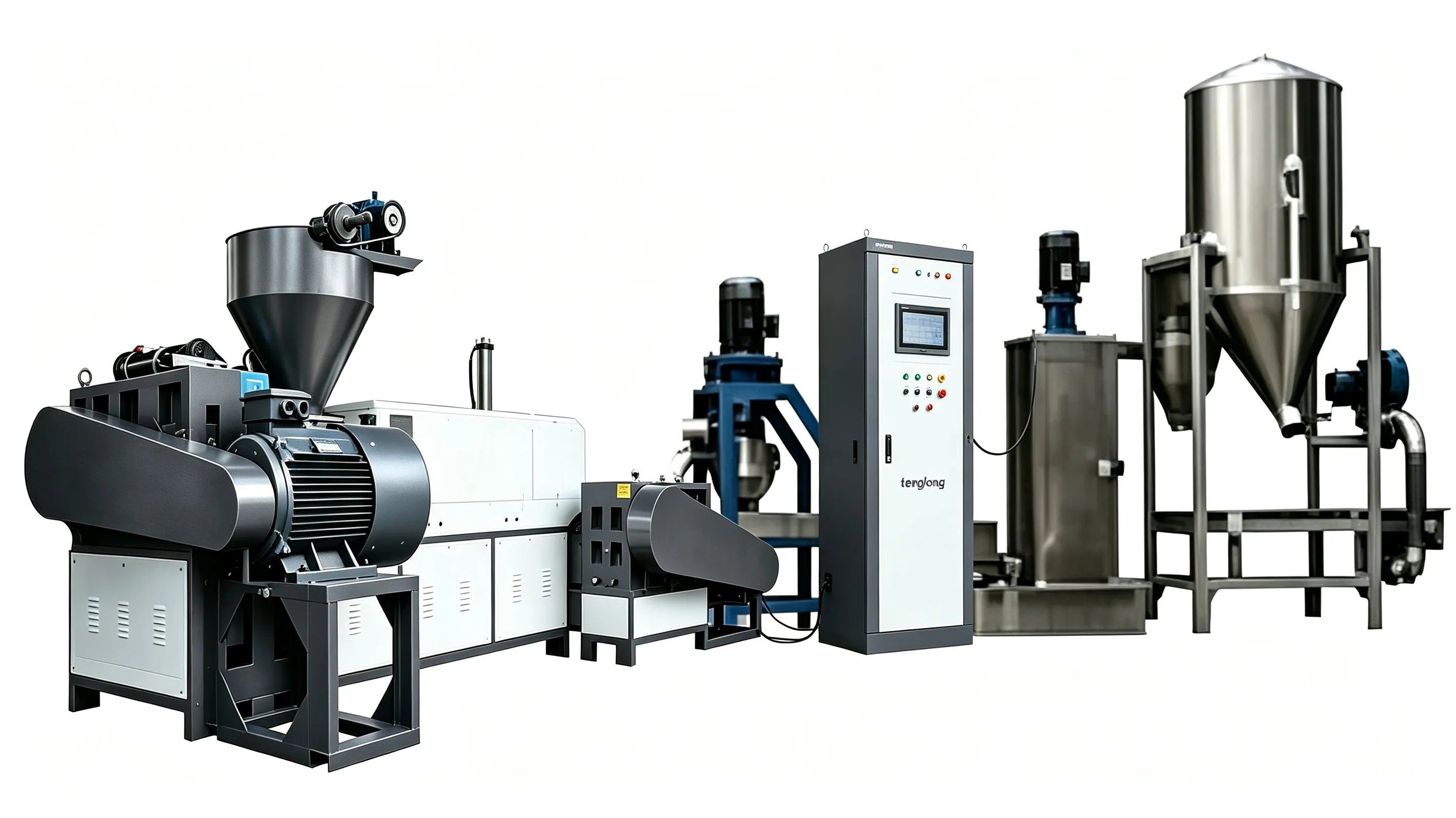
TL-TS · Extrusion granulating
Twin Screw Extruder Granulating Line
Co-rotating 65–95 mm screws for filled, reinforced and alloyed compounds — 300 to 1,500 kg/h.
- Output
- 300–1,500 kg/h
- Screw diameter
- 65 / 75 / 95 mm
- Feedstock
- PP, PE, ABS, PA, PC, filled and reinforced compounds
- Indicative price
- US$38,000 – 128,000
What this machine does
A twin screw earns its price when the product is a recipe, not a recycled polymer. Segmented screws with kneading blocks, two side feeders and a liquid injection port let you put 70% calcium carbonate or 30% glass fibre into PP without burning the carrier. Screw elements are interchangeable, so a formulation change is a build change, not a new machine.
The TL-TS uses a 40:1 barrel with six independently cooled zones and a melt-pump-ready outlet. Gravimetric dosing on eight channels holds each component to ±0.5%, which is what keeps a masterbatch shade repeatable from lot to lot. Vacuum venting at zone 8 removes moisture from fillers so the pellets do not foam.
Filtration depends on the filler: unfilled compounds run a 60–80 mesh pack, highly filled grades may run a melt pump instead and skip the screen. Both underwater and strand cutting are available on the same frame, so the cutting method can be changed after the first year if the product mix shifts.
Models and output
| Model | Output | Screw diameter | Screw L/D | Main motor | Footprint | Weight |
|---|---|---|---|---|---|---|
| TL-TS-65 | 300–450 kg/h | 62.4 mm | 40:1 | 90 kW | 9.5 × 2.2 × 2.6 m | 6.5 t |
| TL-TS-75 | 600–900 kg/h | 71 mm | 40:1 | 160 kW | 11.0 × 2.4 × 2.8 m | 9.2 t |
| TL-TS-95 | 1,100–1,500 kg/h | 93 mm | 40:1 | 315 kW | 13.5 × 2.8 × 3.0 m | 14.5 t |
Output figures refer to LDPE film at 85% bulk density with 3% moisture. Actual output depends on feedstock, flake size and filtration.
Engineering highlights
- Segmented screws: conveying, kneading and reverse elements configurable per recipe
- Eight-channel gravimetric dosing with recipe management and batch traceability
- Bimetallic barrel sleeves and PM-HIP screw elements for abrasive fillers
- Deep-groove cooling bores with independent water circuits per zone
- Torque limiter and melt-pressure trip protect the gearbox on a cold start
- Siemens S7-1500 with OPC-UA, ready for MES integration
How the line works
Dose
Polymer, filler, additive and liquid are fed on eight gravimetric channels, each within ±0.5%.
Melt and disperse
Kneading blocks disperse and distribute the filler; barrel zones are water-cooled to hold 190–260 °C.
Vent and pressurize
Two vacuum vents strip moisture; the melt pump builds 60–120 bar for a stable die feed.
Cut and dry
Underwater cutting at 1,500–3,500 rpm, then a centrifugal dryer brings surface moisture below 0.2%.
Where it runs
- Calcium carbonate and talc filled PP compound
- Glass-fibre reinforced PA6 and PP
- Colour and additive masterbatch
- Flame-retardant cable compound
- PCR / virgin polymer blends
Options and upgrades
- Side feeder for talc, glass fibre and CaCO3
- Liquid injection for silane, oil or flame retardant
- Melt pump and continuous screen changer
- Underwater pelletizer with centrifugal dryer
- Loss-in-weight refill with vacuum loader per component
Questions buyers ask
Twin screw or single screw for recycled pellets?
For plain PP or PE regrind with no filler, a single screw is cheaper per kg and easier to maintain. Move to a twin screw when you add more than 15% filler, need colour dispersion below 20 µm, or run engineering polymers that need strong devolatilization.
Can the same line run CaCO3 filled PP and glass-fibre PA6?
Frame and drive can, but the screw configuration, barrel metallurgy and wear parts should differ. Most buyers keep one screw set per product family and swap in 4–6 hours; abrasive glass fibre needs PM-HIP elements and bimetallic sleeves.
What is the lead time and what do you need to quote?
35–45 days for standard 65 and 75 mm lines. To quote we need the formulation, filler load and bulk density, target output, pellet size, voltage and site country.
Related machines
Other platforms in the range
 TL-MB
Specialised lines
Masterbatch Granulator
Small-batch twin screw line for 20–60% pigment loading — 20 to 500 kg/h with minimal changeover loss.
- Output
- 20–500 kg/h
- Indicative price
- US$26,000 – 110,000
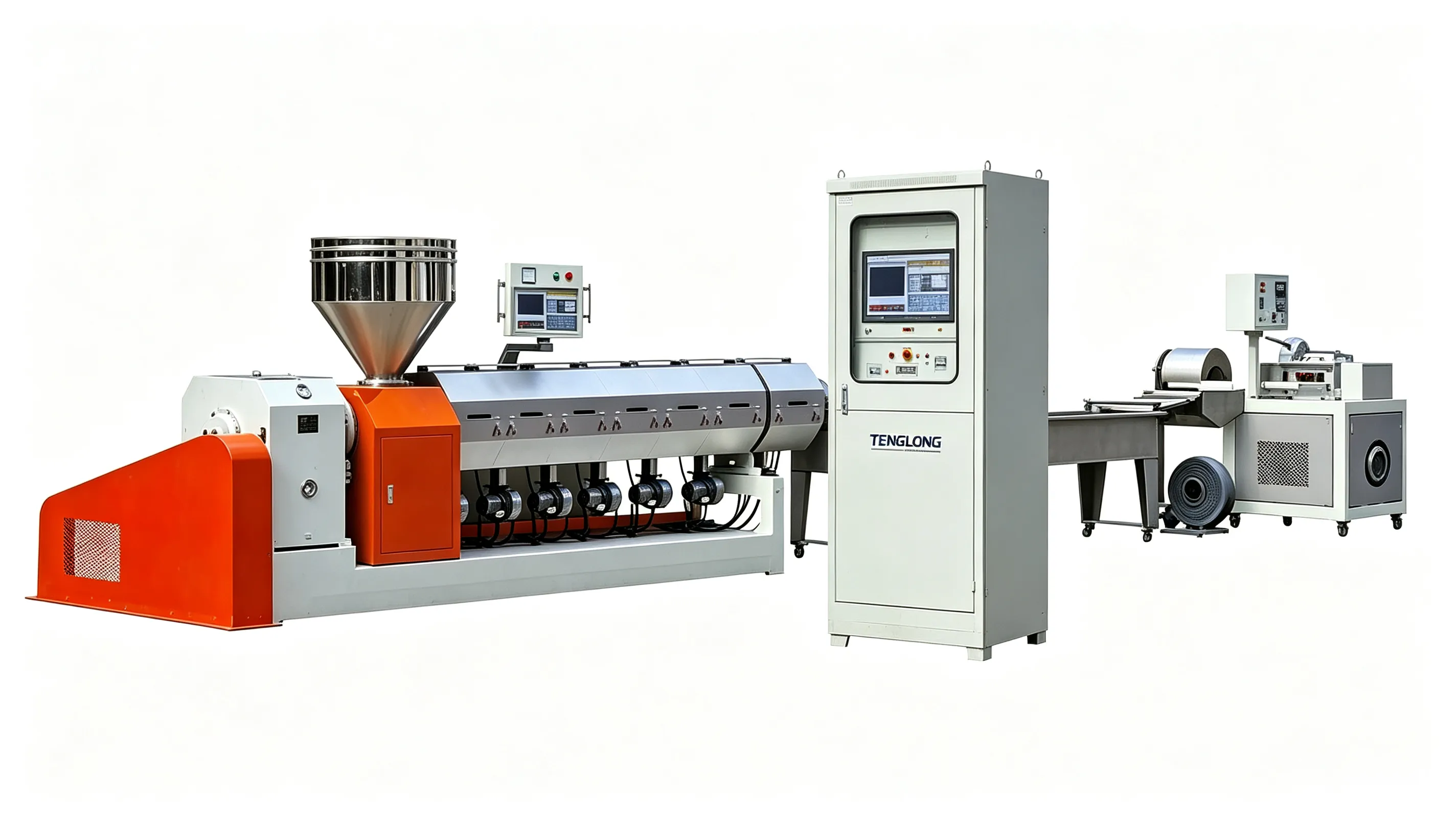 TL-SJ
Extrusion granulating
Single Screw Plastic Granulator
The workhorse pellet extruder for PP, PE and ABS regrind — 150 to 700 kg/h with one hardened screw.
- Output
- 150–700 kg/h
- Indicative price
- US$12,500 – 46,000
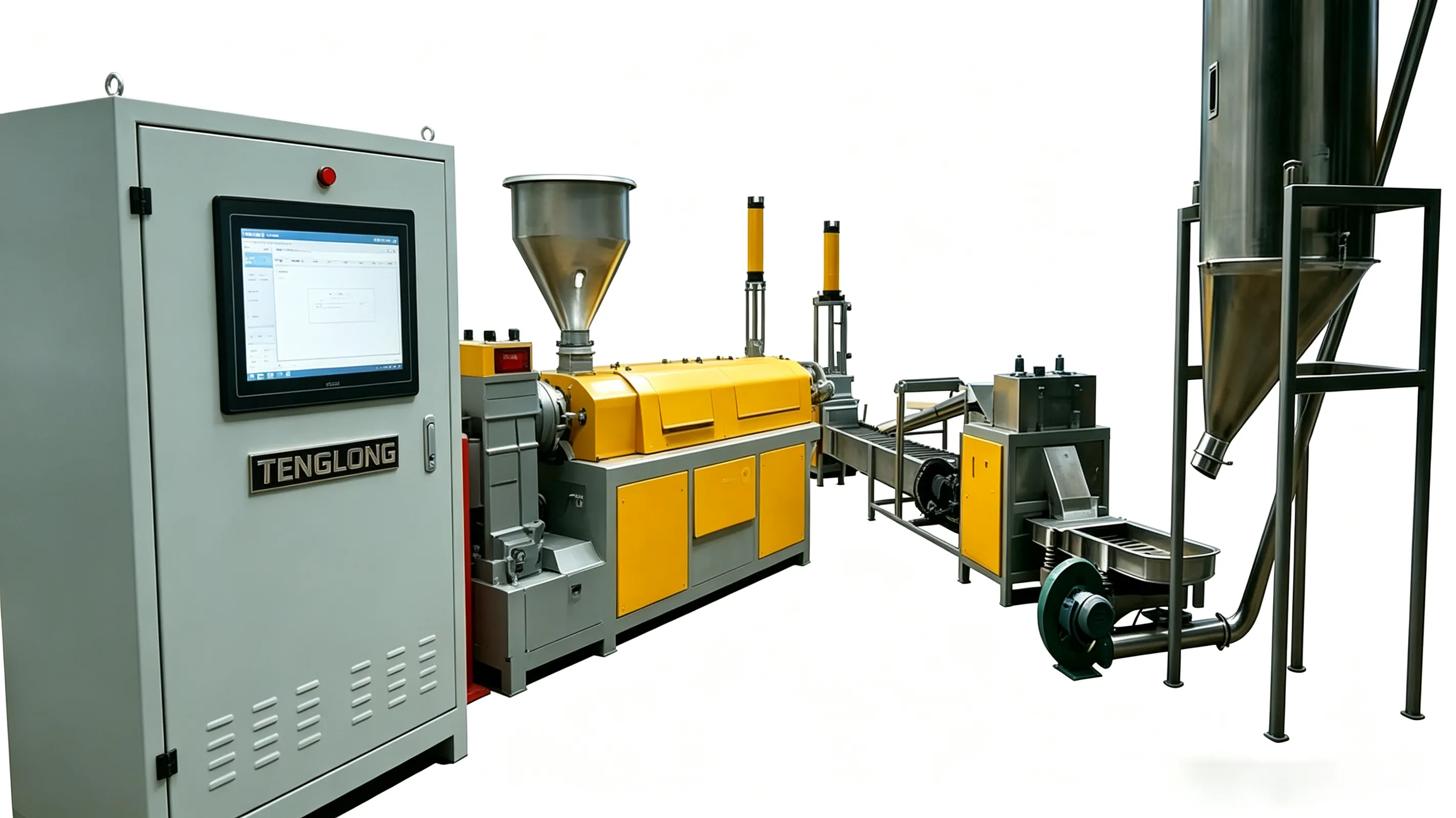 TL-UW
Pelletizing systems
Underwater Pelletizer
Shear-cut pellets in a pressurised water chamber — 300 to 2,000 kg/h with spherical, dust-free pellets.
- Output
- 300–2,000 kg/h
- Indicative price
- US$62,000 – 160,000
Need a line sized to your material?
Twin Screw Extruder Granulating Line
Send the polymer, contamination level and target output. You get a model recommendation, power estimate and price range within one working day.
- Reply within 1 working day
- Sample test before you commit
- Factory visits and live video trials by appointment.
Tell us what you need to granulate
Six fields is enough for a first recommendation. Drawings, layout and a firm price follow after the material sample is tested.