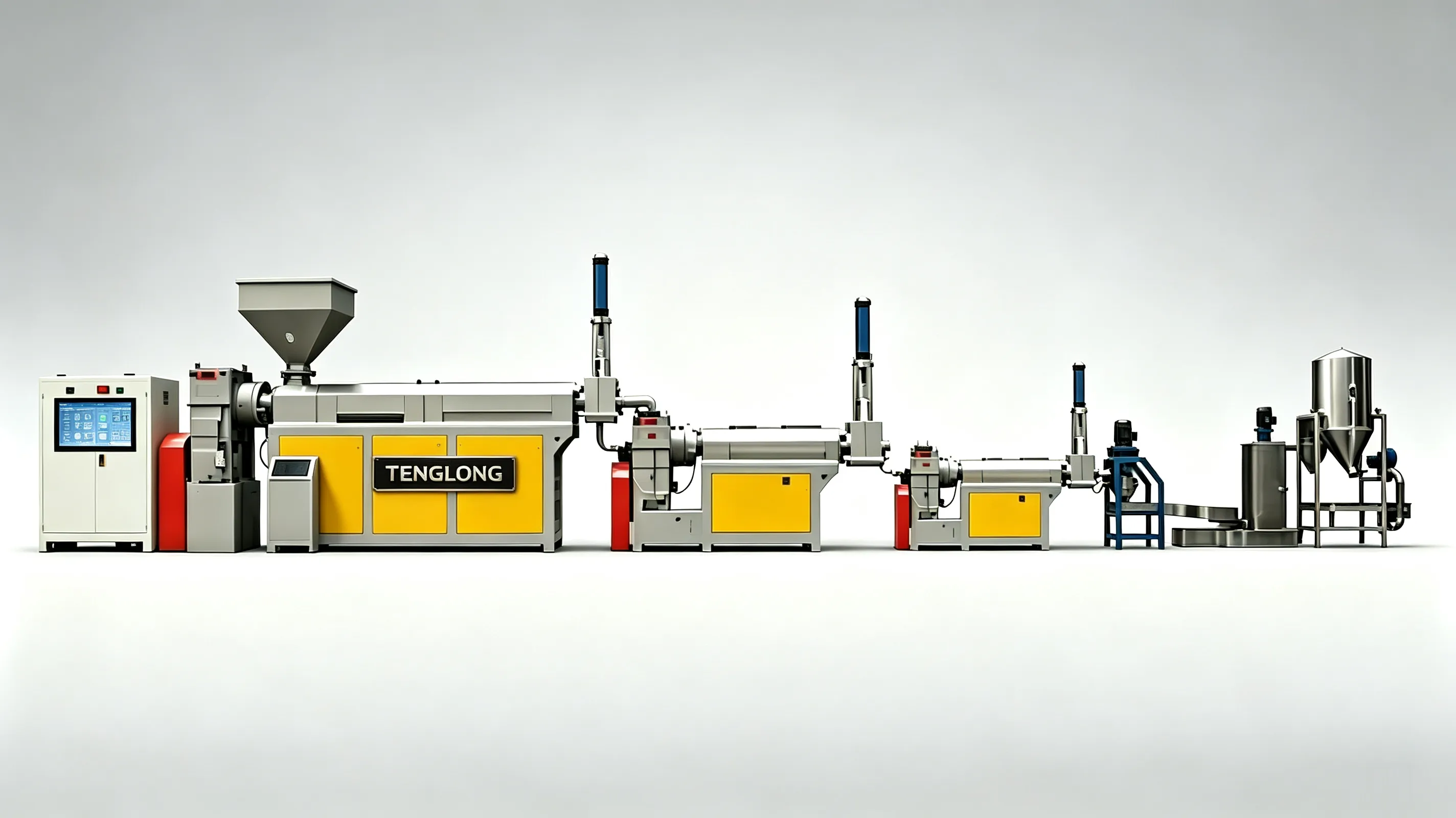
TL-2S · Recycling lines
Two Stage Granulating Line
First stage melts and filters heavy contamination, second stage pelletizes — 300 to 1,200 kg/h of dirty waste plastic.
- Output
- 300–1,200 kg/h
- Screw diameter
- Stage 1: 120–180 mm · Stage 2: 100–130 mm
- Feedstock
- Agricultural film, woven bags, post-consumer mixed PE/PP
- Indicative price
- US$46,000 – 135,000
What this machine does
Post-consumer film is the hardest feedstock in recycling: bulky, wet, inked and full of sand. A single long extruder has to melt, vent and filter all of it in one pass, so the screen blinds every 20–30 minutes and output swings. The TL-2S removes that problem by giving melting and pressure build-up their own screw.
Stage one is a 25:1 grooved-feed extruder with a large-diameter screw and a hydraulic cutter-compactor feeding it directly. It melts at low shear (190–210 °C for LDPE) and pushes through the screen changer at modest pressure, which is why a 100 mesh pack survives four to six hours. Stage two is a short 12:1 screw that takes the filtered melt and builds the 80–120 bar the die needs, independent of screen condition.
Because die pressure is decoupled, pellet size stays within ±0.2 mm even as the screen loads — the difference between selling to a blown-film line and selling to a injection moulder. Energy consumption is 5–8% higher than a single stage on clean feedstock, but on dirty film the specific energy per ton of good pellets is usually lower because there are far fewer production stops.
Models and output
| Model | Output | Screw diameter | Main motor | Filtration | Footprint | Weight |
|---|---|---|---|---|---|---|
| TL-2S-120 | 300–400 kg/h | 120 / 100 mm | 75 + 45 kW | 80 mesh | 12.5 × 2.2 × 2.6 m | 8.5 t |
| TL-2S-150 | 600–800 kg/h | 150 / 120 mm | 132 + 55 kW | 80 mesh | 15.0 × 2.5 × 2.8 m | 12.0 t |
| TL-2S-180 | 1,000–1,200 kg/h | 180 / 130 mm | 200 + 90 kW | 60–80 mesh | 18.0 × 3.0 × 3.2 m | 18.5 t |
Output figures refer to LDPE film at 85% bulk density with 3% moisture. Actual output depends on feedstock, flake size and filtration.
Engineering highlights
- Cutter-compactor on stage one accepts whole film and woven bags without pre-crushing
- Decoupled die pressure: pellet size held to ±0.2 mm while the screen loads
- 80–100 mesh filtration on dirty film with 4–6 hour screen life
- Stage two screw can be pulled in 30 minutes for cleaning or material change
- Interlocked start sequence prevents cold melt reaching the die
- Water ring cutter with dewatering screen and cyclone, pellets below 0.3% moisture
How the line works
Compact
A rotating cutter and water spray densify film from 60 kg/m³ to over 300 kg/m³ before it reaches the screw.
Melt and filter
Stage one melts at low shear and passes the melt through an 80–100 mesh pack in a double-piston changer.
Re-pressurize
Stage two receives filtered melt at atmospheric pressure and rebuilds 80–120 bar at the die.
Cut and dewater
The water ring cutter produces 2–4 mm pellets; a dewatering screen and cyclone remove surface water.
Bag or silo
A blower moves pellets to a storage silo or a weighing bagging station.
Where it runs
- Greenhouse and silage film
- PP woven bag and jumbo bag scrap
- Post-consumer LDPE shopping bags
- Mixed PE/PP agricultural waste
- Stretch film and shrink film
Options and upgrades
- Two-stage vacuum venting for heavily printed film
- Automatic back-flush screen changer for 100 mesh and finer
- Melt pump on stage two for ±0.3% pellet weight
- Inline washing and dewatering upstream
- Die-face water ring or underwater cutting
Questions buyers ask
What moisture content can the line handle?
Up to 8% surface moisture with the standard two-stage venting, because stage one vents before filtration. Above 8%, add a mechanical dewatering press upstream: drying film with heat costs three times more than squeezing the water out.
How much floor space does a TL-2S-150 need?
About 15 × 2.5 m for the line itself, plus 3 m at the feed end for the conveyor and 2 m of clearance around the control cabinet. A 6 m ceiling is enough for the silo-free layout.
What is the price of a two stage granulating line?
Indicative FOB Qingdao: TL-2S-120 from US$46,000, TL-2S-150 around US$78,000, TL-2S-180 around US$118,000, before washing equipment and installation. Final price depends on the screen changer, cutter type and electrical standard.
Related machines
Other platforms in the range
 TL-FL
Recycling lines
Film Granulating Line
Compactor-fed line for LDPE, LLDPE and stretch film — 200 to 800 kg/h without pre-crushing.
- Output
- 200–800 kg/h
- Indicative price
- US$42,000 – 98,000
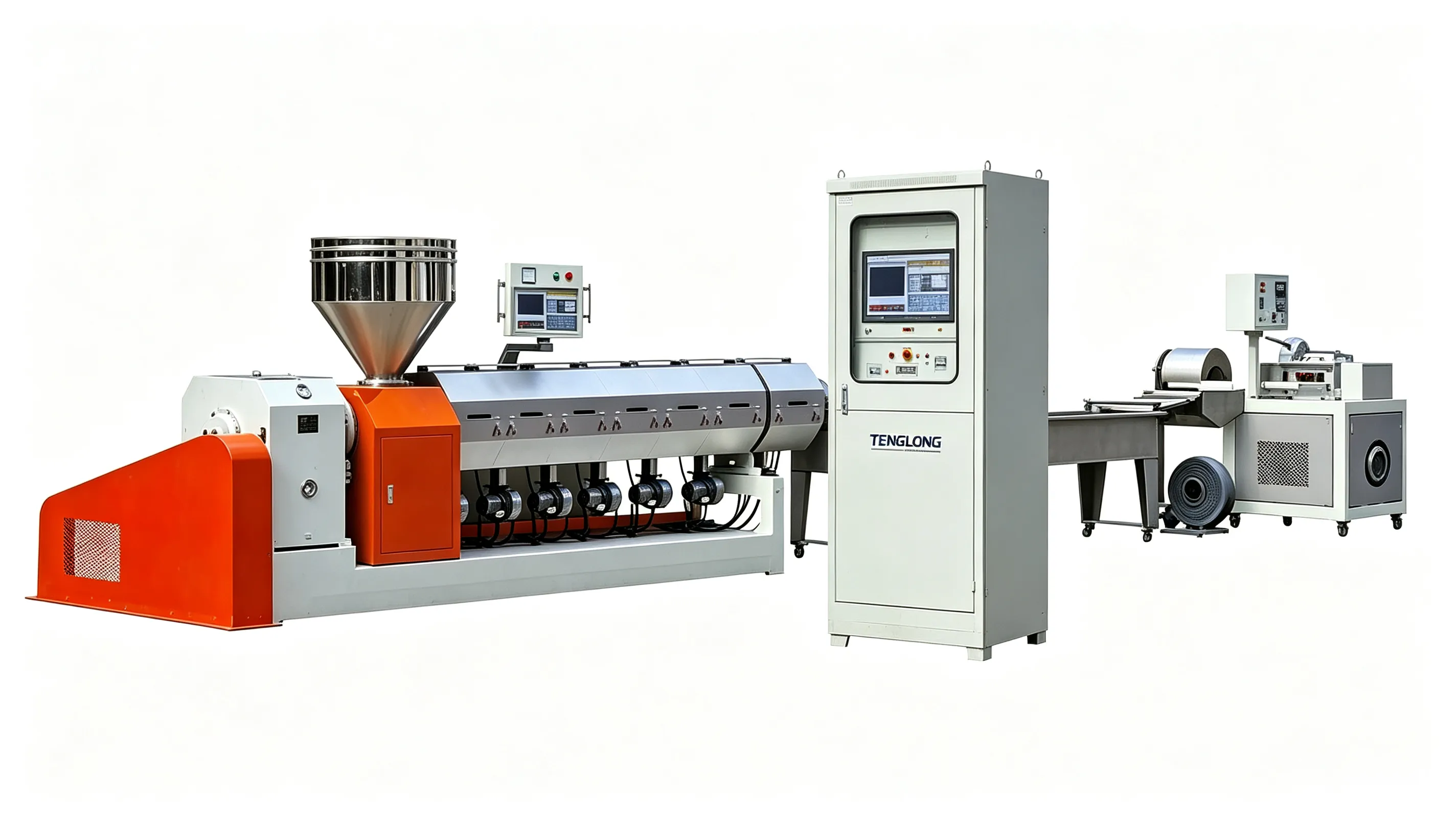 TL-SJ
Extrusion granulating
Single Screw Plastic Granulator
The workhorse pellet extruder for PP, PE and ABS regrind — 150 to 700 kg/h with one hardened screw.
- Output
- 150–700 kg/h
- Indicative price
- US$12,500 – 46,000
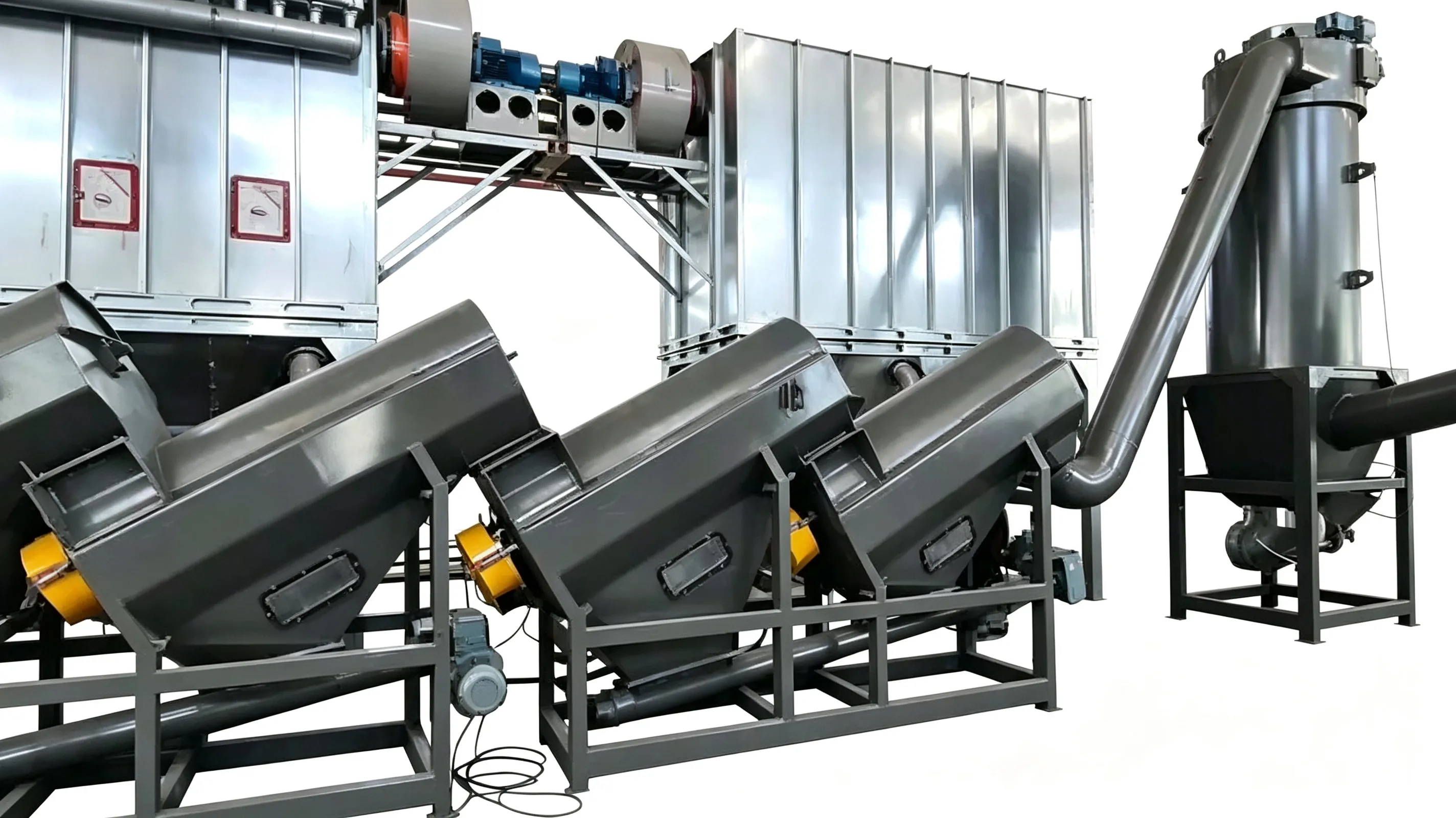 TL-GPL
Recycling lines
Plastic Granules Production Line
Turnkey washing and pelletizing: from baled bottles or film to bagged granules, 500 to 3,000 kg/h.
- Output
- 500–3,000 kg/h (finished pellets)
- Indicative price
- US$85,000 – 260,000
Need a line sized to your material?
Two Stage Granulating Line
Send the polymer, contamination level and target output. You get a model recommendation, power estimate and price range within one working day.
- Reply within 1 working day
- Sample test before you commit
- Factory visits and live video trials by appointment.
Tell us what you need to granulate
Six fields is enough for a first recommendation. Drawings, layout and a firm price follow after the material sample is tested.