Yellow pellets are almost always a temperature problem upstream of the cutter. The polymer sat in the barrel longer or hotter than the grade tolerates, the antioxidant was consumed, and the cut faces oxidised at the same moment the rest of the batch was still sound. Moving the problem downstream by storing the pellets warmer or older makes it worse, never better.
A good underwater pellet is spherical because the surface tension of the melt did the shaping before the cutter touched it, dense because the water quenched it evenly, and the right colour because it never saw oxygen while it was soft. That last point is why the twin vent and the vacuum arrangement on the cutter chamber matter more to quality than the cutter blade count.
What a buyer checks on the sample
- Sieve analysis: oversize, on-size and fines, with the out-of-tolerance material disposition stated.
- Bulk density, because it decides storage volume and how the pellets meter downstream.
- Moisture by Karl Fischer or halogen meter; PET loses 0.01 dl/g of intrinsic viscosity per 100 ppm of moisture.
- A 200 g visual check for black specks, and a 20 µm blown-film trial every shift — the trial catches contaminants that laboratory checks miss.
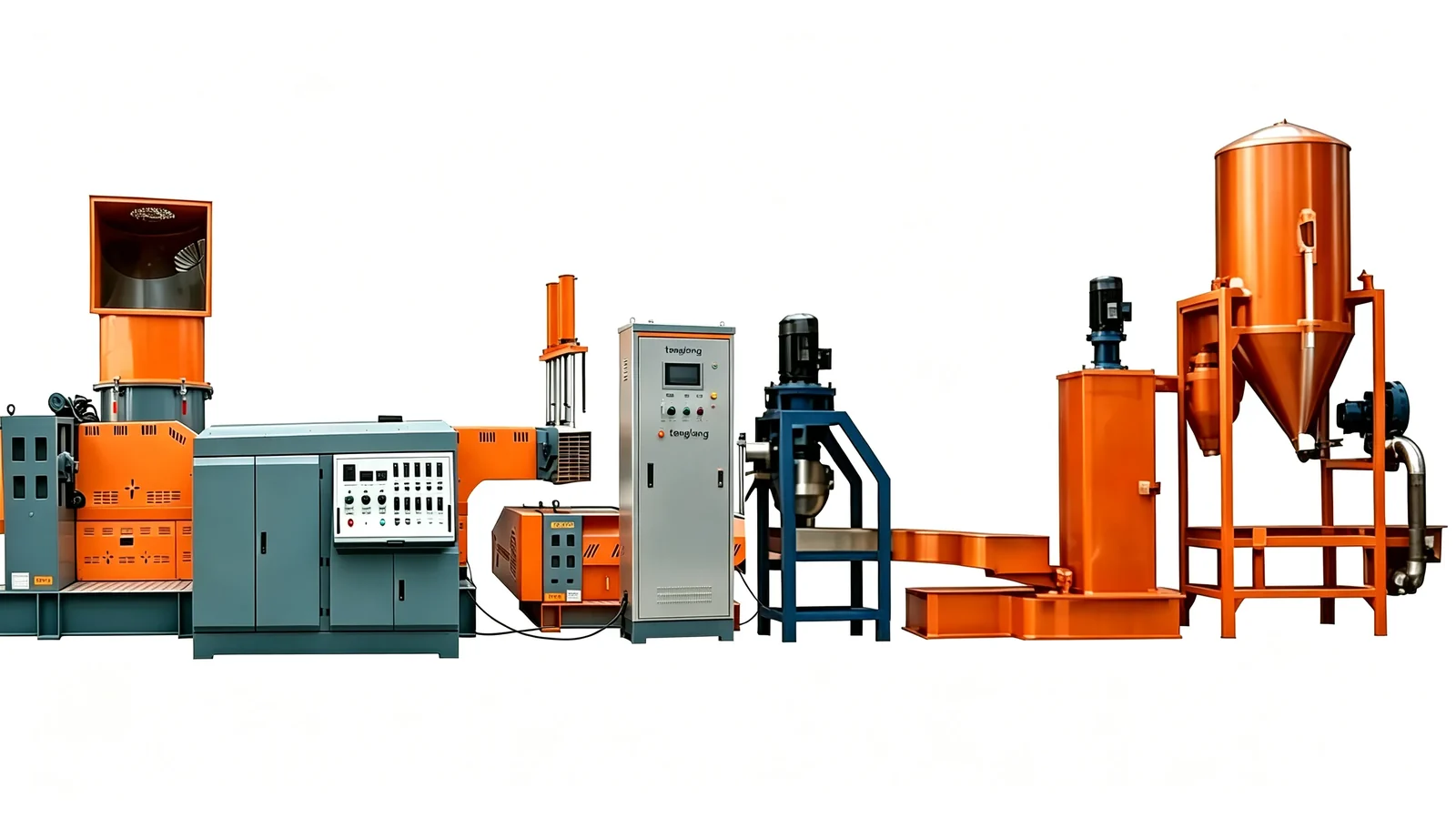
Where yellow pellets actually come from
Yellowing and black specks in recycled pellets are usually blamed on the material. Sometimes they are. More often they come from heat, and heat has three sources.
The first is residence time. Material that sits in a barrel too long degrades, and degradation products are what discolour the melt. The second is melt temperature. Every degree above the setpoint accelerates oxidation. The third is air contact — and this is the one an underwater pelletizer removes entirely.
A strand pellet is formed in air. The surface of the strand sees oxygen at extrusion temperature for as long as it takes to travel to the cutter, which is why a strand line running PP needs careful purging between colours and why dark-to-light changes take 40–60 minutes of cleaning. An underwater pellet is formed in water. It never sees air at all.
The practical result is a pellet with an oxidised layer of essentially zero rather than a measurable one. For a buyer whose customer is a bottle-to-bottle converter, that difference is the difference between food-contact grade and not.
What actually makes a good spherical pellet

Shape is the visible part, but four properties decide whether the pellet passes incoming inspection.
Size and its tolerance. Our published tolerance is ±0.15 mm on underwater cutting, against ±0.2 mm on strand. A tighter tolerance means less variation in the customer’s dosing.
Roundness. A sphere flows and doses better than a cube because it packs tighter and has no orientation. The cutter geometry and the die hole layout determine this, and it is a design property, not an operating adjustment.
Fines. 0.5% is normal; 2% is a maintenance signal. Underwater cutting produces the least dust of the three methods, and any fines that do exist are removed by a vibrating screen downstream — which is a screen that removes what already exists, not a fix for a worn cutter.
Bulk density. This follows from the shape and it is quoted separately on every contract, because it changes how the pellet behaves in the customer’s hopper.
The checks a buyer will run
It helps to know exactly how your material will be tested, because the sampling method changes the result more than most people expect.
Our per-batch inspection covers sieve analysis for oversize, on-size and fines; bulk density; moisture by Karl Fischer or a halogen meter; and a 200 g visual check for black specks. For film customers we add a 20 µm blown-film trial every shift.
That last one is worth understanding. A 20 µm blown-film trial catches contaminants that pass every laboratory check, because it puts the pellet through the same shear and temperature history the customer will put it through. If your customer makes film, running it yourself every shift is the cheapest insurance available.
Moisture is measured rather than assumed, and it matters more for hygroscopic polymers than for anything else on the line. PET loses 0.01 dl/g of intrinsic viscosity per 100 ppm of moisture, which is why the drying specification comes before the pelletizing specification.
What to specify when you buy the machine
Five items on the specification sheet decide the pellet quality, and all five should be written down rather than left to the default.
The pellet size and tolerance, and what happens to the pellets that fall outside it. A stated tolerance with no stated disposition for out-of-tolerance material is not a specification.
The die hole diameter and the cutter blade material. The die sets the size and the cutter determines the dust. Alloy cutters and precision dies with adjustable 2–5 mm output are the norm on modern underwater systems.
The vacuum or pressure arrangement in the cutter chamber, because that is what keeps the melt flowing steadily into the cutter instead of surging.
Whether the machine has a vent for moisture and volatiles. An optional twin vent removes moisture before the melt reaches the die, and on high-filled or high-viscosity material it is the difference between stable output and a machine that fights its material.
The screen and filtration arrangement, with the mesh and the filter area, so that the pellet specification and the filtration duty are matched rather than assumed.
Per-batch pellet inspection points
These are the checks a serious buyer runs on a sample, and they are cheap to run while the machine is on site.
| Check | Method | What it protects against |
|---|---|---|
| Oversize / on-size / fines | Sieve analysis | Dosing consistency, dust at the customer’s hopper |
| Bulk density | Standard density test | Storage volume and metering behaviour |
| Moisture | Karl Fischer or halogen meter | Hydrolysis and intrinsic viscosity loss |
| Black specks | 200 g visual check | Carbonised polymer and contamination carryover |
| Film trial | 20 µm blown film every shift | Contaminants that pass every laboratory check |
What buyers ask us before they order
Q1: Why are my pellets yellowing?
Almost always heat and time rather than the material itself: too long in the barrel, too hot, or too much contact with air. If your line runs strand, air contact is a real possibility, because a strand forms in air and the surface oxidises on the way to the cutter. Switching to underwater cutting removes that source entirely.
Q2: How much moisture can PET flake carry into the extruder?
Below 50 ppm after crystallisation. Every 100 ppm of moisture costs 0.01 dl/g of intrinsic viscosity, so 300 ppm of moisture costs 0.03 dl/g — which on a food-contact line is the difference between passing and failing the specification.
Q3: What is a normal fines level?
0.5% is normal and 2% is a maintenance signal that the cutter needs attention. Underwater cutting produces the least dust of the three methods; a strand line with a worn bed knife produces the most. A vibrating screen removes the fines that already exist but cannot fix the cutter that made them.
Q4: Does underwater cutting guarantee food-grade pellets?
No, and the distinction matters. The machine can be supplied with stainless contact parts, closed-loop water and documented process parameters, which is what certification bodies ask for. Actual food-contact approval also depends on feedstock traceability and, for PET, an SSP step, and it is issued to the converter rather than to the machine.
Further reading on this site: PET pelletizing line, masterbatch granulator, the 12-platform comparison and quality and factory testing.
The rest of this series covers the same equipment from different angles: Underwater Pelletizer vs Strand and Water Ring Cutting, Underwater Pelletizer Sizing: Throughput and Floor Space, Underwater Pelletizer Commissioning and Acceptance and When an Underwater Pelletizer Is the Wrong Choice.
About the author
Zhou Gong (周工) is the recycling machinery engineer at TENGLONG Plastic Machinery in Linyi, Shandong — a plant of 18,000 m² with 30-plus staff, 12 platforms and 820-plus installations across 46 export markets. Colour is the cheapest quality signal I know: it costs nothing to check and it tells you within minutes whether the problem is in the melt, the machine or the warehouse. Where a figure is quoted here it has been measured or published with a date attached; nothing in this article is an estimate.
The quickest way to a real answer is to send the feed form, the contamination level and the throughput you need. A model and a price range come back within one working day, the trial on 10–20 kg of your material is free, and a result that misses the agreed output by more than 5% leaves the deposit refundable.