
Summary: The question is not whether a plastic pellet mill is better than a full granulating line. It is where the boundary sits for your tonnage, your material and your customer. That boundary can be drawn on six dimensions: annual tonnes, shift pattern, labour, floor space, connected electrical load and the specification your customer actually accepts. Below the line, a 100 to 500 kg/h machine on a four metre skid is the cheaper and more flexible answer, and a line is wasted capital. Above it, the compact machine becomes the bottleneck and every hour of its downtime stops a delivery. This article draws the line with arithmetic rather than adjectives, then states the four hard limits that no amount of volume will overcome.
Tonnage first: compute the number before arguing about the machine
Annual tonnes equals rate in kg/h, multiplied by running hours, multiplied by yield. A TL-PM plastic pellet mill at its published ceiling of 500 kg/h on one shift of 1,600 hours gives 800 tonnes a year at 100% availability. Plan on 75% and the honest figure is 600 tonnes. That is the whole envelope, and it is smaller than most people assume when they read 500 kg/h.
Run the calculation backwards for your own case. Weekly tonnes divided by five gives daily tonnes; daily tonnes divided by eight gives the kg/h you need. A workshop recovering three tonnes a week needs 75 kg/h and sits comfortably inside the smallest model. A trader supplying eight tonnes a week needs 200 kg/h and is at the middle of the range with no room for a bad day.
Translate the annual figure into days before you trust it. Six hundred tonnes over 200 working days is three tonnes a day, which is 375 kg/h across an eight-hour shift with no allowance for changeover, cleaning or a blocked die. Add a realistic 20% for those and the machine sits at 450 kg/h for its whole life, 90% of the published ceiling. A machine run at 90% of ceiling every day is a machine with no reserve, and reserve is what absorbs a wet bale or a delivery that arrives late.
The number that actually decides it
Compare required kg/h with the confirmed rate on your material, not the published band, then add the availability you can really achieve. Above roughly 1,000 tonnes a year on one shift, or 2,000 on two, the compact platform is being asked to run continuously with no maintenance window, and that is where a line earns its cost. The all 12 platforms compared in one table puts the platform against the other eleven in one table.
Shift pattern and the second pair of hands
The compact mill is designed around one operator: one frame, one panel, one person feeding and bagging. That is its main economic advantage and its first boundary. Add a second shift and you add a second person, which is fine. Add washing and drying upstream and you add two more, and at that point the labour structure looks like a line while the machine still has the throughput of a workshop.
There is a second, quieter limit. One person can watch current, sample pellets and keep the hopper fed, but not those three plus a wash stage, a dewatering screen and a bagging scale. The moment you need a supervisor rather than an operator, the per-tonne labour advantage of the small machine has gone, and the comparison should be made on uptime instead.
The maintenance window nobody plans for
Knives, screens and seals are consumables, and changing them takes the machine out of production. On one shift there is a natural window at the end of the day. On continuous running there is none, so maintenance either costs output or does not happen, and a machine that never stops for maintenance stops by itself instead. Two machines, or a line built from parallel modules, is how continuous plants solve that problem; a single skid cannot.
Floor space and the floor itself
The skid is 2.8 to 4.0 m long and weighs 1.2 to 2.7 t. With feed access, bagging space and a metre at the die head, a working installation fits in a room about six by four metres. Nothing needs a foundation beyond a level floor, which is what makes the machine viable in a rented unit, a farm building or a corner of an injection shop.
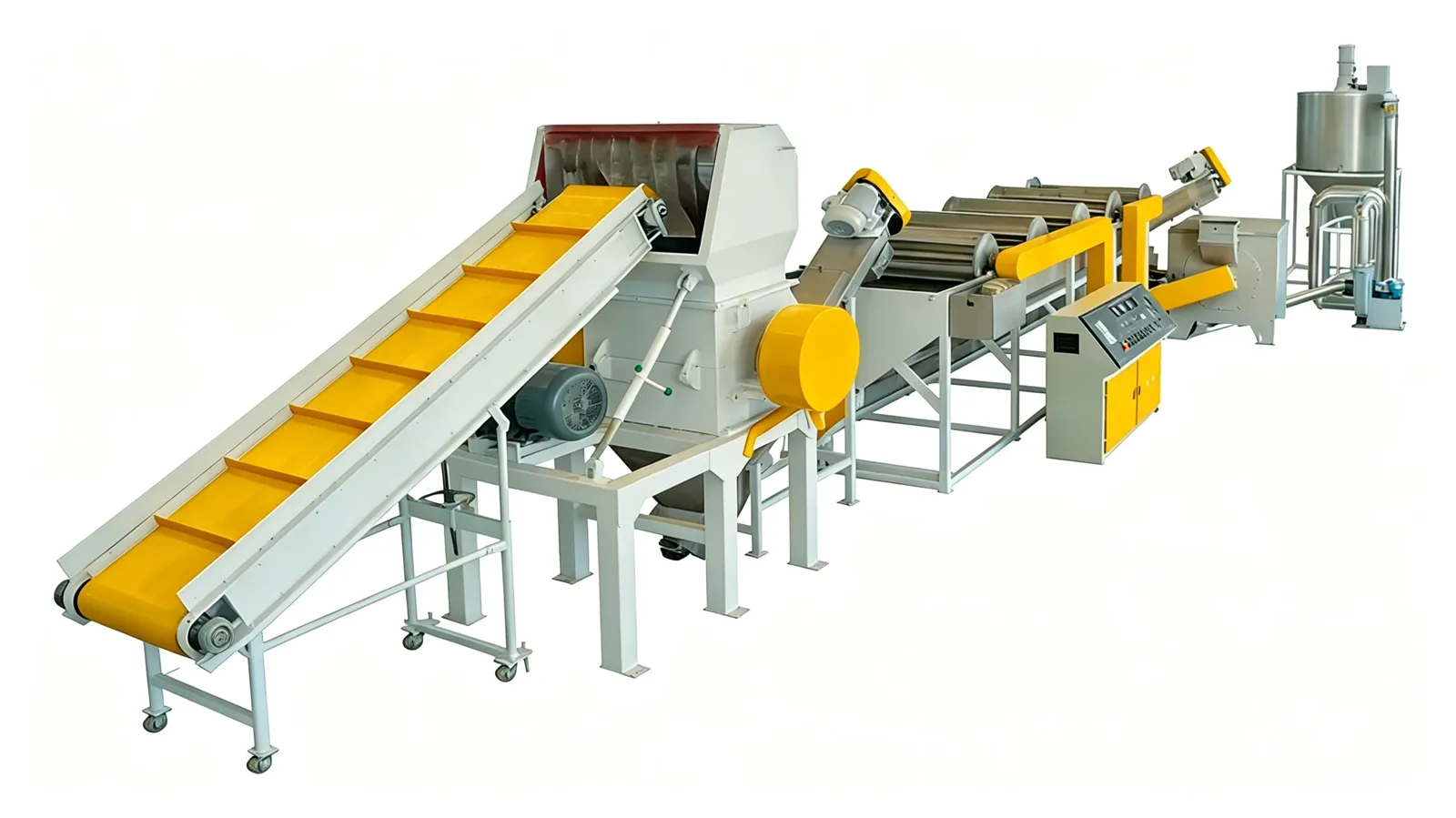
A line that adds washing, drying and a second extrusion stage needs a building rather than a room, with drainage, a water treatment route and a foundation for each heavy module. The cost is not the floor area; it is the civil work, the drainage and the fact that the plant cannot be moved once it is set.
Two practical details decide whether a room works. The floor has to take about 675 kg per foot under the largest model, which rules out a mezzanine but not a normal slab. And the material has to come in and the bags go out without crossing the operator’s working position at the die head, because that is where the hot work happens and where you cannot afford a trip hazard. A room that fits the skid but not the route gets reorganised within a month.
Connected electrical load and the supply you have
37 to 90 kW covers the whole compact range, and the 220 V single-phase option on the smallest model caps out at 22 kW and about 80 kg/h. A line typically needs several hundred kW connected, which usually means a transformer upgrade, a new service and a conversation with the utility that lasts longer than the machine lead time.
That is often the real boundary rather than tonnage. If the site has a 200 A three-phase service, a compact mill is a connection; a line is a project. Check the supply before the price list, because a machine you cannot power is not a bargain.
What your customer’s specification actually accepts
The last dimension is the one that overrides the other five. A compact mill runs 40 to 60 mesh filtration and a 26:1 to 30:1 screw. That is enough for a moulding shop buying regrind to run in its own machines. It is not enough for a customer who specifies a fines limit, a bulk density tolerance, a colour consistency band or a food-contact declaration.
The tell is in the purchase order. If the specification is one line — “PP regrind, 3 mm, no visible contamination” — the compact machine can meet it. If it runs to a page with test methods, the coarse screen and the short screw become the constraint, and no amount of care at the die will change that. Where the pellet has to carry a food-contact claim, TL-PET food-contact PET pelletizing line is a different platform entirely.
Ask for that specification in writing rather than accepting it verbally. A customer who says “the same as last time” is quoting a document you have not seen, and the document usually contains a fines figure or a sieve test that decides the machine. Where no document exists, write one from your own sieve analysis and agree it, because the argument at the first rejected load is always about a number nobody wrote down.
The four hard limits, and what to buy instead
Four things do not scale with tonnage, and crossing any one of them means the pellet mill is the wrong machine however few tonnes you make.
- Filtration — 40 to 60 mesh will not hold back heavy print, metallised film or fine grit. Above that contamination level you need a melt filter, and a melt filter needs a line.
- Screw length — 26:1 to 30:1 gives conveying and melting, not dispersive mixing. Filled compounds, masterbatch and alloys need longer.
- No upstream integration — washing, drying and metal separation are separate operations. Wet or dirty feed is not a mill problem you can tune out.
- No pressurised die-face control — without melt pressure and temperature held at the die, a tight size band and a low fines figure cannot be guaranteed lot to lot.
What to buy instead depends on which limit you hit. Heavy contamination points to a two-stage arrangement, TL-2S two stage granulating line with a melt filter ahead of the die. Mixed rigid regrind at 300 to 700 kg/h points to TL-SJ single screw granulator, and a greenfield plant that needs washing through to bagging points to TL-GPL turnkey granules production line. The mistake to avoid is buying a mill for the tonnage it can deliver and then discovering the limit was contamination, which tonnage never fixes.
| Dimension | Pellet mill is enough | The line becomes necessary | Why the boundary sits there |
|---|---|---|---|
| Annual tonnage | Up to about 600-800 t on one shift | Above about 1,000 t on one shift | The 500 kg/h ceiling arrives well before 1,000 tonnes |
| Shift pattern | One or two shifts, one operator each | Continuous running with a maintenance window | A single machine has no redundancy |
| Labour | One person feeds, samples and bags | Two or more plus supervision | Watching three points at once is not possible |
| Floor and civil work | Six by four metres, level floor, no foundation | Building, drainage, foundations per module | Washing and drying cannot be retrofitted into a room |
| Connected load | 37-90 kW, 220 V single phase on the smallest | Several hundred kW, transformer upgrade | The supply often decides before the budget does |
| Customer specification | One-line spec, moulding-shop regrind | Fines limit, bulk density band, food contact | 40-60 mesh and 26:1 cannot be tuned past a spec |
Frequently asked questions
Q1: At what output do I need a full granulating line instead of a pellet mill?
There is no single tonnage, but the practical ceiling is about 600 to 800 tonnes a year on one shift, which is the 500 kg/h model run at realistic availability. Above roughly 1,000 tonnes, the machine runs continuously with no maintenance window. Contamination or a tight customer specification can move the boundary far below that figure.
Q2: Can a plastic pellet mill handle washed film?
Washed film is workable if it is genuinely dry and free of grit, but 40 to 60 mesh filtration will not hold back fine contamination, and the mill has no drying stage of its own. Film that is still wet, or carries print and metallised layers, belongs on a line with a melt filter rather than on a compact machine.
Q3: Is a pellet mill cheaper to run per tonne than a full line?
Not automatically. At low tonnage it wins because capital and supervision are small; at high tonnage the line wins because power and labour per tonne fall with scale. The compact mill carries a higher specific energy, 0.35-0.50 kWh/kg, largely because heaters and blower draw a near-fixed load whatever the rate.
Q4: What are the hard limits of a compact plastic pellet mill?
Four: 40 to 60 mesh filtration, a 26:1 to 30:1 screw that conveys and melts rather than disperses, no integrated washing or drying, and no pressurised die-face control. None of them improve with tonnage. Each one, on its own, can rule the machine out for a material or a customer specification.
Q5: Can I add a second pellet mill instead of buying a line?
Often yes, and it is the cheaper route to about 1,000 tonnes a year. Two mills give redundancy a single line does not, and they can run different materials without a changeover. The arrangement stops working when you need washing, drying or melt filtration, because those stages do not exist on a skid.
Engineer’s note
Buyers usually arrive with a tonnage and leave having discovered their real constraint was contamination or a customer specification. I would rather lose a mill order than sell one into a feed it cannot screen: a 40 to 60 mesh pack and a 26:1 screw are honest limits, and no setting changes them. Ask what the pellet has to pass before asking what the machine can make.
Engineering note: the numbers on this page are our own published reference ranges for the machine family, not a specification guarantee for any individual unit. Final output, specific energy and pellet quality are set by the incoming material, its moisture and contamination level, and the screen pack fitted. We write the confirmed figures onto the quotation after a factory test run on your own material.
Who wrote this
Zhou Gong (周工) is a senior plastic machinery engineer at TENGLONG Plastic Machinery in Linyi, Shandong. The factory was registered as Linyi Hedong District Tenglong Plastic Machinery Factory on 7 June 2016 and grew out of a screw and barrel workshop, so his work is rooted in the parts that decide whether a granulator holds output: screw geometry, nitriding case depth, barrel alignment and melt filtration. He prepares the technical specification for customer quotations, reviews the four-hour factory test data before shipment, and runs commissioning support on site. Screws are nitrided in-house to a 0.5–0.7 mm case at HV 900–1000 and straightened to 0.03 mm runout over the full length; barrel, screw, gearbox and frame are aligned to 0.05 mm before the test run.
Figures quoted here are engineering reference ranges published on our own product pages, not guaranteed values for any specific machine. Real output, specific energy and pellet quality depend on the incoming material, its moisture and contamination level, and the screen pack fitted. Final values are written after a factory test run on the customer’s own material, and the PLC-logged test report ships with the machine. For a quotation that reflects your material, send the feed form, contamination level and target output and a configuration comes back within one working day.
Send the feed form, the contamination level, the tonnage and the customer specification, and we will tell you whether a TL-PM covers it or whether the answer is a line. Start with the material and the recommendation comes back within one working day.