Size a PET pelletizing line against the clean flake your wash line can reliably deliver and the hours you will really run, not against the tonnage you hope to collect. The TL-PET platform spans 500–2,000 kg/h, but real washing-line throughput runs 60–80% of nameplate, so the upstream stage sets the ceiling.
The order of the arithmetic matters: delivered flake first, running hours second, capacity third. Output is quoted as finished bagged pellets averaged over four hours, and start-up takes 25–40 minutes from cold, so a machine that looks big on paper can still be the wrong size for your shift.
Flake first, hours second, size last
- The wash line sets the ceiling: real throughput runs 60–80% of nameplate.
- Size on delivered flake and delivered hours, never on peak daily tonnage.
- Output is finished bagged pellets over four hours, so start-up and screen changes count.
- A 500–2,000 kg/h PET line is one option; washed flake may need far less.
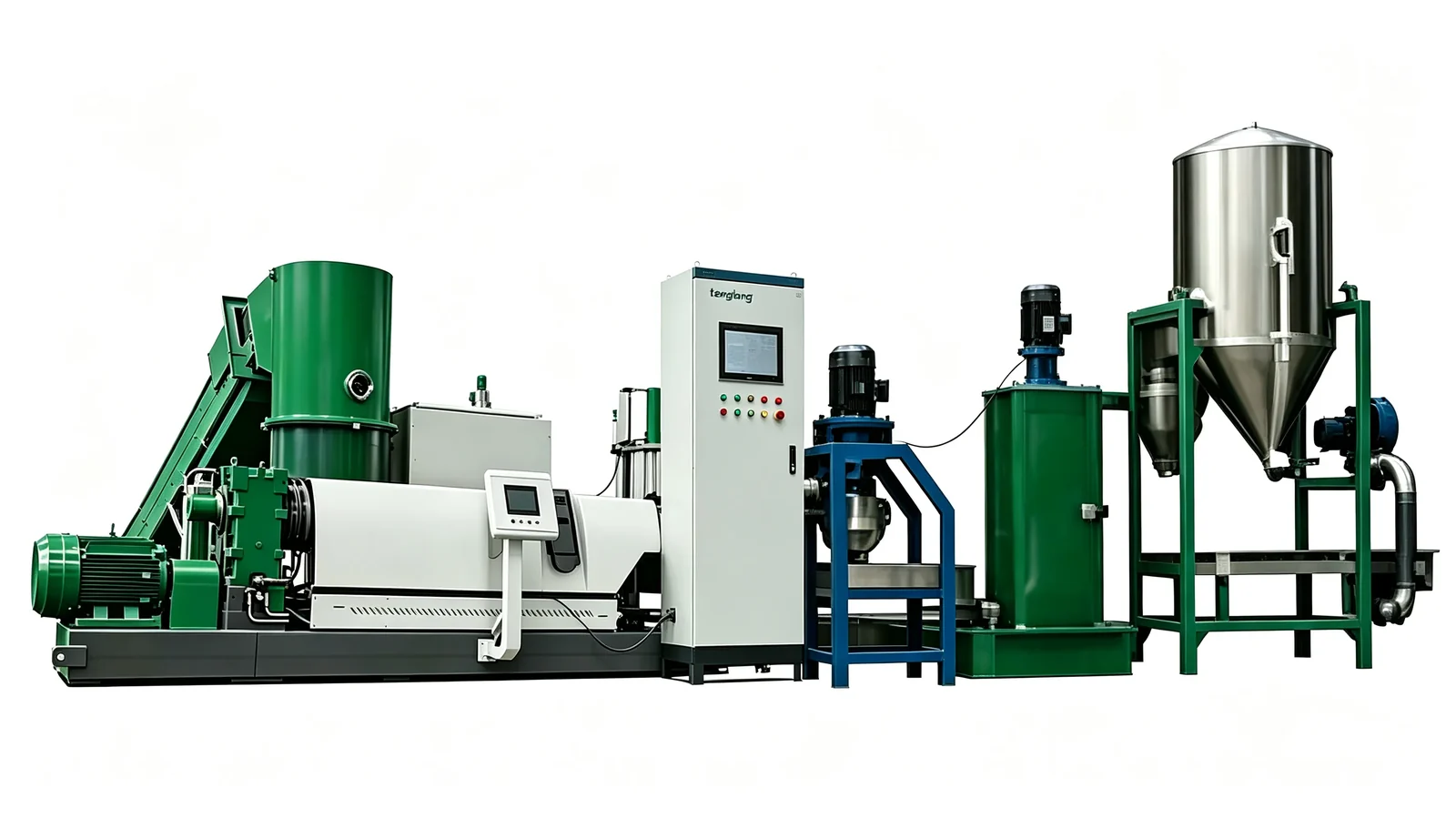
Start With the Flake, Not the Tonnes
Sizing a pelletizing line is arithmetic that most buyers do in the wrong order. The question is not how many tonnes they would like to process, it is how many tonnes of clean, dry flake the wash line can reliably produce each day, because the pelletizer can only eat what arrives. The TL-PET platform covers 500–2,000 kg/h and the turnkey plastic granules production line covers 500–3,000 kg/h, but neither number matters if the washing stage upstream runs at half of it.
The published crushing target for post-consumer material is 25–30 mm: small enough to wash, large enough not to be lost in the float-sink tank. That size is what the whole chain is designed around. If the crusher tears bales into 50–100 mm pieces instead, the flake reaches the dryer in a condition the dryer was never sized for, and the whole downstream calculation was made on the wrong feed.
So the sizing conversation has three inputs in a fixed order: hourly flake supply, pelletizer capacity, and running hours per day. Everything else in the specification, screw length, motor power, filtration, dryer capacity, follows from those three. A quotation that arrives before the three are fixed is a quotation for a guess, and the guess is usually generous.
Nameplate Is Not Output

Output for this equipment is quoted as finished bagged pellets, averaged over four hours. That definition does the heavy lifting, because it excludes the melt rate in the first minutes after startup and it includes the pauses. The published startup figure is 25–40 minutes from cold and 10 minutes from a 120 °C standby, so a line started cold every morning spends a real part of the early shift not producing saleable pellets.
Add the routine stops. A 20-minute screen change every 3–4 hours with an 8-hourly blade check, and one spare screw, one die plate and two screen packs to keep unplanned stops under 2%. That is the machine telling you it expects to run dirty material for long stretches. When you size against a target of hours per day, those screen changes belong inside the number rather than alongside it.
The twelve-model comparison is useful here for a narrow reason. Several of the platforms sit in overlapping capacity bands and are built for overlapping duties, so a buyer who has not fixed the flake supply can read the whole range and end up with a machine that matches no particular grade. Fix the input first, then read the range, and the shortlist writes itself.
Drying and Washing Set the Real Ceiling
The energy and water numbers are what tie pelletizing to the rest of the plant. Specific energy for the equipment runs 0.26–0.50 kWh/kg, and washing adds 18–30 kWh per ton of flake with water at 0.3–1.5 m³ per ton and recirculation. A complete washing line uses 0.8–1.2 m³ per ton of flake. These are the flows the plant has to supply every day, and they are settled before the pelletizer is switched on.
Space is the constraint people forget. A strand line occupies 8–12 m, a water ring pelletizer 5–7 m, a two stage line 15–18 m, and a full washing plus pelletizing plant 32–58 m. If the building is fixed and short, the choice of pelletizer narrows before any technical argument happens. It is better to have that conversation in the first week than in the third month.
The feedstock assumption also decides whether you need the whole food-grade package. Washing and flotation, optical sorting for final purity above 99.5% and PVC below 50 ppm for food grade, and flake moisture after drying below 1–2% all sit upstream of the pelletizer. If your input is already a clean, sorted, pre-ground stream, then the drying and venting stages on the PET line are the parts that will work hardest.
Choosing Between the Platforms
The choice in practice is between several shapes of answer. A flakes pelletizing machine at 300–1,000 kg/h starting at US$28,000 handles washed HDPE or PP flake at 80–100 mesh and is the right answer for a plant that has already solved washing. An underwater pelletizer at 300–2,000 kg/h from US$62,000 produces spherical PET, PA or masterbatch pellets from 1.2–3 mm. The PET pelletizing line at 500–2,000 kg/h from US$120,000 adds crystallization, dehumidified drying and vacuum venting for food-contact material.
Above those sit the general-purpose lines. A twin screw extruder line at 300–1,500 kg/h from US$38,000 handles filled and reinforced compounds at 40:1 L/D, and a two stage granulating line at 300–1,200 kg/h from US$46,000 is built for high-contamination waste at 60–100 mesh. A complete plastic granules production line at 500–3,000 kg/h from US$85,000 is turnkey: crush, wash, dewater, dry, pelletize. The granulator types page lists all twelve side by side, and the difference between them is mostly about which upstream problem you have already solved.
Published prices are indicative starting prices for 2026 and are configuration-dependent, and the market range for the same machines runs well above the catalogue figure. Third-party 2026 plant cost breakdowns put a 500–1,000 kg/h rigid line at US$180,000–400,000 and a 1,000–2,000 kg/h PET pelletizing line on its own at US$400,000–1,200,000. When two quotations are compared, the first question is whether both are quoting the same scope, because a pelletizer and a pelletizing line are different products with different numbers attached to them.
What the Wrong Size Costs
Over-buying is not only a bigger invoice. A machine held well below its rated output runs at a duty cycle it was not designed for, and the published specific energy of 0.26–0.50 kWh/kg is a band rather than a single number, so an underloaded machine does not automatically sit at the bottom of it. Under-buying fails the other way: the line becomes the constraint, the wash line keeps running, and the material that was not pelletized has to be stored, rehandled and run again.
There is also civil work and electrical capacity. A larger line needs a longer hall, more foundation and more power. The smallest machines run on 220 V single-phase, while a line like this is specified for 380 V / 50 Hz three-phase standard with IE3 motors and IP54 panels, and 415 V / 50 Hz, 440 V / 60 Hz and 220 V single-phase alternatives. Discovering the supply mismatch after delivery is an expensive week that has nothing to do with the machine.
The cheapest configuration is the one that matches your flake and your hours. If the flake supply is fixed, capacity above it is capital standing on the floor. If the hours are fixed, a line that spends 25–40 minutes on every cold start is capacity the schedule never sees. Work the arithmetic in that order and the machine size falls out of it, which is the only way I know to keep the quotation and the plant from arguing with each other later.
Platforms a PET project actually chooses between
Sizing a pelletizing line starts from the flake you actually have and the output you actually need. The table turns those two numbers into a machine size without guesswork.
| Platform | Capacity and starting price | What it is for |
|---|---|---|
| TL-FK flakes pelletizing machine | 300–1,000 kg/h, US$28,000 | Washed HDPE or PP flake at 80–100 mesh |
| TL-2S two stage granulating line | 300–1,200 kg/h, US$46,000 | High-contamination waste at 60–100 mesh |
| TL-UW underwater pelletizer | 300–2,000 kg/h, US$62,000 | PET, PA or masterbatch, spherical 1.2–3 mm |
| TL-PET | 500–2,000 kg/h, US$120,000 | Food-contact PET, IV loss below 0.03 dl/g |
| TL-GPL plastic granules production line | 500–3,000 kg/h, US$85,000 | Turnkey: crush, wash, dewater, dry, pelletize |
Common questions, with short answers
Q1: Should I size the pelletizer to my wash line or to the tonnage I want?
Size it to the flake the wash line can reliably deliver. The pelletizer can only process what arrives clean and dry, and if the upstream runs below the pelletizer’s rate then the extra capacity sits idle while the material is stored and reprocessed.
Q2: Does the 500–2,000 kg/h figure include washing?
No. That band is the pelletizing line alone. Washing, crushing, dewatering and drying are separate packages, and a complete food-grade rPET plant runs from around US$350,000 to more than US$1,000,000 depending on capacity and automation.
Q3: How many hours a day should the line run?
Set it against the flake supply and the schedule. Output is quoted as finished bagged pellets averaged over four hours, and startup takes 25–40 minutes from cold or 10 minutes from a 120 °C standby, so those hours belong inside the daily plan.
Q4: What if I only need washed flake pelletized, not food-grade material?
A flakes pelletizing machine at 300–1,000 kg/h from US$28,000 handles washed HDPE or PP flake at 80–100 mesh. The food-grade PET package earns its price only when the end customer will pay for the grade.
The companion write-ups for this machine family are: PET Pelletizing Line: What the Line Actually Contains, PET Pelletizing Line and rPET Intrinsic Viscosity, PET Pelletizing Line Cost: Capital and Running Cost and PET Pelletizing Line Acceptance: The Test That Proves It.
About the author
Zhou Gong (周工) is the recycling machinery engineer at TENGLONG Plastic Machinery in Linyi, Shandong — a plant of 18,000 m² with 30-plus staff, 12 platforms and 820-plus installations across 46 export markets. I have argued with more buyers about over-sizing than about price, and in every case the fix was a conversation about their flake supply. Where a figure is quoted here it has been measured or published with a date attached; nothing in this article is an estimate.
The quickest way to a real answer is to send the feed form, the contamination level and the throughput you need. A model and a price range come back within one working day, the trial on 10-20 kg of your material is free, and a result that misses the agreed output by more than 5% leaves the deposit refundable.