Nitrided or bimetallic is decided by the duty, not by the price. A nitrided case of 0.5-0.7 mm at HV 900-1000 handles clean, unfilled regrind. A bimetallic build adds a 2.0-3.0 mm alloy layer at HRC 58-62 over a chrome-plated nitrided base, and that extra depth is what survives abrasive feed.
The published comparison puts a bimetallic barrel at roughly 25% more initial cost, 2-3 times longer life in harsh duty, a wear rate cut of more than 60%, and three-year ownership about 50% lower. None of that applies to clean feed, so the honest answer is that most recycling lines should run nitrided and abrasive lines should run bimetallic.
Choosing between the two builds
- Nitrided is a 0.5-0.7 mm case at HV 900-1000 and suits clean, unfilled regrind.
- Bimetallic adds 2.0-3.0 mm of alloy at HRC 58-62 for abrasive duty.
- The premium is about 25% up front and about 50% lower ownership over three years.
- Ask for case depth and hardness in writing, because HV and HRC do not convert.
What nitriding gives you
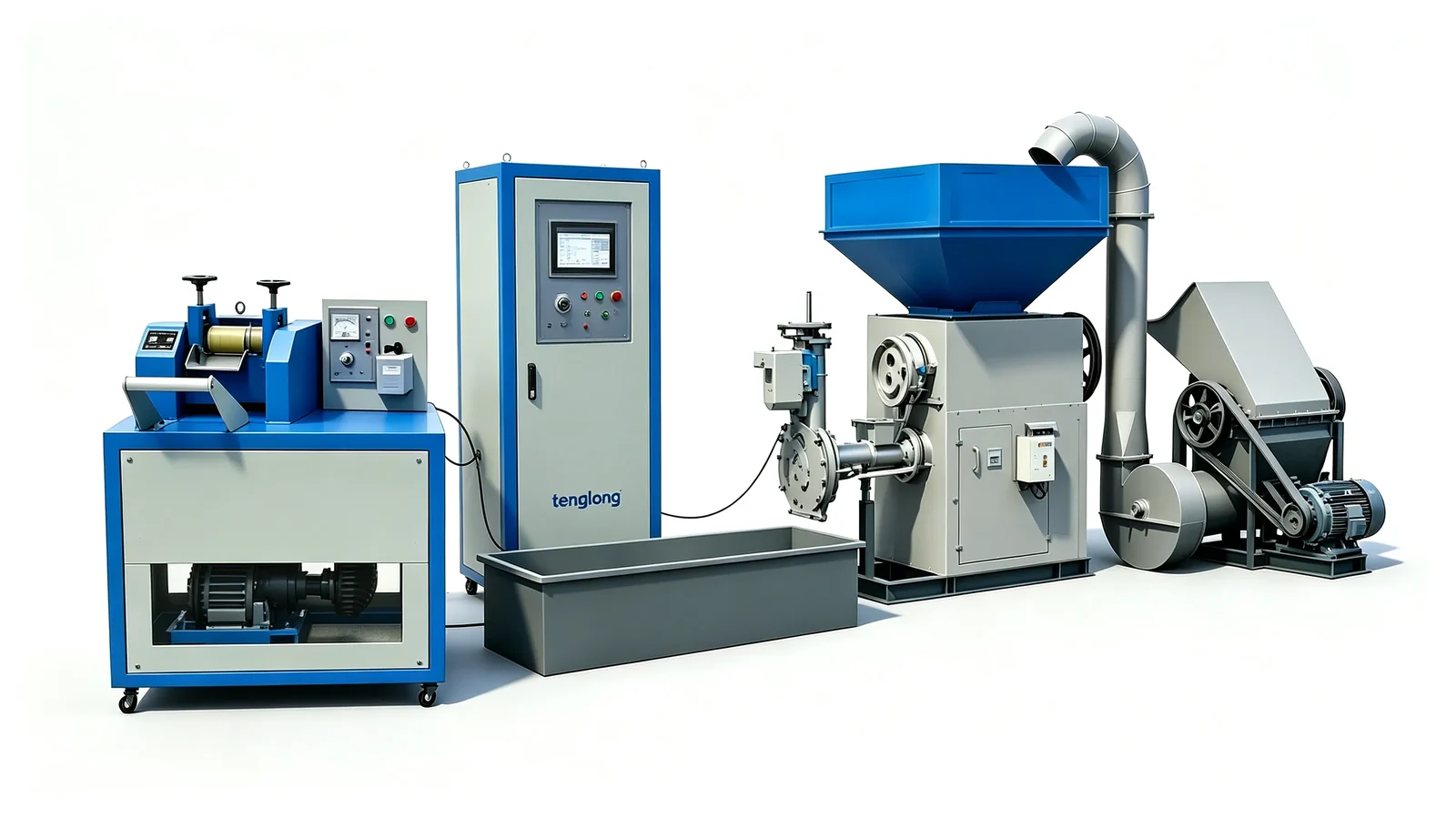
A nitrided screw is the sensible default for a recycling line, and a bimetallic screw is the answer when the feed is abrasive enough to eat through the case. The difference sits in the surface layer itself. Nitriding produces a hard case of 0.5-0.7 mm at HV 900-1000 in this plant, while a bimetallic build adds a 2.0-3.0 mm alloy layer at HRC 58-62 over a chrome-plated nitrided base.
Those figures are not interchangeable, and a supplier who mixes them is telling you something. HV and HRC are different scales, so HV 900-1000 and HRC 58-62 describe a similar order of hardness in two languages. What a buyer actually needs is the depth of the hard layer, because that is how much material the wear can remove before it reaches the softer core at HB 240-280.
In house the case runs 0.5-0.7 mm at HV 900-1000 and the screw is straightened to 0.03 mm. Published supplier specifications for nitrided recycling screws and barrels run 0.5-0.8 mm case, HV 900-1,000, Ra 0.4 and 0.015-0.02 mm straightness. A straightness figure of 0.03 mm is looser than that published band, so if the contract needs the tighter number it belongs in the contract.
What the bimetallic layer adds

The bimetallic layer is not a coating, it is a separate alloy laid over a nitrided, chrome-plated base, and it is thicker than the case underneath it. Two to three millimetres of alloy at HRC 58-62 gives the wear surface a depth that a 0.5-0.7 mm case cannot offer. Published data puts the wear rate down by more than 60% and extrusion consistency up by about 15% in harsh duty.
Life is the headline: 2-3 times longer in harsh duty. On a barrel that otherwise runs 1-5 years in high-filler PVC extrusion, that is the difference between scheduling a replacement and discovering one. For a line running continuously on dirty feed, the bimetallic build is not a premium option, it is the cheaper way to buy the years the line will actually run.
Consistency matters as much as life. A screw that holds its geometry holds a steady melt pressure, and steady melt pressure is what keeps strand diameter inside the published cutting tolerance. An extrusion consistency gain of about 15% is worth more to a compounding customer than to a pellet trader, because the compounding customer puts your pellets through a second extruder and inherits your melt behaviour.
The premium and what it buys
A bimetallic barrel carries roughly 25% more initial cost than a nitrided one. That is the figure every buyer hears, and on a single set it is real, because you are buying 2.0-3.0 mm of alloy instead of a shallow case. The published comparison then runs to three years, where total cost of ownership is quoted about 50% lower for the bimetallic build through fewer replacements.
Take that arithmetic to your own hours before accepting it. The 50% figure assumes the harsh duty the alloy was made for. On clean, unfilled, well-sorted regrind a nitrided screw runs a long time and the premium buys very little. On high-filler compounds, contaminated flake or reinforced regrind the same premium is repaid inside a single replacement cycle.
There is a second cost that never appears on the invoice, and it is the reason to buy a spare rather than to plan a purchase. Wear parts are stocked for three years and one spare screw ships with the line. That stock is what stops a scheduled replacement from turning into an emergency, and it is why holding a spare of the same build beats rebuilding one part and waiting for a shipment.
Which build the material asks for
Start with the contamination level, because it sets the filter duty and therefore the screw duty. A single screw tolerates about 2% non-melting contamination at 60-80 mesh, and a two stage granulating line takes 5-8% at 100 mesh because the melt gets a second filtering and melting pass. Above 8% the published advice is blunt, washing is cheaper than filtering. Where you already wash, the screw faces a relatively clean melt and nitriding is usually enough.
Next look at what is inside the polymer, not only at what is around it. Filled and reinforced compounds are the abrasive case, and that is what a twin screw extruder line is built for. A masterbatch granulator runs 20-60% pigment loading with fast colour changes, where the screw has to hold temperature while the load changes. That is a thermal and surface-quality question rather than a pure abrasion question, and nitriding serves it well.
And check the abrasive that is not polymer at all. Contamination at 5-8% carrying grit and glass is where the 2-3 times wear-life figure starts to look at home. Bimetallic earns its place on a two stage line working high-contamination waste, because the alloy survives what a shallow nitrided case would lose in a season.
How to write the specification
Put the numbers in the order rather than the adjectives. Ask for the case depth and surface hardness on a nitrided build, the layer thickness and substrate on a bimetallic build, and the length and diameter of the screw against the machine it will go into. Then state what the supplier guarantees if the case measures below the agreed depth on arrival. Quality control on a wear part is a piece of paper long before it is a measurement.
Ask where the work is done, because it decides who controls the case depth. Screws up to 4 m and 220 mm diameter are turned and milled in house here, and barrels are made by bimetallic centrifugal casting. A supplier with its own furnace can adjust the case to the duty you describe. One that buys finished blanks cannot, and will sell you whatever the stock happens to be.
Ask for the wear data to be quoted with the duty it came from rather than as a general lifetime. The 3,000-5,000 hour figure belongs to wear-resistant alloy builds on ordinary plastics, where blades stay reusable for three to five regrinds. The 1-5 year barrel figure belongs to high-filler PVC extrusion. Quote either number outside its own context and it will be wrong, and the fault will be yours.
Nitrided and bimetallic side by side
Both builds are legitimate; they solve different problems. The table sets them against each other on cost, wear life and the material they can carry.
| Property | Nitrided build | Bimetallic build |
|---|---|---|
| Case or layer depth | 0.5-0.7 mm in house, 0.5-0.8 mm published | 2.0-3.0 mm alloy layer |
| Surface hardness | HV 900-1000 | HRC 58-62 |
| Base material | Carbon steel core at HB 240-280 | Chrome-plated nitrided base |
| Wear rate | Reference level | More than 60% lower |
| Life in harsh duty | 1-5 years in high-filler PVC | 2-3 times longer |
| Initial cost | Lower | About 25% higher |
Common questions, with short answers
Q1: Is a bimetallic screw worth the extra cost on a normal recycling line?
Only if the duty is harsh. The premium is repaid through a 2-3 times longer wear life in abrasive service and a wear rate more than 60% lower, and none of that applies to clean unfilled regrind. Judge the feed and the running hours, not the invoice.
Q2: What is the difference between HV and HRC hardness?
They are two different scales. A nitrided case is quoted at HV 900-1000, while the bimetallic alloy layer is quoted at HRC 58-62. Neither converts into the other without a test, so the specification should name the scale it expects and the depth it expects.
Q3: How deep does the hardened case need to be?
For a nitrided screw the published case depth is 0.5-0.8 mm and this plant runs 0.5-0.7 mm. For a bimetallic build the alloy layer is 2.0-3.0 mm. Depth is what decides how much wear the part can absorb before it reaches the core at HB 240-280.
Q4: Does nitriding change the core of the screw?
The core stays at about HB 240-280 while the case reaches HV 900-1000, which is the whole point of the process. It is a hardened skin over a tough body, so the case depth in the specification matters more than the headline hardness.
The rest of this series covers the same equipment from different angles: Extruder Screw and Barrel: What the Part Does, Extruder Screw Diameter and Length: How to Match It, Screw and Barrel Cost: Replacement and Total Cost and Screw Inspection and Commissioning: A Working Routine.
About the author
Zhou Gong (周工) has spent his working life on recycling machinery at TENGLONG Plastic Machinery in Linyi, Shandong, where 820-plus lines have been delivered across 46 export markets since 2016. I distrust a hardness number on a quotation that nobody measured on the actual screw, and I say so before the order rather than after the failure. Each figure quoted here is either measured on a machine or published with a date attached; nothing has been estimated to fill a gap.
Give our engineers the material form, the contamination level and the throughput, and the answer comes back within a working day as a model and a price range. Running 10-20 kg of your own material is free, and a measured output more than 5% under the agreed figure puts the deposit back in your hands.