A food-grade PET pelletizing line is a sequence of moisture-control stages, not a single machine: crystallizer, dehumidifying dryer, nitrided extruder with a screen, multi-stage vacuum venting, underwater pelletizer, pellet dryer, silo and bagging. Most of the cost sits in the parts that remove water.
What each module decides is worth stating plainly. The crystallizer and dryer decide whether the melt can be made at all. The melt filter and the vacuum section decide whether the pellets come out clean. The cutter decides the shape and the size spread. Once you can name which stage does what, a quotation becomes much easier to read.
A chain of stages, one argument
- Crystallization comes before drying, and drying comes before the melt ever forms.
- The melt filter and the vacuum section protect the grade, and both are easy to leave vague in a quote.
- Underwater cutting gives spherical pellets held to ±0.15 mm accuracy.
- Output is finished bagged pellets averaged over four hours, not a melt rate.
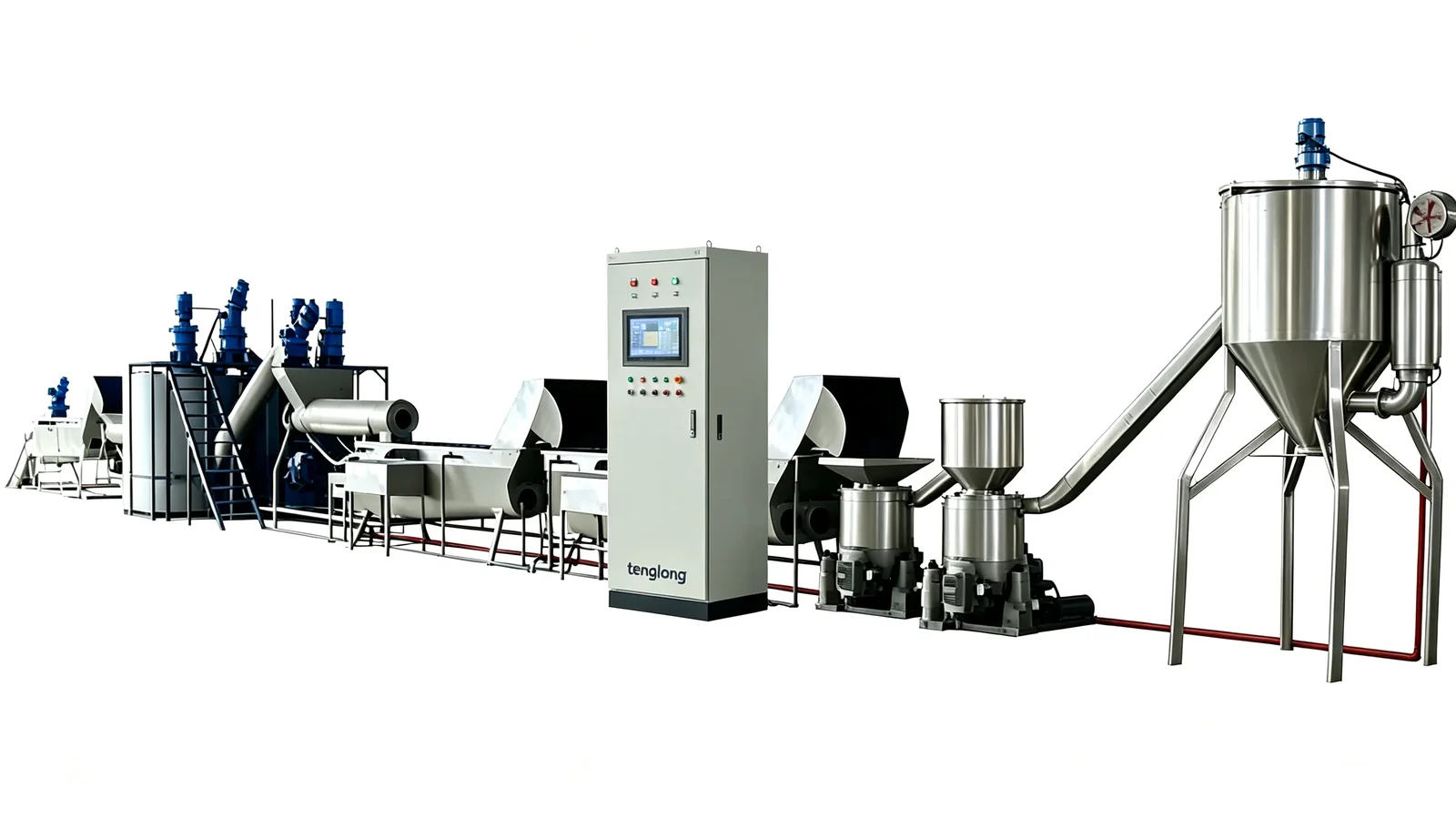
The Line Is a Sequence, Not a Machine
A food-grade PET pelletizing line is a chain of modules that hands material from one to the next: a feeding and crystallizing stage, dehumidified drying, a single-screw extruder with a screen, multi-stage vacuum venting, an underwater pelletizer, pellet drying, then storage and bagging. Buyers often ask how many machines are in the package. The honest answer is that the line is one continuous moisture argument, and each module exists to remove a specific problem the previous one created.
The order is not arbitrary. Flake arriving from a wash line is wet and amorphous; wet flake cannot be dried properly, and undried flake cannot be melted without losing the property the buyer paid for. So the crystallizer comes first, then the dryer, then the extruder, and only after that does anything melt at all. The published capability note is plain about the sequence: crystallizing and underwater pelletizing capability was added in 2022 for food-grade rPET, and those two steps are what turned a granulating line into a PET line.
The phrase food-contact PET also carries obligations that show up in paperwork rather than in steel. A formal quote states filtration mesh, drying method, motor power, control system and the exact scope of supply, which tells you that the document being priced is a process proposal rather than a machine list. Washing line equipment is normally quoted as a separate package, so before comparing two quotations for this line, line up each of those items and check that they answer the same question.
Crystallizer and Dehumidifying Dryer
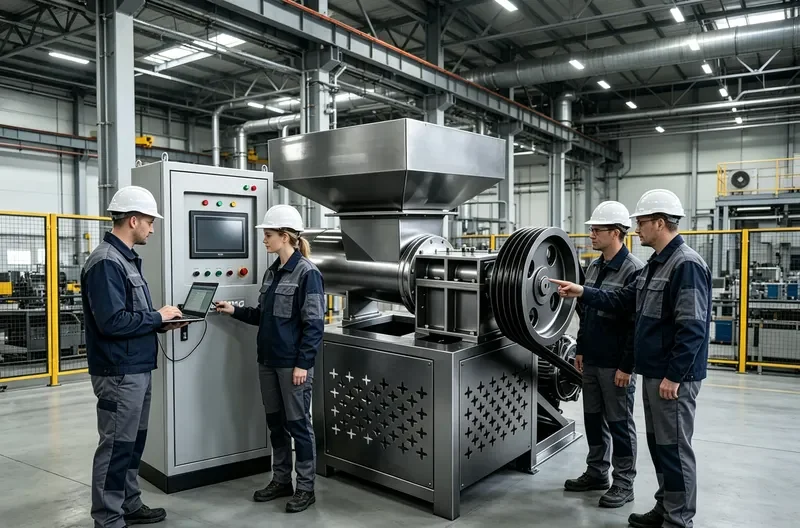
PET needs crystallization and dehumidified drying to about 50 ppm plus vacuum venting, because moisture hydrolyses PET and destroys intrinsic viscosity. That single requirement explains why the front end of this line carries the most engineering, and why a simple hopper is not enough. Crystallization gives the flake a defined melting behaviour so it can be held at drying temperature without the material welding itself together in the hopper, and the dehumidifying dryer then pulls the water out of it.
The published moisture targets separate the two materials clearly. PET to below 50 ppm after crystallization; PA to below 0.1%. PET is the demanding one because of the hydrolysis reaction, and PA is the comparatively forgiving case. If a plant intends to switch between polymers on the same equipment, that line does most of the argument for separate drying recipes rather than one compromise setting that suits neither.
Vacuum venting is listed in the same requirement, which surprises buyers who think of venting as an extrusion feature. On a PET line it belongs to the moisture story: water that did not leave the flake in the dryer reappears in the melt as vapour, and the venting stage pulls out what is left before the melt reaches the die. Crystallization, drying and venting are one operation seen from three sides, and a quotation that prices the dryer while leaving the vacuum system vague has not described the line.
The Extruder, the Screen and the Melt Filter
The extruder gets most of the attention and has the least room for difference. Screws are nitrided in the company’s own plant to a 0.5–0.7 mm case at HV 900–1000, straightened to 0.03 mm, with one spare screw supplied with the line. CNC turning and milling handles screws up to 4 m and 220 mm diameter, and bimetallic centrifugal casting covers the barrels. On this line that matters, because the feed is wet, mildly alkaline flake rather than clean regrind.
A melt filter is a large-area filtration unit for dirty feed; on film lines 80 mesh is typical, and two-stage recycling lines use 60–100 mesh across two stages. On a PET line the filtration specification matters for two reasons at once. It has to pass a specification mesh without strangling the throughput, and it has to remove enough fine PET dust that the dust does not end up blocking the vacuum ports downstream. Those two requirements pull against each other, which makes the mesh a real engineering decision rather than a detail.
The published operating routine is worth reading twice: a 20-minute screen change every 3–4 hours, an 8-hourly blade check, and one spare screw, one die plate and two screen packs to keep unplanned stops under 2%. That routine is written for a dirty-recycling duty. It tells you the machine is expected to run for long stretches between screens, which in turn tells you the downstream stages must be able to accept a long steady run without a fouling problem. Filter, screw and screen are one system, not three spare-parts lines.
Vacuum Venting and the Underwater Cutter
A multi-stage vacuum degassing system runs at -0.08 to -0.1 MPa to pull volatiles out of the melt, and fine PET dust blocks those vacuum ports if it is not removed after washing. That second half of the sentence is the one that catches people out. The system is not delicate in the way a laboratory degasser is delicate, but it is not self-cleaning either, and the dust that fills it is dust the wash line was supposed to remove and did not.
The die head is the plate at the end of the extruder that shapes the melt into strands or feeds a die-face cutter, and the pellet cutter is the blade assembly after the die or water bath: 12-blade strand cutters, water ring die-face cutters or underwater cutters. This line runs the underwater pelletizer arrangement, because the water bath both cools and cuts. Underwater cutting is held to ±0.15 mm against ±0.2 mm for strand cutting, and the pellets come out spherical.
Spherical matters for more than appearance. A spherical pellet feeds evenly into a preform machine and has no orientation, so a downstream blow moulder sees a consistent melt instead of a variable one. Pellet size is 3 mm by default for injection and blow moulding, 2–2.5 mm for film and cable, and 4 mm for large mouldings. A buyer should be clear that the cutter sets the size range, so a different grade is a cutter and tool change rather than a software setting.
Downstream: Drying, Storage and Bagging
Pellets leaving an underwater cutter are wet, and the water on them has to go before they can be bagged. The pellet dryer strips that surface water, and after it the material goes into storage. A silo is a buffer vessel for finished pellets before bagging, letting the pelletizer keep running while bags are changed downstream, and a storage hopper is the smaller vessel above the feeder, usually paired with a crammer on low-density film flake.
The loader and the hopper feed are auxiliary equipment, and the auto loader is a vacuum conveyor that refills the hopper automatically from a bag or silo, keeping the feed throat at a constant level. A feed throat that runs low changes the bulk density the screw sees, and a changing bulk density shows up downstream as a varying melt and a wider spread of pellet size. None of this is exotic, but it is exactly the sort of item that gets left out of a scope list and then blamed on the extruder.
Then the numbers that define the line commercially. Specific energy runs 0.26–0.50 kWh/kg, and output is quoted as finished bagged pellets averaged over four hours rather than as the peak melt rate in the first minutes after startup. Footprint for a full washing plus pelletizing plant is 32–58 m. The published startup figure is 25–40 minutes from cold and 10 minutes from a 120 °C standby, which tells you how the line is meant to be run shift by shift.
What each stage of a PET pelletizing line is for
A pelletizing line is a chain of matched stages, and the output is only as good as the weakest link in it. These are the stages, what each one is responsible for, and where the numbers come from.
| Stage | What it does | What to check in the quote |
|---|---|---|
| Crystallizer | Gives wet flake a defined melt behaviour so it can be dried | Crystallizing added in 2022 for food-grade rPET |
| Dehumidifying dryer | Removes water from the flake before any melting happens | PET dried to below 50 ppm after crystallization |
| Extruder and screen | Melts and filters the dried flake | Nitrided screw, 0.5–0.7 mm case, HV 900–1000 |
| Melt filter | Holds back fines and PET dust before the die | Filtration mesh stated in the formal quote |
| Vacuum venting | Pulls volatiles and residual moisture out of the melt | Multi-stage system at -0.08 to -0.1 MPa |
| Underwater pelletizer | Cools and cuts the melt into spherical pellets | Underwater cutting held to ±0.15 mm |
| Pellet dryer, silo, bagging | Strips surface water and buffers the bagging | Output averaged over four hours |
Frequently asked questions
Q1: What is the difference between strand pelletizing and underwater pelletizing on PET?
Strand cuts the melt in air with 12-blade strand cutters, while the underwater arrangement cuts it in a hot water bath and gives spherical pellets held to ±0.15 mm. The water cools the pellet as it forms, which is why the underwater method suits food-grade PET.
Q2: Why does a PET pelletizing line need crystallization?
Wet, amorphous flake agglomerates if it is heated without being crystallized first. Crystallization gives the flake a defined melting behaviour, so the dehumidifying dryer can bring it to about 50 ppm without the material welding together in the hopper.
Q3: Does the quoted PET pelletizing line include the crusher and the washing plant?
No. Washing and crushing sit upstream of the pelletizing hall and are quoted separately. The crusher target for post-consumer material is 25–30 mm, small enough to wash and large enough not to be lost in the float-sink tank.
Q4: How long does the whole line take to start up?
From cold, 25–40 minutes; from a 120 °C standby, 10 minutes. Output is quoted as finished bagged pellets averaged over four hours, so the startup period is not counted in the rated rate.
If you are working through the same machine family, these are the other PET Pelletizing Line and rPET Intrinsic Viscosity, Sizing a PET Pelletizing Line Without Over-buying, PET Pelletizing Line Cost: Capital and Running Cost and PET Pelletizing Line Acceptance: The Test That Proves It.
About the author
Zhou Gong (周工) is a recycling machinery engineer at TENGLONG Plastic Machinery in Linyi, Shandong, where 30-plus staff work across 18,000 m² and 12 machine platforms covering 100 to 3,000 kg/h. I walk new buyers through a commissioned line in the order the material moves, because almost every question they bring turns out to be about moisture. Every figure used here has been measured on a machine or taken from a dated published source, not from a brochure.
Send the material form, the contamination level and your target output to our engineering team and you get a model and a price range within one working day. A test run on 10-20 kg of your own material is free, and if the measured output misses the agreed figure by more than 5%, the deposit is refundable.