The published starting price for the TL-PET platform is US$120,000, and that figure covers the machine, not the plant. Freight, foundations, water treatment, spare-parts stock and installation are quoted separately, so the number on the invoice and the number the plant carries are rarely the same.
The wider market range is worth holding in view: a 500–1,000 kg/h rigid line at US$180,000–400,000, a 1,000–2,000 kg/h PET line alone at US$400,000–1,200,000, and a complete food-grade plant from around US$350,000 to more than US$1,000,000.
The machine is the smaller number
- US$120,000 starting price; the market range runs from US$180,000 to over US$1,000,000.
- Food grade adds 15–25% on capital and roughly US$600–1,200 per ton on the pellet price.
- Running cost is electricity and water: 0.26–0.50 kWh/kg plus 18–30 kWh per ton of flake.
- Freight, foundations, water treatment, spares and installation sit outside the machine price.
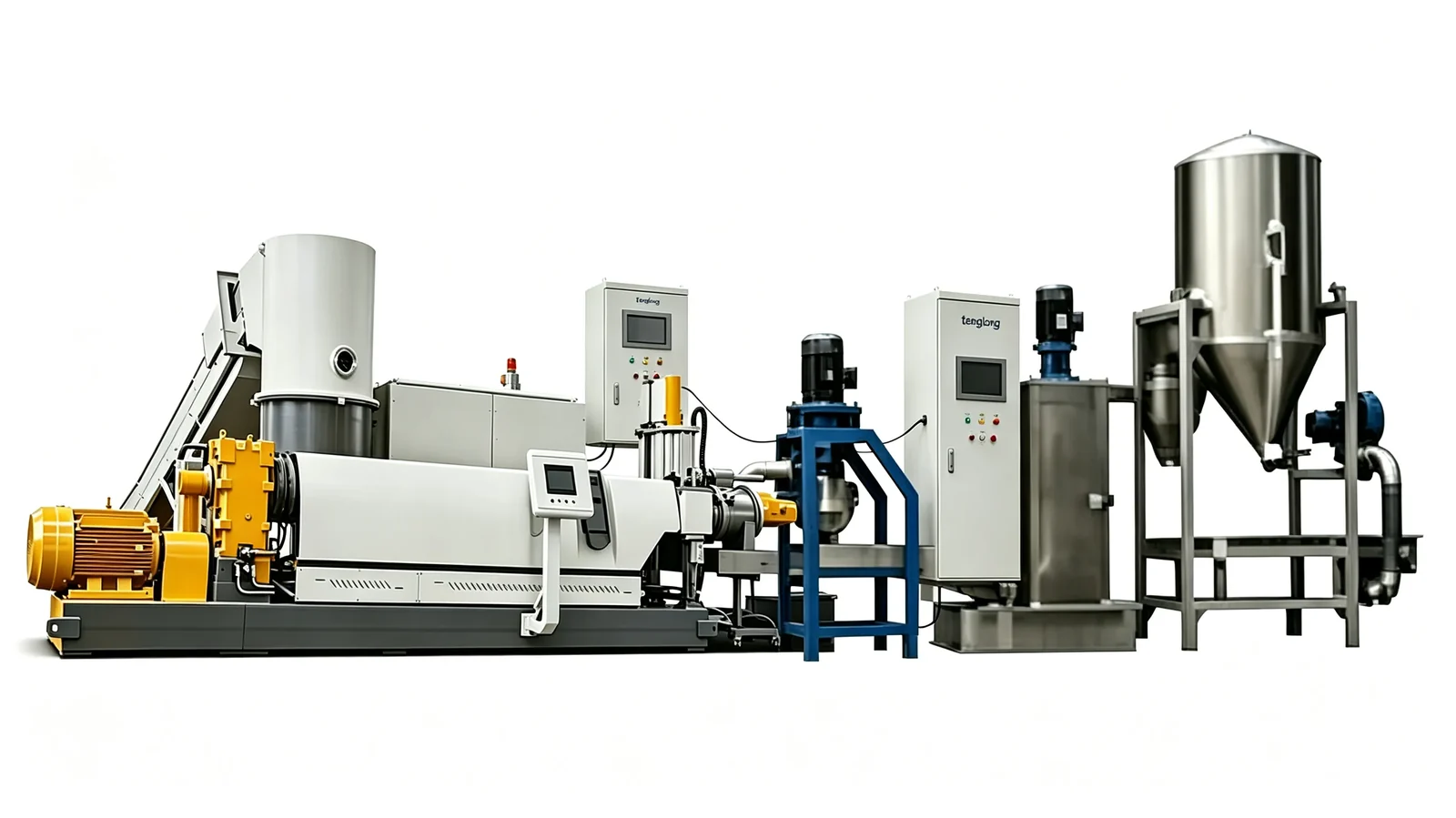
The Catalogue Price Is the Starting Point
The published starting price for the TL-PET platform is US$120,000, and the word starting is doing real work in that sentence. Published prices are indicative starting prices for 2026 and are configuration-dependent, so two quotations at US$120,000 may cover different packages, and the larger one is not the better value. The catalogue below that figure is wide: a single screw granulator starts at US$12,500 and a two stage granulating line at US$46,000.
The market range for the same equipment sits well above the catalogue figure. A 500–1,000 kg/h rigid line is quoted at US$180,000–400,000 and a 1,000–2,000 kg/h PET pelletizing line alone at US$400,000–1,200,000. A complete food-grade rPET bottle washing and pelletizing plant runs from around US$350,000 to more than US$1,000,000 depending on capacity and automation. Those figures come from third-party plant cost breakdowns rather than from the factory, and they are the right benchmark for a budget.
A middle case matters for buyers who already wash. Adding a pelletizing extruder to an existing washing line is quoted at US$60,000–200,000 depending on size and whether it is a compounding machine. So the real question for many plants is not what a line costs, it is whether the money is buying the pelletizer or the whole hall, and that decides which of those figures applies to you. Ask for a formal quote that states the scope of supply line by line, then compare it against the market ranges above.
Where the Money Actually Goes

The extra washing and documentation stages that food-grade output requires are quoted as adding 15–25% to the capital cost of a commodity line. That is the cost of the compliance route rather than the cost of the machine, and it explains why a food-grade quotation and a non-food-grade quotation for the same capacity are not comparable at all. A turnkey pelletizing solutions package bundles the washing, the water treatment and the commissioning into one contract, which is convenient for a plant that wants a single supplier to answer for.
The stage prices show where the money lands. A hot caustic wash vessel with heating and dosing is listed at US$58,000-125,000, a float sink tank with surface skimmer at US$28,000-62,000, a wet grinder with screen and water injection at US$34,000-72,000, an optical bottle sorter at US$90,000-240,000, and a wastewater treatment and water recycle skid at US$55,000-135,000. None of those components are inside the pelletizer price, and all of them decide whether the plant runs at all.
Those stage prices are quoted delivered to the plant but before foundations, piping, cabling and commissioning, and the price list assumes it. The honest total for a food-grade project is a pelletizer, plus a washing package, plus water treatment and commissioning, plus the civil and installation work, and that last part is where a budget written on paper stops matching the budget in reality. A two stage granulating line at US$46,000 handles the high-contamination waste that food-grade feed does not, and the comparison is worth keeping in mind.
Running Cost: Energy, Water, Screens and Labour
Specific energy for the equipment is 0.26–0.50 kWh/kg and output is finished bagged pellets averaged over four hours. Washing adds 18–30 kWh per ton of flake with water at 0.3–1.5 m³ per ton and recirculation, and a complete washing line uses 0.8–1.2 m³ per ton of flake. Multiply those by annual tonnage and the running cost of a PET line is mostly electricity and water, not spares and not labour.
Screens and blades are the recurring parts. A 20-minute screen change every 3–4 hours, an 8-hourly blade check, and one spare screw, one die plate and two screen packs to keep unplanned stops under 2%. On a plant running two shifts, the line is stopped for filtration repeatedly through the working day, and that time is a real cost whether or not it appears in the quotation.
Labour is smaller but not trivial. Wear teeth, filters, bearings and belts add US$4-9 per ton and inspection and cleaning labour adds a further US$2-5 per ton on a washing line. Those are consumable figures from the washing side, but the same logic applies to the pelletizer: a line with no scheduled screen and blade discipline turns a small consumable cost into a large downtime cost. A single screw granulator at US$12,500 sits lower in the catalogue, but it is not a substitute for a food-grade PET line.
What the Pellets Are Worth
Running cost only means something against what the pellets sell for. The April 2026 rPET price series put fibre-grade clear pellets with IV 0.72 at US$1,130/t and food-grade pellets with IV 0.88 at US$1,300/t, while non-food-grade clear or mixed-colour material was reported at US$800–1,200/t and super-clean food-grade rPET at US$1,500–2,500/t. Food-grade rPET output commands a market premium of roughly US$600–1,200/t over non-food-grade rPET.
That premium is the reason the food-grade specification is worth engineering for, and also the reason it is worth checking what the plant can actually deliver. A line running well below its rated output produces fewer tonnes to spread the fixed costs across, and the premium per tonne does not grow because the volume fell. Payback arguments are usually made with the capital cost and the premium; the running cost and the achieved output belong in the same calculation.
I would put the question plainly to any supplier: at my flake supply and my operating hours, what do I sell, at what price, and what does it cost me per tonne to make it. A supplier with a test hall and published figures will answer with numbers. One without will answer with adjectives, and adjectives are what appear in the invoices later.
The Costs That Are Not on the Invoice
The invoice a buyer approves and the cost a plant carries are therefore different numbers, and the difference is where overruns come from. Delivery, foundations, water treatment, a first spare-parts stock and installation all sit outside the machine line on a quotation, so a budget that treats the machine price as the project price will discover the rest of it in the second month.
Time is money here too. Lead times are 45–60 days for a custom line or washing plant and 25–35 days for a standard line, and sea freight to Europe adds 30–40 days while Southeast Asia adds 7–12 days. Installation runs 7–10 days on site for a line, including commissioning, two days of operator training and a signed handover report. Payment is 30% T/T deposit with 70% before shipment, and L/C at sight above US$50,000.
Then the parts and the promise. Wear parts are stocked for three years, and the warranty runs 18 months from commissioning or 24 months from shipment, whichever comes first. Those two lines are worth more to a plant than a discount on the machine, because they decide whether the line stands still in month eight while a screen waits somewhere. The cheapest quotation is rarely the one that costs least per tonne.
What a PET pelletizing project costs, item by item
The invoice is the smallest part of the cost. The table separates the capital figure from the running cost per tonne, because only the second one decides whether the line pays back.
| Item | Published figure | Note |
|---|---|---|
| TL-PET platform, starting price | US$120,000 | Indicative 2026 price, configuration-dependent |
| 500–1,000 kg/h rigid line | US$180,000–400,000 | Third-party plant cost breakdown, 2026 |
| 1,000–2,000 kg/h PET pelletizing line | US$400,000–1,200,000 | Third-party plant cost breakdown, 2026 |
| Complete food-grade rPET plant | US$350,000 to more than US$1,000,000 | Depends on capacity and automation |
| Pelletizer added to an existing wash line | US$60,000–200,000 | Size and compounding type decide the figure |
| Extra washing and documentation stages | 15–25% on capital cost | The cost of the food-grade route |
| Food-grade output premium | US$600–1,200 per ton | Against non-food-grade rPET |
| Warranty | 18 months from commissioning or 24 from shipment | Whichever comes first |
What buyers ask us before they order
Q1: How much does a PET pelletizing line cost?
The published starting price for the TL-PET platform is US$120,000, indicative for 2026 and configuration-dependent. Market comparisons are US$180,000–400,000 for a 500–1,000 kg/h rigid line and US$400,000–1,200,000 for a 1,000–2,000 kg/h PET line alone.
Q2: What does food grade add to the price?
The extra washing and documentation stages are quoted as adding 15–25% to the capital cost of a commodity line, and food-grade rPET output commands roughly US$600–1,200 per ton more than non-food-grade material.
Q3: What is the running cost per tonne?
Specific energy is 0.26–0.50 kWh/kg for the equipment and 18–30 kWh per ton of flake for washing, with water at 0.3–1.5 m³ per ton and a complete washing line at 0.8–1.2 m³ per ton of flake.
Q4: What is not included in the machine price?
Freight, foundations, water treatment, spare-parts stock and installation are quoted separately. Lead time is 45–60 days for a custom line or washing plant, and sea freight to Europe adds 30–40 days to that.
Read next, if the same model is going on your line: PET Pelletizing Line: What the Line Actually Contains, PET Pelletizing Line and rPET Intrinsic Viscosity, Sizing a PET Pelletizing Line Without Over-buying and PET Pelletizing Line Acceptance: The Test That Proves It.
About the author
Zhou Gong (周工) works on the screw and barrel line at TENGLONG Plastic Machinery, which began in 2016 as a workshop serving recycling plants around Linyi and now ships 820-plus lines to 46 export markets. My rule is that the cheapest quotation is rarely the one that costs least per tonne, and I have seen enough quotations to know which one it was. Nothing in this article is rounded up from a brochure: every figure was read off a machine or carries the date on which it was published.
Describe the material, the contamination and the output you need, and our engineering team will answer with a model and a price range inside one working day. The trial on 10-20 kg of your own material is free, and a measured output more than 5% under the agreed figure leaves the deposit refundable.