Acceptance is a protocol, not a handshake: a free test on 10–20 kg of your own material with video, measured output, specific energy and pellet photos before the balance is paid, then 7–10 days on site with commissioning, operator training and a signed handover report.
The readings that matter are already defined. Output is finished bagged pellets averaged over four hours, specific energy should land at 0.26–0.50 kWh/kg, IV loss below 0.03 dl/g, and fines at 0.5% rather than the 2% that signals a maintenance problem.
Agreement in writing, before the money moves
- The free test on your own material happens before the balance is paid.
- A result more than 5% short of the agreed output puts the deposit back in your hands.
- Installation is 7–10 days, with two days of operator training and a signed report.
- Blocked vacuum ports and caustic carry-over are the two faults of the first weeks.
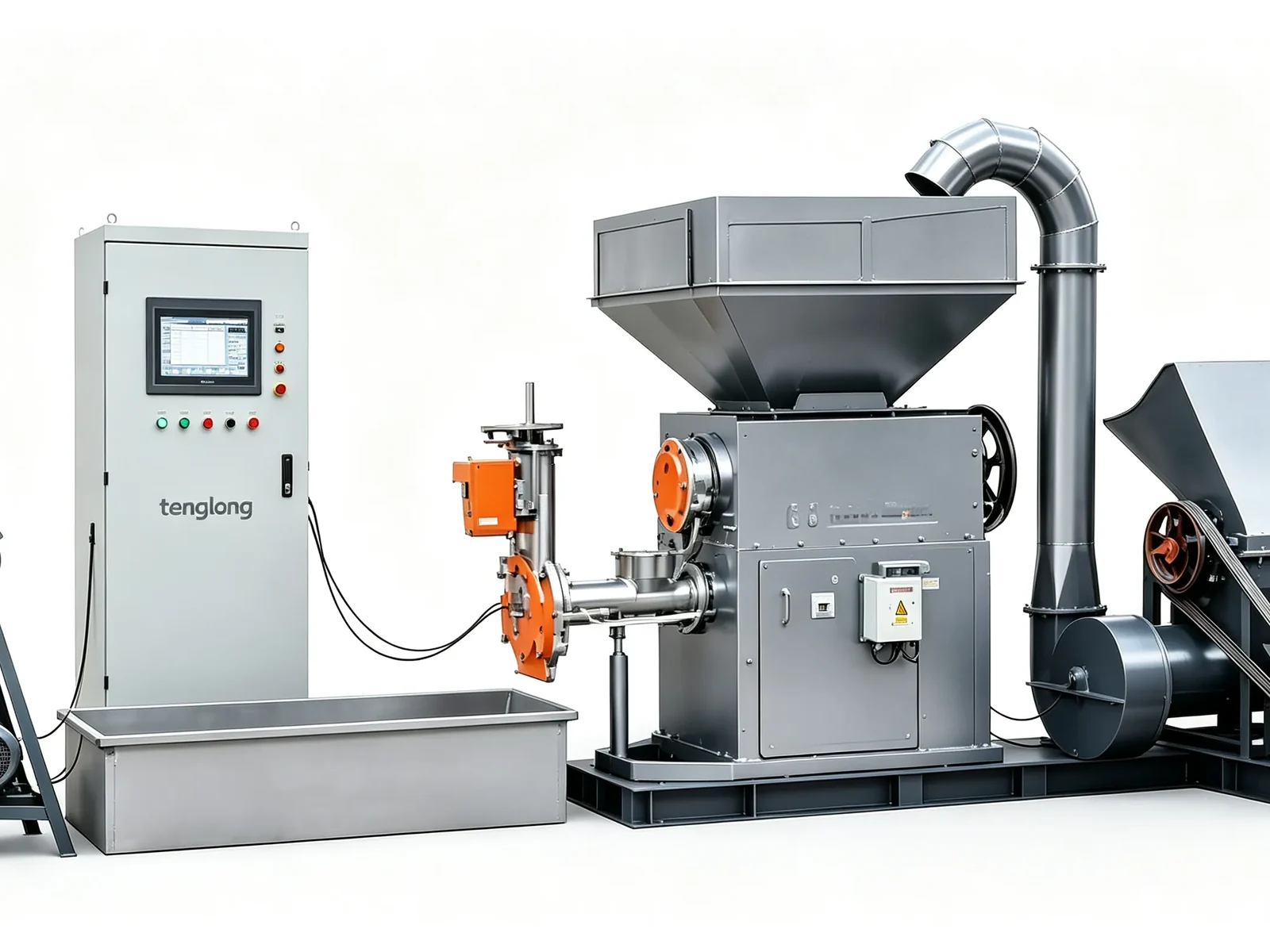
Acceptance Is a Protocol, Not a Handshake
A PET pelletizing line is not accepted because it ran on the seller’s material. It is accepted when it runs on yours, for the agreed number of hours, at the agreed output, and when the result is written down and signed by both sides. Installation runs 7–10 days on site for a line, including commissioning, two days of operator training and a signed handover report, and that report is the document that ends the argument later.
Before that, there is a factory test. The published arrangement is a free test on 10–20 kg of the buyer’s material, with video, measured output, specific energy and pellet photos sent before the balance is paid, and should that run fall more than 5% short of the agreed output the deposit becomes refundable. That combination puts the risk where it belongs, on the party that built the machine.
Both documents answer the same question in different forms: does this machine do on my material what the supplier said it would do. The handover report answers it with readings and signatures from your site. The factory test answers it earlier, on your material, with the money still in the seller’s hands. A buyer who skips the first and relies on the second has given away the cheapest test on the market.
What the Test Has to Show

The output figure is defined, which removes most of the room for interpretation. Output is finished bagged pellets, averaged over four hours, so the number on the report is neither a melt rate nor a peak. Specific energy should appear in the same report, inside the published band of 0.26–0.50 kWh/kg. Pellet photos matter more than they look like they do, because colour and surface tell you about the melt before any laboratory result comes back.
For a PET line the pellet sample itself is the evidence that matters. The line holds IV loss below 0.03 dl/g at 500–2,000 kg/h, and that claim only means something if it was measured on your flake. Ask for the intrinsic viscosity of the test pellets, not just for a photograph of them. Bottle-grade rPET is specified at 0.80–0.84 dl/g, and a photograph cannot show you whether the sample came in at the top of that band or the bottom.
Other numbers from the same report describe whether the machine was behaving. Fines of 0.5% is normal and 2% is a maintenance signal, so a rising fines figure in the acceptance run is a note about condition rather than about quality. Pellet size is 3 mm by default for injection and blow moulding with ±0.15 mm underwater cutting, and moisture is checked against the below 50 ppm drying target and the -0.08 to -0.1 MPa vacuum specification.
The Paperwork Around the Machine
The warranty runs 18 months from commissioning or 24 months from shipment, whichever comes first, and the difference between those two starting points is a contractual detail worth settling before the handover rather than afterwards. Wear parts are stocked for three years. The machines are CE marked and the company works to ISO 9001:2015, which matters for a buyer whose own customers audit their suppliers.
Payment terms are 30% T/T deposit with 70% before shipment, and L/C at sight above US$50,000. Lead time is 45–60 days for a custom line or washing plant and 25–35 days for a standard line, so the delivery date on the order is not the date the machine arrives. Sea freight to Europe adds 30–40 days and to Southeast Asia 7–12 days. Put the two together and the commissioning date has to be planned backwards from it.
After commissioning the documentation is what protects you: the signed handover report, the recorded test readings, the spare parts list with one spare screw, one die plate and two screen packs, and the operator training that came with the line. The quality control record that comes out of the first month is worth more than the discount you did not get, and it is the document a customer’s auditor will actually ask to see.
What the First Weeks of Production Expose
The most common first-week fault on a PET line is the vent. Vacuum degassing at -0.08 to -0.1 MPa is what pulls volatiles out of the melt, and fine PET dust blocks those ports if it is not removed after washing. A vent pressure that drifts is a dust problem, and the fix belongs in the filtration and the wash rather than in the vacuum settings, which is why the acceptance readings should include the vacuum figure.
The second fault is chemical. A flake pH below 8.0 keeps residual caustic from foaming the melt and yellowing the pellet, and residual caustic means the wash line has drifted, usually because the hot wash is running at the wrong caustic concentration or the neutralising rinse is short. The symptom is yellow pellets with bubbles in them and foam in the die, and it is expensive to diagnose because it presents as a melt problem.
The third fault is routine rather than dramatic: screens, blades and startup. 25–40 minutes from cold, 10 minutes from a 120 °C standby, a 20-minute screen change every 3–4 hours and an 8-hourly blade check. If the plant’s schedule does not allow for those, the plant will absorb them in another way, usually in rising fines and in the promised unplanned stops under 2% becoming a regular event.
Proving It and Seeing It For Yourself
The test hall is the practical part of all this. It is described as having material storage, water and a 500 kVA supply, with three simultaneous material runs, so several suppliers can be run on your material in the same week rather than one at a time over a quarter. A free test on 10–20 kg of the buyer’s material with video, measured output, specific energy and pellet photos is a small ask compared with the size of the decision it informs.
The visit is shorter than most buyers expect. The factory in Linyi is 2.5 hours by high-speed train from Jinan and 1.5 hours by air from Shanghai, and a typical visit takes half a day. Half a day in the workshop and half a day in the test hall answers more questions than a fortnight of email, and it lets you ask for a test run on your own material. The FAQ page covers the recurring questions, but a supplier who answers them again, in the room, with a running line behind, tells you something.
A line like this is bought once and run for years, and acceptance is the only moment where a supplier’s claims and your material meet. That is worth arranging properly, with a written protocol, agreed readings and a signature at the end of it. If the machine disappoints in month four, it will not be because the acceptance was careless. It will be because nobody agreed what to measure. Reading how the wider plastic recycling equipment picture fits together helps, since the pelletizer is one module of a plastic recycling machine.
Acceptance readings and what each one tells you
A handover test is only worth writing down if the numbers are written down first. The table is the acceptance sheet we work through with the buyer.
| Reading | Published target | What it tells you |
|---|---|---|
| Output | Finished bagged pellets, averaged over four hours | Whether the rate is real or a peak |
| Specific energy | 0.26–0.50 kWh/kg | Whether the machine is loaded properly |
| IV loss | Below 0.03 dl/g at 500–2,000 kg/h | Whether the grade survived processing |
| Fines | 0.5% normal, 2% a maintenance signal | Condition of the cutter and the screen |
| Pellet size | 3 mm default, ±0.15 mm underwater cutting | Whether the cutter is set and sharp |
| Moisture | Below 50 ppm after crystallization | Whether the dryer is doing its job |
| Vacuum pressure | -0.08 to -0.1 MPa | Whether the vents are clear |
Frequently asked questions
Q1: What does a PET line acceptance test include?
A free test on 10–20 kg of your material with video, measured output, specific energy and pellet photos, then 7–10 days on site including commissioning, two days of operator training and a signed handover report.
Q2: What happens if the test misses the agreed output?
A run that lands more than 5% short of the agreed output makes the deposit refundable. The payment structure behind it is 30% T/T deposit with 70% before shipment, and L/C at sight above US$50,000.
Q3: Which faults appear in the first weeks of running?
Blocked vacuum ports from fine PET dust, residual caustic pushing the flake pH above 8.0 and foaming the melt, and the ordinary wear of screens and blades. All three are visible in the daily readings if the routine is in place.
Q4: Can I watch the machine run before I pay the balance?
Yes. The test hall has material storage, water and a 500 kVA supply with three simultaneous material runs, and a visit to Linyi takes half a day, with the city 2.5 hours from Jinan by high-speed train.
Also worth reading: plastic recycling machine.
Three more notes from the same test floor: PET Pelletizing Line: What the Line Actually Contains, PET Pelletizing Line and rPET Intrinsic Viscosity, Sizing a PET Pelletizing Line Without Over-buying and PET Pelletizing Line Cost: Capital and Running Cost.
About the author
Zhou Gong (周工) commissions recycling machinery at TENGLONG Plastic Machinery in Linyi, Shandong, a factory of 18,000 m² and 30-plus staff that has delivered 820-plus lines across 46 export markets. I insist the handover report is signed on the last day of the visit, because the lines I remember are the ones with a page of readings attached. The figures here come from test-floor readings and from published sources dated 2026, and the ones we could not verify have been left out.
The material form is the whole conversation: send it and you get a model, a price range and a test plan back within a working day. The run on 10-20 kg of your material is free, and if it comes up more than 5% short of the agreed output, the deposit is refundable.