Separation in a sink-float tank is buoyancy, and nothing more complicated than that. PET flake at about 1.38 g/cm³ sinks in water; PP and PE below 1.0 g/cm³ float and are skimmed off the surface. The published removal rate for the floating fraction is 95–99%, which is why the tank is the stage that decides whether a bottle-to-bottle grade is even reachable.
What the tank cannot do is separate PET from PVC, because both sink. PVC has to be removed by washing and by optical sorting, and for a food-grade line the requirement is PVC below 50 ppm with final purity above 99.5%. Tank design decides how well the stage works: aeration, residence time and skimming speed are what separate a tank that removes 99% of the floaters from one that removes 80%.
What the tank does and what it does not
- PET at about 1.38 g/cm³ sinks; PP and PE below 1.0 g/cm³ float and are skimmed.
- Published removal rate for the floating fraction is 95–99%.
- PVC sinks with PET, so the tank cannot remove it. Food grade needs PVC below 50 ppm, which means optical sorting.
- Published tank sizes: PTC500 up to 1,000 kg/h at US$18,000–25,000; PTC1500 up to 3,000 kg/h at US$45,000–65,000, FOB Shanghai, stainless 304.
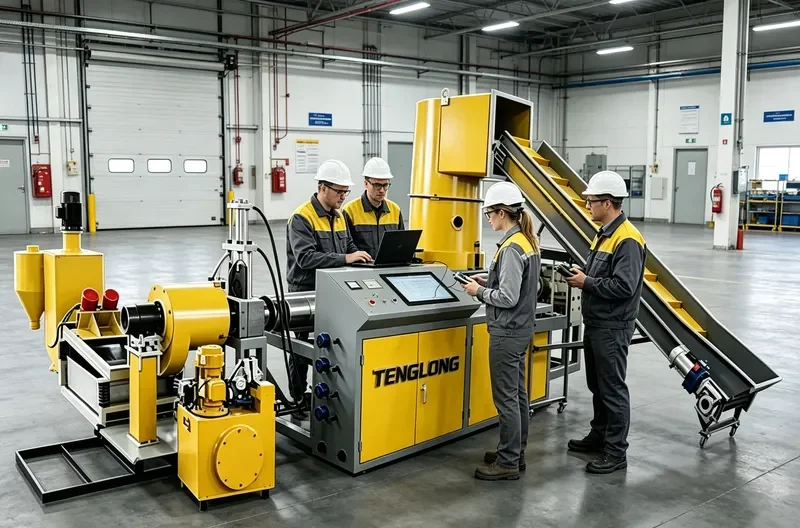
The physics, in one paragraph
PET has a density of about 1.38 g/cm³. Water is 1.0 g/cm³. Polypropylene and polyethylene sit below 1.0 g/cm³. That gap is the entire mechanism: in a tank of water, PET sinks and everything you do not want floats.
It is an unusually robust separation because it depends on a material property that does not change with dirt, colour, shape or how badly the bottle was crushed. A dirty PET bottle and a clean PET bottle sink exactly the same amount.
The tank is not a passive bath. Agitation keeps the flakes suspended long enough for density to act on them; a bottom screw conveyor collects the sinking PET; and surface skimmers remove the floating caps, rings and label fragments continuously rather than in batches. Published separation efficiency is 95–99% of the floating fraction.
What it removes, and what it cannot
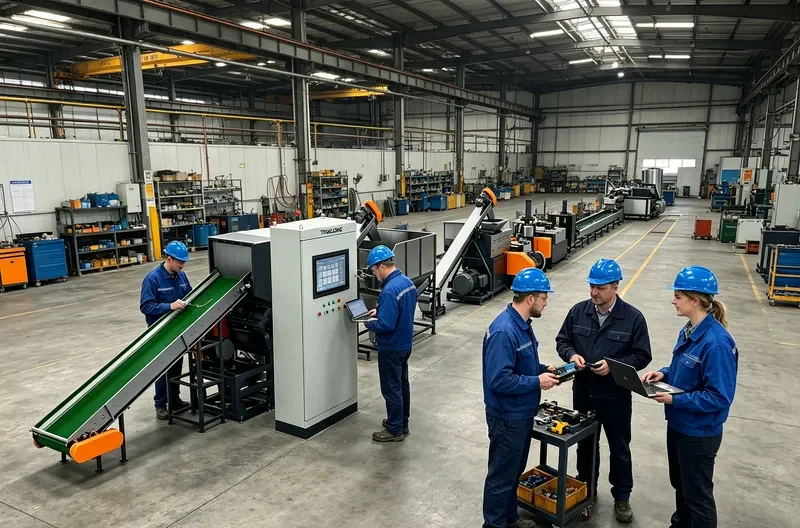
The value of the tank is concentrated in removing material that no other stage in the line can reach.
It removes PP and PE caps, rings and label fragments, and the bulk of the light plastic fraction. One tank does more contamination removal than three manual sorters, which is why it is a standard stage rather than an optional one.
What it cannot do is separate PVC from PET. PVC has a density of about 1.38 g/cm³ as well, so it sinks along with the PET. This is the limitation that shapes the whole line design: PVC removal has to happen earlier, at the label removal stage and at pre-sort, or afterwards with optical sorting. A tank that is expected to remove PVC is being asked to do something it cannot do.
Salt water flotation exists for the cases where floatation alone cannot separate materials of similar density — a published salt water series at 1,000–4,000 kg/h uses 316 stainless with automatic density control for engineering plastics, at US$35,000–50,000 FOB Shanghai for the 1,000 kg/h unit. That is a specialised answer to a specialised problem, and it is not what a standard PET line needs.
Why tank design decides whether it works
The chemistry of the separation is trivial; the hydraulics are where lines fail.
Adequate agitation keeps flakes suspended long enough for density to act. Counter-current flow carries floating caps and films toward the overflow and lets clean PET settle toward the discharge screw. A tank sized to the line throughput gives sufficient residence time even at peak feed rates.
A tank that is too small lets contaminated material short-circuit through and reach the flake outlet. This is the most common under-sizing error in the whole line, and it is invisible in a quotation because the tank still appears in the layout.
Geometry matters as much as volume. The published 304 stainless configurations run 6 m × 1.2 m × 1.5 m at 1,000 kg/h, 8 m × 1.5 m × 1.8 m at 2,000 kg/h and 10 m × 2 m × 2 m at 3,000 kg/h, each with adjustable agitation, a high-capacity skimming system and a bottom auger conveyor. At the larger sizes a dual agitation system and multiple skimmers are used, because a single skimmer cannot keep up with the floating load.
Multi-stage, and what each additional tank buys
Many PET lines use more than one float tank, and it is worth knowing why rather than assuming it is upselling.
The first tank after the crusher handles the heavy floating load: caps, rings, large label pieces. By the time the material has been through the hot washer and the friction washer, the remaining floating fraction is much finer and lighter, and the second tank catches it.
The published reference for a complete line runs a first float tank immediately after crushing, then a hot washing tank, then a high-speed friction washer, then a third and fourth float tank, with a horizontal dewatering machine and a hot air drying system behind them.
The practical benefit of the later tanks is that they catch micro-sized floating fragments that the first one missed, which is exactly the fraction that pushes flake purity from 98–99% to the 99.5%+ that food-grade buyers require.
Float tank sizes and published prices, FOB Shanghai
Published tank sizes and prices, with the payback the suppliers themselves quote.
| Model | Capacity | Tank size | Price | Published payback |
|---|---|---|---|---|
| PTC500 | Up to 1,000 kg/h | 6 × 1.2 × 1.5 m, SS304 | US$18,000–25,000 | 6–9 months |
| PTC1000 | Up to 2,000 kg/h | 8 × 1.5 × 1.8 m, SS304 | US$28,000–40,000 | 5–7 months |
| PTC1500 | Up to 3,000 kg/h | 10 × 2 × 2 m, SS304 | US$45,000–65,000 | 4–6 months |
Frequently asked questions
Q1: How does a sink-float tank separate PET from plastic caps?
By density. PET is about 1.38 g/cm³ and sinks in water; PP and PE are below 1.0 g/cm³ and float, where surface skimmers remove them. Agitation keeps flakes suspended long enough for the density difference to act, and a bottom screw collects the sinking PET.
Q2: Can a sink-float tank remove PVC from PET flake?
No. PVC has a density of about 1.38 g/cm³, very close to PET, so it sinks with it. PVC has to be removed earlier at the label removal and pre-sort stages, or afterwards with optical sorting. Any specification claiming the tank removes PVC is describing something that does not work.
Q3: How many float tanks does a PET washing line need?
One after crushing handles the heavy floating load; a second and third after hot washing and friction washing catch the finer fraction, and that is what moves purity from 98–99% to the 99.5%+ that food-grade buyers require. Each additional tank adds capital and floor space, so it is worth specifying against a measured contamination level.
Q4: Does the tank need stainless steel?
For food-grade output, yes. The published 304 stainless configurations run US$18,000–65,000 FOB Shanghai. One industry comparison puts the upgrade of flake contact parts to 304 stainless at about US$16,000 on a standard 500 kg/h configuration, which for a food-grade line is the difference between selling to fibre producers and selling to bottle converters.
Further reading on this site: plastic granules production line, granulator by material and the 12-platform comparison.
The rest of this series covers the same equipment from different angles: PET Washing Line: What Each Stage Removes and Costs, Hot Washing Machine for PET: Temperature and Caustic, How to Choose a PET Washing Line for Your Material and PET Washing Line Maintenance: Five Costly Failure Modes.
About the author
Zhou Gong (周工) builds recycling lines at TENGLONG Plastic Machinery, a factory in Linyi, Shandong, with 18,000 m² of floor area, 30-plus staff and 820-plus lines delivered to 46 export markets. The tank is the stage where feed consistency matters most. A batch that arrives with the caps in a different place in the bale behaves like a different material, and the tank cannot correct for it. The numbers in this article come from test runs and from dated published sources, not from a sales sheet.
If you want a recommendation rather than a catalogue, send the material form, the contamination level and the target output. We return a model and a price range within one working day, and the test run on 10–20 kg of your own material is free before the balance is paid.