The failure that stops a washing line fastest is almost never the crusher or the tank. It is blocked nozzles in the rinse header, because scale and suspended solids close the jets, the rinse stops being uniform, and clean flake and dirty flake come out of the same tank together. From that point the line is producing an inconsistent flake and the buyer notices before the plant does.
The second-most expensive failure is the quiet one: a hot wash tank drifting away from its setpoint because of scale on the heating surfaces. It does not stop the line, it just quietly raises the glue residue in the flake until a customer complains, and by then the cause is a month old.
The five failures and their prevention
- Blocked nozzles: treat the water, screen the rinse header, check the jets daily.
- Worn crusher blades: inspect regularly and keep D2 and D3 blades ready; grit is what wets and dulls them.
- Temperature drift: clean the tank and check the heaters, because scale insulates.
- Caustic drift: measure the concentration daily; consumption tracks contamination.

The failure that stops a line fastest
A blocked nozzle in a hot wash or rinse tank will stop a PET line faster than anything else on it, and it is the failure that is easiest to prevent.
The mechanism is straightforward. The wash water carries dissolved and suspended material — label fragments, glue residue, fine plastic — and that material carries calcium from the process water. It precipitates on the nozzle and inside the tank, the flow distribution becomes uneven, the tank stops washing evenly, and the result is uneven flake with glue residues in some places and clean flake in others.
Prevention is a combination of water treatment, a rinse screen and a cleaning routine. The inspection is simple: look at the nozzles and the tank walls. If the water is leaving the nozzles in visible jets rather than as a sheet, they are partly blocked, and the line is already running unevenly.
Blade wear in the wet crusher
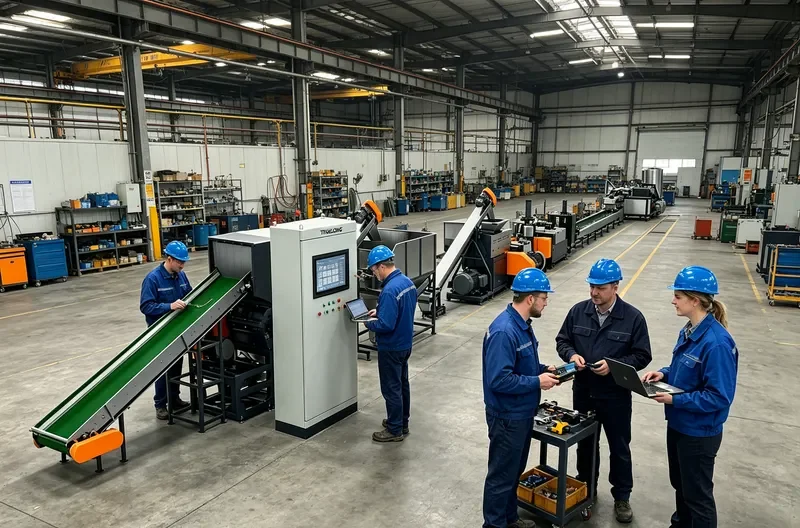
The wet crusher is the machine that does the most work per hour in the line and the one most often neglected, because it runs wet and because it is away from the operator’s eye line.
Wet crushing suppresses dust and cools the material, which is why it is used, but it also means sand and grit from the pre-wash are being taken straight onto the blades. A wet crusher with D2 or D3 wear-resistant blades on a hydraulic quick-opening frame is the standard configuration, and it is designed to be opened quickly so the blades can be checked without a long shutdown.
The symptom to watch is flake size consistency. When the blade clearance grows, the flake gets larger and more variable, and a poorly set screen then forces every downstream stage to work harder. Screen size and flake size are chosen together — a screen set too fine for the blades is what makes a whole line feel slow.
Temperature drift and water quality
Two failures are related and worth treating together.
Temperature drift in the hot wash usually comes from the heater, from scale, or from a change in throughput. Scale is the classic cause: as calcium precipitates on the tank walls and the heating surfaces, the heat transfer degrades and the heater has to work harder to hold temperature. A tank that cannot hold 90 °C is usually a scale problem before it is a heater problem.
Water quality drives both. The published design guidance for a closed-loop line is to recirculate about 90% of the water, which means the water is going round many times and everything dissolved in it concentrates. Without filtration and treatment, that loop eventually reaches a state where scale, foam and suspended solids all become problems at once.
Foaming is the visible symptom of the third failure. Persistent foam in a wash tank usually means excess surfactant or an organic load that is not being removed, and it carries material out of the tank in the foam rather than settling it where it can be filtered out.
The routine that prevents all of it
None of these failures is expensive to prevent, and all of them are expensive when they happen because they stop the line.
The routine has four parts. Daily: check the nozzles and the water jets; check the hot wash temperature against the setpoint rather than the panel; look for foam; and check the caustic concentration. Weekly: inspect the crusher blades and the screen, and check the water treatment indicators. Monthly:</strong clean the tanks and check for scale, check the dewatering machine and the dryer, and review the reject quality. Quarterly: measure the actual output against the nameplate, review the flake quality data, and trend the consumption of caustic, water and electricity.
The quarterly review is the one that gets skipped and the one that matters most, because it is where a slowly drifting number becomes visible. A caustic concentration that drifts down 0.3% over a quarter will never trigger an alarm, and it will cost glue in every batch.
And the discipline underneath all of it: sample and monitor the output rather than waiting for a finished-flake complaint. Inline metal detection, periodic PVC checks and moisture probes catch a drifting separator or a tired blade before it ships bad material. The difference between a line that runs and a line that consistently ships specification flake is that discipline.
PET washing line failure modes and prevention
The five failures that cost the most, what each one looks like from the floor, and what prevents it.
| Failure | Symptom | Cause | Prevention |
|---|---|---|---|
| Blocked nozzles | Uneven jets, uneven flake cleanliness | Scale and suspended solids | Water treatment, rinse screen, daily check |
| Worn crusher blades | Larger, more variable flake | Abrasive grit in wet crushing | Regular blade inspection, D2/D3 blades |
| Temperature drift | Tank will not hold setpoint | Scale on heating surfaces | Tank cleaning, heater check |
| Poor water quality | Foaming, high suspended solids | Recirculation without adequate treatment | Filtration and treatment on the loop |
| Caustic drift | Slow rise in glue residue | Consumption not made up | Daily concentration check |
What buyers ask us before they order
Q1: What causes a PET washing line to stop most often?
Blocked nozzles in the wash or rinse tanks, and worn crusher blades. Both are wear-and-fouling problems rather than design problems, and both are preventable with a daily check and a weekly inspection. What they cause is worse than the stop itself: uneven flake cleanliness, which is discovered by the customer rather than by the plant.
Q2: How often should the wash tanks be cleaned?
Monthly for scale and deposits, with a daily visual check for blocked nozzles and foam. Scale on the heating surfaces is the common cause of a hot wash that will not hold temperature, and a tank that has scaled cannot be cleaned at temperature — it needs the line stopped.
Q3: Why does my hot wash tank lose temperature?
Usually scale, not the heater. Calcium precipitates on the tank walls and heating surfaces, degrading heat transfer, so the heater works harder and still cannot hold the setpoint. Check the water treatment before replacing the heater.
Q4: How do I know whether the line is actually meeting specification?
Sample and monitor continuously rather than waiting for a complaint. Inline metal detection, periodic PVC checks and moisture probes catch a drifting separator or a tired blade before the material ships. The quarterly review of output, flake quality and consumable consumption is where a slow drift becomes visible.
Also worth reading: quality and factory testing, plastic granules production line and FAQ on materials and output.
Three more notes from the same test floor: PET Washing Line: What Each Stage Removes and Costs, Sink-Float Separation Tank: How PET Is Separated, Hot Washing Machine for PET: Temperature and Caustic and How to Choose a PET Washing Line for Your Material.
About the author
Zhou Gong (周工) builds recycling lines at TENGLONG Plastic Machinery, a factory in Linyi, Shandong, with 18,000 m² of floor area, 30-plus staff and 820-plus lines delivered to 46 export markets. A blocked rinse header is the failure I look for first on any line that has started producing inconsistent flake, and it is also the cheapest one to prevent. The numbers in this article come from test runs and from dated published sources, not from a sales sheet.
If you want a recommendation rather than a catalogue, send the material form, the contamination level and the target output. We return a model and a price range within one working day, and the test run on 10–20 kg of your own material is free before the balance is paid.