A melt filter is a large-area filtration unit for dirty feed, and it contains six things that each do one job: a housing that holds the melt at pressure, a screen and mesh that do the separating, a support grid behind the screen, heating, a seal set, and a gauge that reports how the filter is loading.
The part people underrate is the grid. A fouled screen is far stiffer than a clean one, and the frame behind it carries that load, so a screen with no grid behind it bows into the chamber the moment the material starts packing.
Six parts, six jobs
- A melt filter is a large-area filtration unit for dirty feed, sitting between the extruder and the die head.
- The screen is the filter; mesh count decides what is caught and how fast the melt passes.
- The support grid carries the load of a fouled screen and stops it bowing into the chamber.
- Keep the differential pressure below twice its starting value, and watch the screen interval: 24–48 hours clean, 8–12 hours recycled.
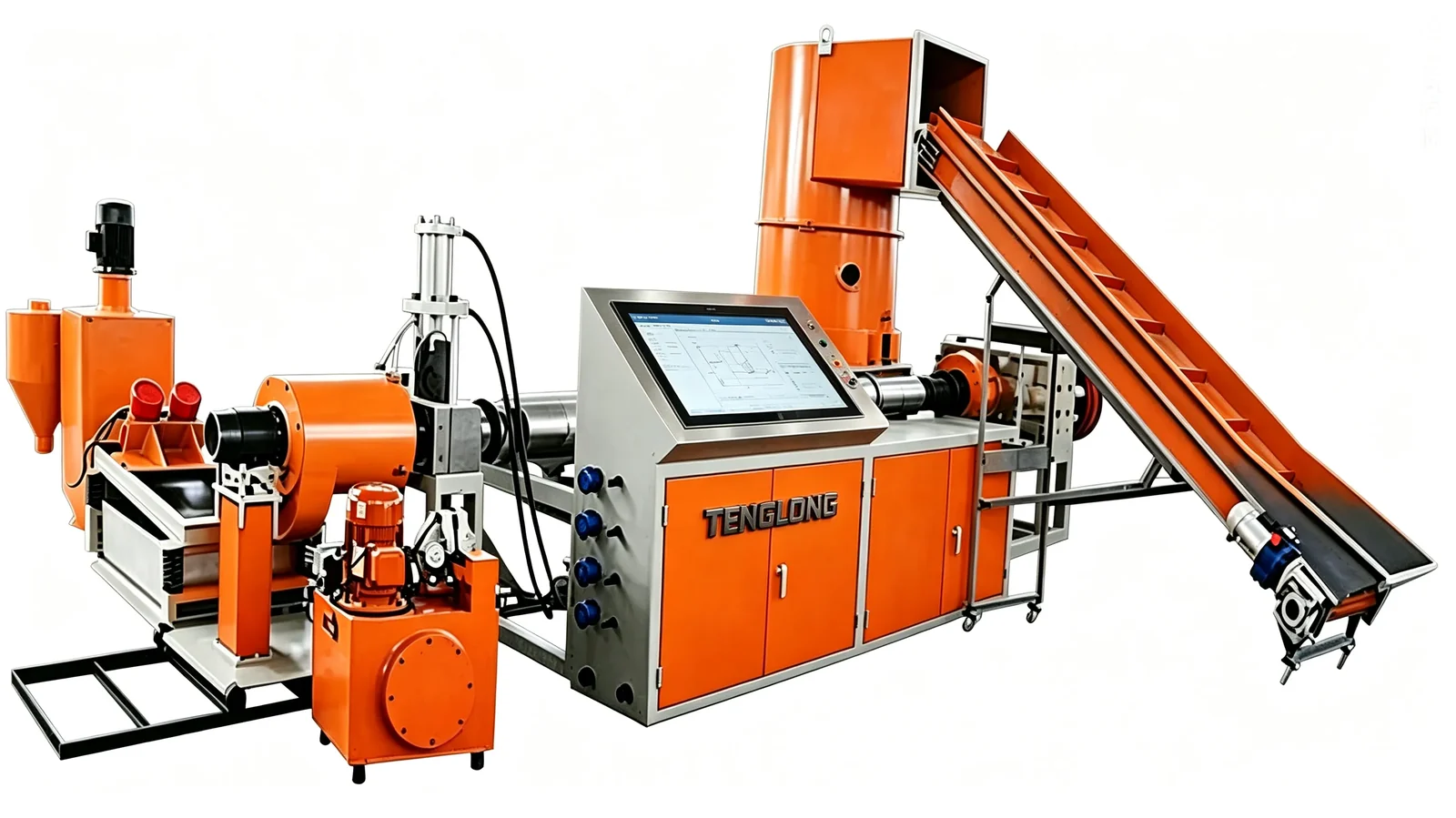
What a melt filter is, and where it sits
A melt filter is a large-area filtration unit for dirty feed. On a film granulating line 80 mesh is typical, and two-stage recycling lines use 60–100 mesh across two stages. It sits in the melt path between the extruder and the die head, and its whole job is to stop solid contamination reaching the die.
The die head is the plate at the end of the extruder that shapes the melt into strands or feeds a die-face cutting assembly, and hole diameter and land length set the pellet size. A blocked hole there is a rejected pellet and a stopped line, so the contamination has to be stopped earlier. Single screw equipment tolerates about 2% non-melting contamination at 60–80 mesh, while a two-stage line handles 5–8% at 100 mesh. Above 8%, washing is cheaper than filtering.
The terminology follows the equipment index on the site, where a melt filter sits with auxiliary equipment rather than among the granulator types. A screen changer is the device that moves a fresh screen into the melt path without stopping the machine; the melt filter is the filtration unit itself. The two are bought together and confused often enough that the glossary on the site is worth a glance before a quotation is read.
The chamber, and the path the melt takes through it
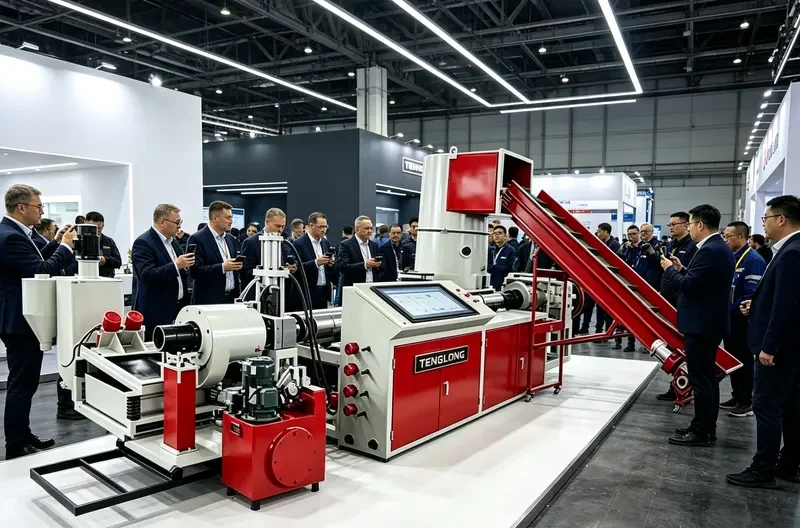
Inside, the housing is a pressure vessel with a defined route for the melt: an inlet from the extruder, a chamber where the melt is spread across the filter face, and an outlet on to the die. That spread matters more than most buyers expect. Melt arriving in one thick stream lands on a narrow band of the screen and leaves the rest of the filter area unused, which is why a well-made filter distributes flow across the whole face.
The housing has to survive the pressure the extruder develops, and the reference floor is 35 MPa for general extrusion and at least 50 MPa for high-viscosity and reinforced compounds. A housing bought to a lower rating is a pressure vessel working at the edge of its job, and the failures arrive as a weeping seal or a screen pack that bows out of shape.
The chamber is heated. Melt that cools inside it stops moving, and a layer of solidified polymer across the screen does the same work as a blocked screen, except that it will not clean off with a brush. That fault looks exactly like contamination, gets diagnosed as the wrong thing, and is one of the first things I look for during commissioning.
The screen pack, and what the mesh count describes
The screen is the filter. Mesh count is the number of openings per inch of woven wire, and the count sets both what is caught and how fast the melt gets through. 100–120 mesh is used for ordinary products, 150–200 mesh for high-requirement film, and recycled material can start with a 60 mesh coarse filter before refining.
Published continuous filter series name their screens with two numbers, for example 28×2 mm and 254×2 mm, and the flow band rises with the screen size rather than with the mesh count. Those names identify the element that does the separating, while the mesh carried on that element is specified separately, and the mesh is what decides the grade of the output.
Under the screen sits a support grid, and the screen is seated on a frame that carries the load once the filter starts to foul. A fouled screen is far stiffer than a clean one, and the frame takes that load. A screen bolted straight onto a flat plate with no grid behind it will not hold its shape once the material starts packing, and it bows into the chamber where it was meant to be sealing.
Seals, heaters and the instrument that tells the story
Sealing is what keeps the melt inside the chamber, and it is the part that decides whether the filter keeps running. The seals sit at the melt temperature of the process, so they age in the heat rather than wearing out in the cold, and they should be planned for as consumables on the same footing as the screen itself.
The heaters keep the chamber and the melt path at process temperature, and without them the melt starts to solidify where it is slowest moving. They are not decoration, and on a plant that runs more than one polymer, the separate heater zones are what allow one housing to serve more than one recipe.
The instrument that earns its place on the panel is the pressure gauge across the filter. Differential pressure tells you when the screen is loading, and the reference rule is to keep that differential below twice its starting value. A gauge that climbs steadily is a screen doing its job; a gauge that climbs fast and flat is a filter that is too small for the flow.
What a matched filter actually buys
On clean material the screen changes every 24 to 48 hours, and on recycled material every 8 to 12 hours. That interval is the most useful single number in the whole subject, because it tells you whether the filter is correctly matched and it tells the operator when the next change is due, instead of leaving it to judgement at the end of a shift.
It shows up in the product as well. 0.5% fines is normal and 2% is a maintenance signal, and contamination that passes the filter ends up inside the pellet rather than in the bin. Continuous filtration is reported to cut energy use by about 8–12%, which is the counter-argument to a filter that is too fine and is fighting the pressure all shift.
None of this is exotic. The unit is a housing, a screen, a support grid, a heater, a seal set and a gauge, and the engineering sits in matching those parts to the material in front of the machine. What is worth spending time on is the material itself: at the end of a shift I would rather look at the fouled screen than at the invoice.
What a melt filter contains and what each part is for
The table sets out what a melt filter contains and what each part is for. Every row names a part that has one job in the melt path.
| Part | What it does | What goes wrong without it |
|---|---|---|
| Melt chamber and housing | Holds the melt at pressure and routes it across the screen | Melt bypasses the screen, or the housing fails at pressure |
| Filter screen and mesh | Separates solid contamination out of the melt | Contamination reaches the die head and blocks the holes |
| Support grid and screen seat | Carries the load of a fouled screen | Screen bows into the chamber and the seal leaks |
| Sealing elements | Keep melt inside the chamber at process temperature | Melt tracks out of the housing and down the frame |
| Heater zones and pressure gauge | Hold temperature and report how the filter is loading | Melt solidifies in the chamber and fouling goes unseen |
Common questions, with short answers
Q1: What does a melt filter remove from the melt?
Solid, non-melting contamination: unmelted polymer, paper fibre, sand and metal fragments carried in with the feed. It does not remove moisture or volatiles, and it cannot rescue a polymer that simply has not melted yet.
Q2: Where does a melt filter sit in a pelletizing line?
Between the extruder and the die head, on the melt side of the machine, so that everything the melt carries is filtered before it reaches the die. The die head sets the pellet size from hole diameter and land length, so it is the last thing the melt should arrive at.
Q3: How much contamination can a granulator handle before the filter is overwhelmed?
A single screw tolerates about 2% non-melting contamination at 60–80 mesh, and a two-stage line handles 5–8% at 100 mesh. Above 8% contamination, washing is cheaper than filtering, and no mesh selection changes that arithmetic.
Q4: Is a melt filter the same thing as a screen changer?
No. The melt filter is the filtration unit that holds contamination back from the die. The screen changer is the mechanism that moves a fresh screen into the melt path without stopping the machine, and a melt filter normally uses one.
If you are working through the same machine family, these are the other Melt Filter Area and Mesh: The One Setting That Counts, Sizing a Melt Filter and What It Costs, Melt Filter Acceptance and First-Week Faults and Melt Filter Cost: Screen Changes, Scrap and Energy.
About the author
Zhou Gong (周工) is the recycling machinery engineer at TENGLONG Plastic Machinery in Linyi, Shandong — a plant of 18,000 m² with 30-plus staff, 12 platforms and 820-plus installations across 46 export markets. I open housings at the end of a shift, and the fouled screen tells me more about the material than any specification sheet does. Where a figure is quoted here it has been measured or published with a date attached; nothing in this article is an estimate.
The quickest way to a real answer is to send the feed form, the contamination level and the throughput you need. A model and a price range come back within one working day, the trial on 10-20 kg of your material is free, and a result that misses the agreed output by more than 5% leaves the deposit refundable.