A die head is the plate at the end of the extruder that shapes the melt into strands or feeds a die-face cutter, and hole diameter and land length set the pellet size. Underneath that description sit five parts, and each one makes exactly one decision about the strand.
The body carries the pressure, the manifold gives every hole the same melt, the land decides how fast the strand leaves, the plate carries the hole count and diameter, and the heater zones hold the face steady. Once those are separated, a die quotation becomes readable and a die complaint becomes diagnosable.
Five parts, five decisions
- The manifold decides whether every hole sees the same pressure and the same temperature.
- The land decides strand speed, melt strength and how much heat stays in the melt.
- The plate is specified by diameter, hole count and hole diameter, nothing else.
- The face should hold plus or minus 1 °C across its width under full load.
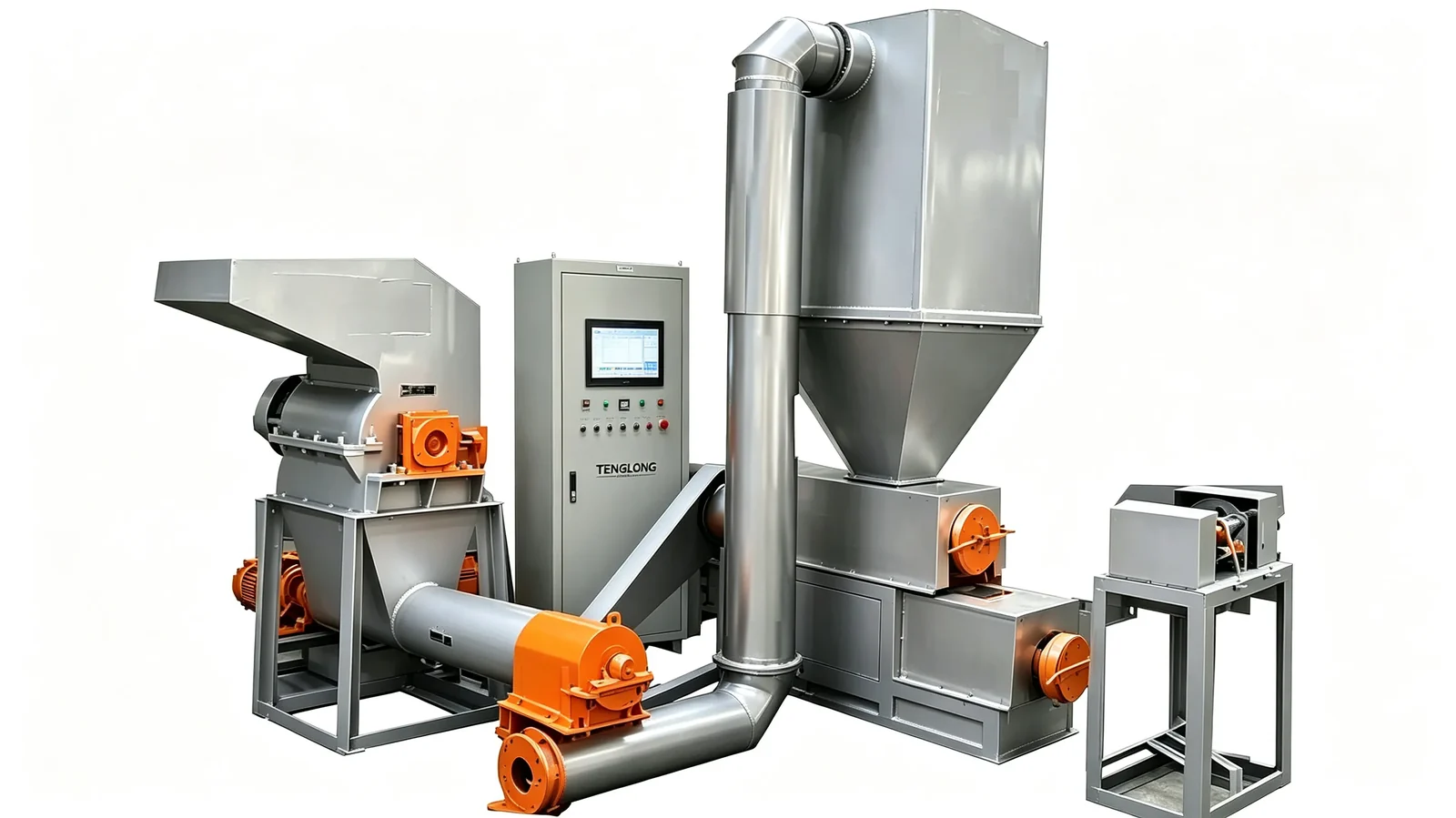
What the Die Head Actually Is
A die head is the plate at the end of the extruder that shapes the melt into strands or feeds a die-face cutter, and hole diameter and land length set the pellet size. That is the whole of it: take a melt that arrives as a thick, hot, fast-moving column and turn it into a set of uniform streams that a cutter can convert into pellets of a stated size. A strand pelletizing line takes those streams into a cooling trough; a water ring pelletizer cuts them at the die face.
The die head is not a filter and not a pump, although it gets blamed for both. It sits downstream of the melt filter, which is a large-area filtration unit for dirty feed; on film lines 80 mesh is typical, and two-stage recycling lines use 60–100 mesh across two stages. By the time the melt reaches the die it has been filtered and pressurised, and the die is where that pressure is finally given a shape.
A die plate is specified by its diameter, its hole count and its hole diameter, and the land length behind each hole decides how much the melt is slowed down before it is cut. Everything else on the head — the body, the manifold, the heaters, the thermocouples — exists to keep those three numbers honest. The strand goes on to a trough and a 12-blade cutter; the die-face arrangement cuts the melt where it leaves the holes.
The Manifold: Equal Melt at Every Hole

Every hole in a plate only sees the same melt if the body feeds it the same way, and that is the work of the coat-hanger or T-type manifold. Without one the melt arrives at the holes unevenly, and the cutter turns that unevenness into pellets of uneven size. The manifold is a set of channels inside the die body that spread the melt sideways before it reaches the hole pattern.
Without that spreading the melt takes the shortest path to the centre holes, so the outer holes are fed later and at a different temperature. The output does not always look wrong on the floor; it cuts differently, and the difference lands in the bag as a size spread. A die head is judged on the spread of its pellets, not on the look of a single strand.
The body around the manifold has to take the pressure as well. A twin screw extruder can develop 200–300 bar and some high-torque lines exceed 400 bar, so a die that is not rated for it bulges and loses dimensional accuracy. Manifold design and body rating are one decision rather than two, and they are quoted together.
The Land Behind Each Hole
The land is the length of straight bore between the entry to the hole and the exit, and it is the part of the die that buyers routinely forget to specify. More land means a stronger, more cylindrical strand, and also more heat held in the melt, which is what heat-sensitive grades object to.
Because the land slows the melt, pressure builds behind it and the strand leaves at a speed the cutter can handle. The published land length to diameter ratio is 8–12 for rPET and 4–8 for rLDPE and rLLDPE. Short lands pass more material at a lower pressure drop, so a high-rate die often carries short lands and a low-rate die carries long ones.
The wear pattern tells you which land you are looking at after a year of production. Melt carrying contamination polishes the entry of the land, and a die run on a filled compound wears it faster still. I have pulled plates with the entry rounded and the exit still sharp, and those plates were never what was holding the output down.
The Plate: Diameter, Hole Count, Aperture
A die plate is specified at 120–500 mm diameter, 10–100 holes and an aperture of 0.7–3.5 mm, with delivery 25 days after the deposit is received. That is the entire commercial content of a plate order, which is why a quotation that leaves those three figures out is not a quotation.
Hole count is set by flow. More holes at the same plate diameter means smaller holes at the same pressure drop, or a bigger plate for the same hole size. The plate diameter has to match the die body it bolts into, and the hole pattern has to sit where the manifold can feed every hole evenly.
A spare plate lets a plant switch hole configuration without replacing the die body, and it is quoted at roughly 20 to 30% of the die cost. For a plant that runs more than one grade, that plate is the cheapest insurance on the floor, and it is also the first thing a buyer should ask to see fitted to the machine.
Heat, Sensors and the Cutter Downstream
A basic die carries 2 heating zones, a high-precision film die 10 or more with independent PID control, and the die face should hold plus or minus 1 °C across the face under full operating load. That figure is a working tolerance rather than an aspiration: a face that varies more than that will not cut consistently from edge to edge.
The zones do two jobs. They keep the melt hot on its way through the land, and they stop the plate cooling where the melt is thin, which is usually out at the outer holes. Where the thermocouples sit decides what the control believes the die is doing, so sensor position is part of the specification and not a detail of the wiring.
Downstream of the die, the pellet cutter is the blade assembly after the die or water bath: 12-blade strand cutters, water ring die-face cutters or underwater cutters; blade condition sets dust level. The die hands over a strand or a slug, and the cutter decides whether that becomes a clean pellet or a dusty length of rod. The cutter and its cooling arrangement are auxiliary equipment, and the quality control of the finished pellet is a joint matter between die face and blade edge.
What each part of the die head decides
The table sets out what each part of the die head decides. Follow it from the extruder flange to the strand leaving the plate.
| Part | What it is | What it decides |
|---|---|---|
| Die body | The housing that carries the manifold, heaters and plate | Pressure rating and how the head bolts on |
| Manifold | Coat-hanger or T-type channel system inside the body | Equal pressure and temperature at every hole |
| Land | Straight bore behind each hole entry | Melt strength, strand shape and pressure drop |
| Die plate | Removable perforated plate, 120–500 mm diameter | Hole count, hole diameter and aperture |
| Heater zones | 2 zones basic, 10 or more on a high-precision die | Face temperature held to plus or minus 1 °C |
| Spare plate | Second plate carrying a different hole pattern | Grade changes without replacing the die body |
| Cutter | 12-blade strand, water ring die-face or underwater | Final pellet size and the dust level |
Questions buyers ask about this machine
Q1: What does a die head do on a pelletizing line?
It is the plate at the end of the extruder that shapes the melt into strands or feeds a die-face cutter. Hole diameter and the land length behind each hole set the pellet size, and the manifold keeps every hole running at the same pressure and temperature.
Q2: Why does a die head need a manifold?
A coat-hanger or T-type manifold gives every hole the same pressure and temperature. Without one the melt reaches the centre holes first and the outer holes later, so the strands differ and the cutter turns that difference into a size spread in the bag.
Q3: Can one die head make two different pellet sizes?
Yes, by changing the plate rather than the body. A spare die plate lets a plant change hole configuration without replacing the whole die, and it is quoted at roughly 20 to 30% of the die cost.
Q4: How long does a die plate take to arrive?
Published delivery is 25 days after the deposit is received, for a plate specified at 120–500 mm diameter, 10–100 holes and an aperture of 0.7–3.5 mm. A standard line takes 25–35 days in total, so the plate often sets the date.
If you are working through the same machine family, these are the other Die Head Hole Size and Land Length: What Sets the Pellet, Sizing a Die Head and What It Costs, Die Head Acceptance and First-Week Faults and Choose a Die Head by Starting With the Pellet You Need.
About the author
Zhou Gong (周工) is a machinery engineer at TENGLONG Plastic Machinery, a 30-plus staff factory in Linyi, Shandong with 18,000 m² of floor space, 12 machine platforms and 820-plus installed lines. I pull die plates apart whenever a strand complaint arrives, and the wear pattern at the land entry usually tells the story before the customer finishes describing the problem. Where a number appears in this article it was taken from a test run or from a source with a date on it, and a figure we could not check has been left out entirely.
Ask for a recommendation rather than a quotation and we will work from your material, your contamination level and your target output. A model and a price range follow within one working day, the test on 10-20 kg of your material is free, and a result more than 5% below the agreed output leaves the deposit refundable.