A mixing tank contains a vessel, an agitator on a central shaft, a drive, separate inlet ports and a discharge to the force feeder. Each one makes one decision, and the machine exists so the extruder sees a consistent bulk density and a consistent recipe instead of a feed blended by hand.
The part people underrate is where the tank sits. It belongs downstream of the dryer and upstream of the force feeder, because a vessel ahead of the dryer blends wet material and the dryer then dries it unevenly, and no amount of mixing afterwards recovers that loss.
Five parts, five decisions
- A mixing tank holds a vessel, agitator, drive, separate inlets and a discharge to the force feeder.
- It blends flake, powder and colour so the extruder sees one bulk density and one recipe.
- Washed PE film sits at 30-80 kg/m³ against 250-400 kg/m³ for rigid flake, so unmixed feed starves the screw.
- Put the tank downstream of the dryer and upstream of the force feeder, never ahead of the dryer.
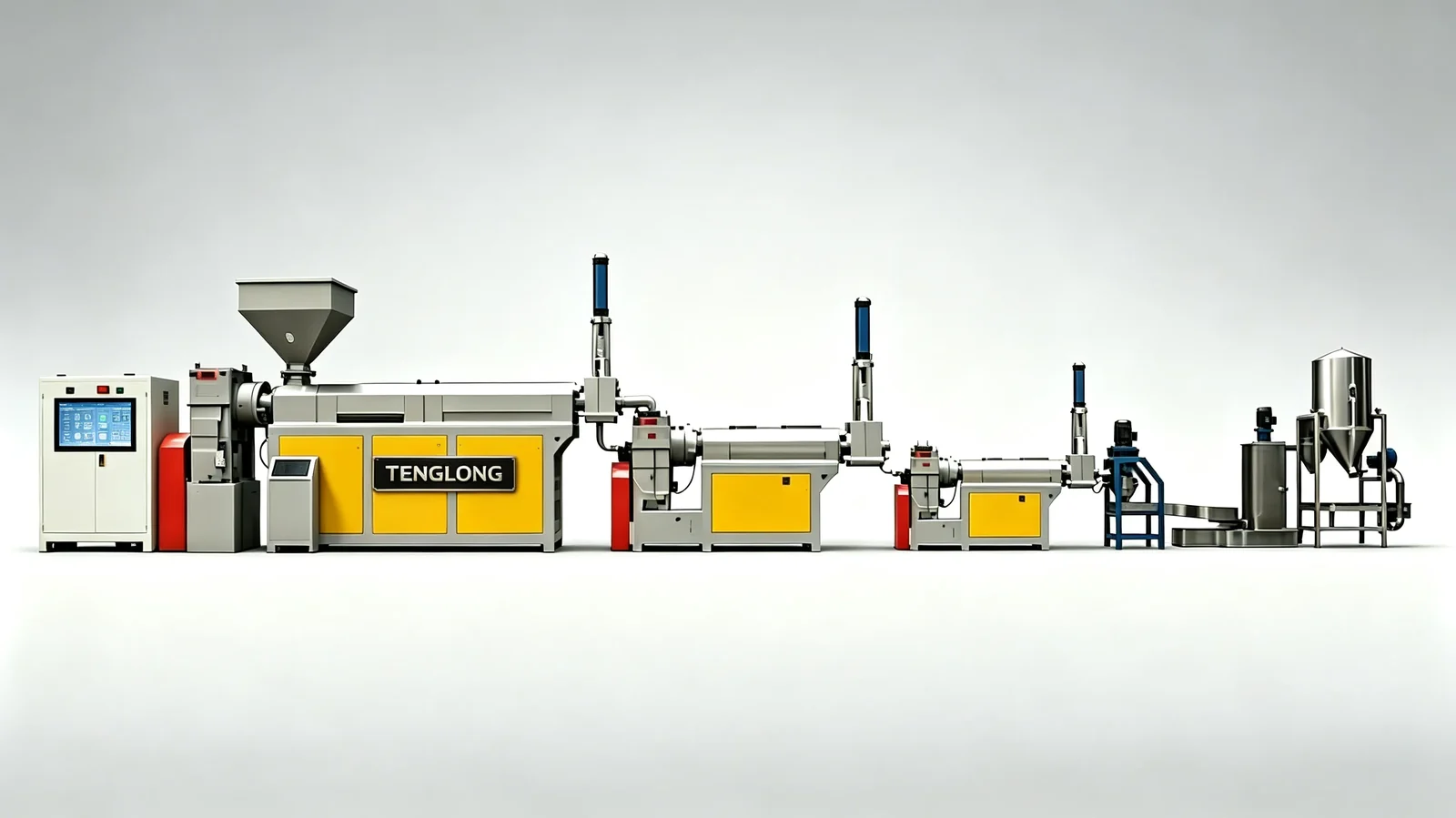
What a mixing tank is, and where it belongs in the line
A mixing tank is a vessel that blends flake, powder and colour so the extruder sees one consistent bulk density and one recipe. It removes the need to blend by hand at the hopper. On a recycling line the machine takes regrind and additives, masterbatch or liquid modifiers and makes them uniform before dosing. The result is a feed whose behaviour the screw can predict, shift after shift, whatever arrives at the inlet.
Position is part of the definition. The tank has to be downstream of the dryer and upstream of the force feeder, so the extruder receives one recipe at one bulk density. A tank placed before the dryer mixes wet material and dries it unevenly, and the unevenness survives every stage after it. On a standard washing line the drying system comes near the end of the sequence, just before storage, and the mixing step belongs immediately after it.
The naming is worth settling early, because buyers use one word for several machines. A plastic mixer or mixing tank homogenises flake, powder and colour so the extruder sees a consistent bulk density and recipe. The high speed versions are sold as batch mixers, while a machine that blends continuously on the way to the throat is usually called a gravimetric blender. Both sit among auxiliary equipment rather than among the granulator types, and the glossary on the site is worth reading before two quotations are compared.
The vessel, and what its volume decides
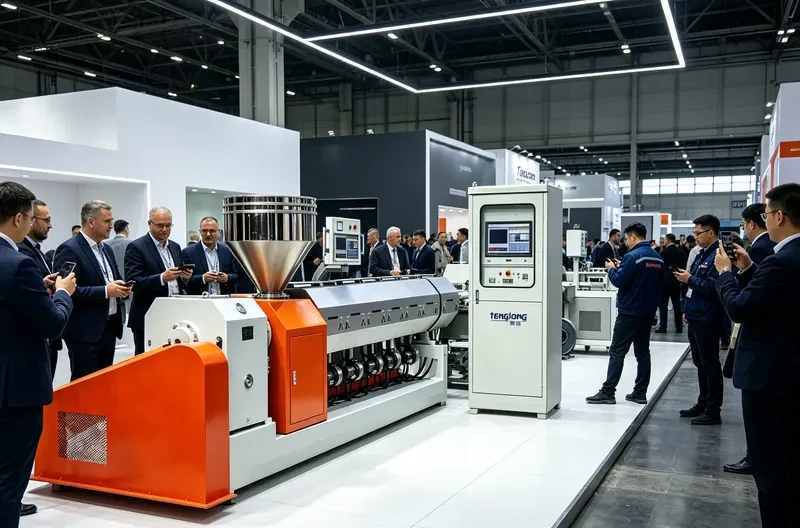
The vessel is the part people photograph and the part that decides least. High speed mixers are available from 5 litres to 2,000 litres, including hot and cold two stage designs for plants that prepare compounds in batches. The volume sets how much material is in the machine at any moment and therefore how long a flake spends under the agitator. Too small a vessel and the line waits; too large and the batch sits longer than the recipe needs.
Inside, the agitator is what actually mixes. A central shaft carries paddles or ribbons that lift material from the bottom and fold it back through the mass, and the pattern decides how quickly a handful of masterbatch disappears through a full vessel. The drive turns that shaft, and on a line running three phase power the standard supply is 380 V / 50 Hz. What the operator sees from outside is a motor; what the recipe sees is a number of turns.
The inlet side is where the recipe is written. Separate ports take the main flake, the powder or regrind, the colour and any liquid modifier, and each one is dosed before the agitator starts work. A gravimetric batch blender shows the arrangement clearly: four hoppers feed one vessel, with one screw rod per hopper, and the compressed air supply runs at 4-6 bar. The number of inlets is therefore a specification, not a detail left to the installer.
Density, and the reason unmixed feed starves the screw
Density is the reason this machine exists. Film flake and rigid flake do not mix by density: washed PE film sits at 30-80 kg/m³ while rigid flake sits at 250-400 kg/m³. Feed the two in turns and the screw sees a bulk density that changes every few minutes. A volumetric device delivers a steady volume, so a drop in density becomes a drop in mass at the throat, and the output follows the hopper rather than the setting.
Moisture moves with density, and it is the other half of the same problem. Washed film enters a line at 50-70% moisture against 30-40% for rigid flake, so a blend of the two arrives at the dryer with a water content nobody has specified. The tank has to sit downstream of the dryer for exactly this reason: a tank placed ahead of it blends wet material, and the dryer then pulls water out of the two ingredients at different rates. No mixing afterwards undoes that.
The consequence is a screw that starves on paper and floods in practice. Unmixed feed starves the screw because the force feeder is built for one bulk density, and a vessel that delivers two in alternation makes the feeder guess. An auto loader can keep the hopper full, but it cannot correct what is in the hopper; it only refills it from the bag or silo at a constant level. Homogeneity upstream is cheaper than compensation downstream.
The discharge, and how the blend is handed to the feeder
The discharge is where the tank hands its work to the next machine. The forced-feed unit that pushes low-density flake into the extruder throat is a screw feeder, and it is the standard answer to a screw that starves. It works by torque rather than by speed: it has to stall when the material is too dense and push when it is too light. The tank’s job is to make that job boring by delivering one material all the time.
Accuracy decides whether the tank can hold the recipe. The price gap is plain: US$2,000-8,000 for a volumetric feeder at typically plus or minus 1 to 2%, against US$8,000-25,000 for a gravimetric one at typically plus or minus 0.25 to 0.5% that compensates for density changes on its own. The difference is not academic when washed film and rigid flake are sharing the same vessel, because the volumetric figure assumes a density that the blend does not have.
Seen in context, the tank is a short step in a long sequence. The standard sequence on a PP PE washing line runs input belt conveyor, metal detector, shredder, L-type belt conveyor, magnetic separation belt, pre-washer, crusher, screw loader, friction washer, floating separation tank, friction washer, drying system, storage silo and electrical control cabinet, and the mixing step fits between the drying system and whatever feeds the extruder. That is the place to draw it, not at the hopper.
What uniform feed is worth
A uniform blend is worth more than the machine costs, and the value shows up in specific energy. The published specific energy band is 0.26–0.50 kWh/kg, and a feed whose bulk density holds steady keeps a line near the better end of it. Published output is finished bagged pellets averaged over four hours, and a tank that removes the hourly swings helps the line reach that average rather than merely quote it.
Product quality follows the same argument. 0.5% fines is normal and 2% is a maintenance signal, and a blend that varies in density produces fines at one end of the cycle and starved pellets at the other. The machine itself is ordinary in construction and the engineering sits in the match. Plants that care about the match specify a vessel whose build carries CE marked, ISO 9001:2015 certification, because the document disciplines the supplier.
At a trial I take a handful from the discharge every few minutes, and a blend that changes colour between handfuls is not ready for the extruder. The feeder will otherwise spend its life correcting a mistake the vessel should never have made. The mixer is the quietest machine on the line, and it is the one whose mistakes the screw reports for the rest of the shift. By the second week the operator should stop thinking about the tank altogether.
What a mixing tank contains and what each part decides
The table sets out what a mixing tank contains and what each part decides. It separates the vessel from the decision the vessel is there to make.
| Part | What it does | What goes wrong without it |
|---|---|---|
| Vessel and batch volume | Holds the batch and sets how long material is mixed | Batch too small to cover the recipe, or material sitting too long |
| Agitator and central shaft | Lifts and folds flake, powder and colour together | Masterbatch streaks survive into the finished pellet |
| Drive and supply | Turns the shaft at a steady rate on three phase power | Uneven mixing when the shaft slows under a full load |
| Separate inlet ports | Dose flake, powder, colour and liquid modifier | Recipe added by hand and repeated by guesswork |
| Discharge to the feeder | Hands one bulk density to the force feeder | Screw fed on alternating densities and starved |
What buyers ask us before they order
Q1: What does a mixing tank actually do?
It homogenises flake, powder and colour so the extruder sees a consistent bulk density and recipe. It blends regrind with additives, masterbatch or liquid modifiers before dosing, and it removes the need to blend by hand at the hopper.
Q2: Where does the mixing tank sit in the line?
Downstream of the dryer and upstream of the force feeder, so the extruder receives one recipe at one bulk density. A tank ahead of the dryer blends wet material and the dryer then dries it unevenly.
Q3: Why does bulk density matter so much in a blend?
Washed PE film sits at 30-80 kg/m³ against 250-400 kg/m³ for rigid flake. Unmixed feed starves the screw, because a volumetric device holds volume rather than mass and a drop in density becomes a drop in output at the throat.
Q4: Is a mixing tank the same as a gravimetric blender?
Not exactly. The high speed versions are sold as batch mixing tanks, while a machine that blends continuously on the way to the throat is usually called a gravimetric blender. Both belong among auxiliary equipment rather than granulator types.
If you are working through the same machine family, these are the other Bulk Density: The Specification That Decides the Blend, Sizing a Mixing Tank and What It Costs, Mixing Tank Acceptance, Commissioning and First-Week Faults and Why Uniform Feed Decides Batch Accuracy in Pelletizing.
About the author
Zhou Gong (周工) signs off the test runs at TENGLONG Plastic Machinery, 18,000 m² of plant in Linyi, Shandong, with 30-plus staff and 820-plus lines delivered to 46 export markets. On the floor I keep a sample cup beside the discharge, because the handful leaving the tank tells me more than the drive setting. Every number in this piece is traceable: measured on our own machines, or published with the date it was checked.
Send us the material form and the target output and we will come back inside one working day with the machine that fits and what it costs. The free test on 10-20 kg of your own material comes before the balance is paid, and a measured output more than 5% below the agreed figure leaves the deposit refundable.