The screw conveys, compresses and melts the material; the barrel holds the melt against the pressure the screw generates and carries the heat into it. Between them they set the melt pressure, and melt pressure is what sets pellet diameter. Everything else on a pelletizing line is adjustable, these two parts are simply worn until they are replaced.
Wear shows up before anything breaks. Fines rise from a normal 0.5% towards the 2% maintenance signal, melt pressure wanders, and strand diameter spreads beyond the published cutting tolerance. A worn screw also changes the compression ratio in the metering section, so the line quietly loses output long before the pellets look wrong.
What the wear pair actually controls
- Melt pressure is set by the screw and barrel together, and pellet diameter follows it.
- The metering section controls output, so wear there shows up as falling output.
- Fines above 0.5% and drifting melt pressure are the first visible signs of wear.
- This company began as a screw and barrel workshop, so the wear part is not an afterthought.
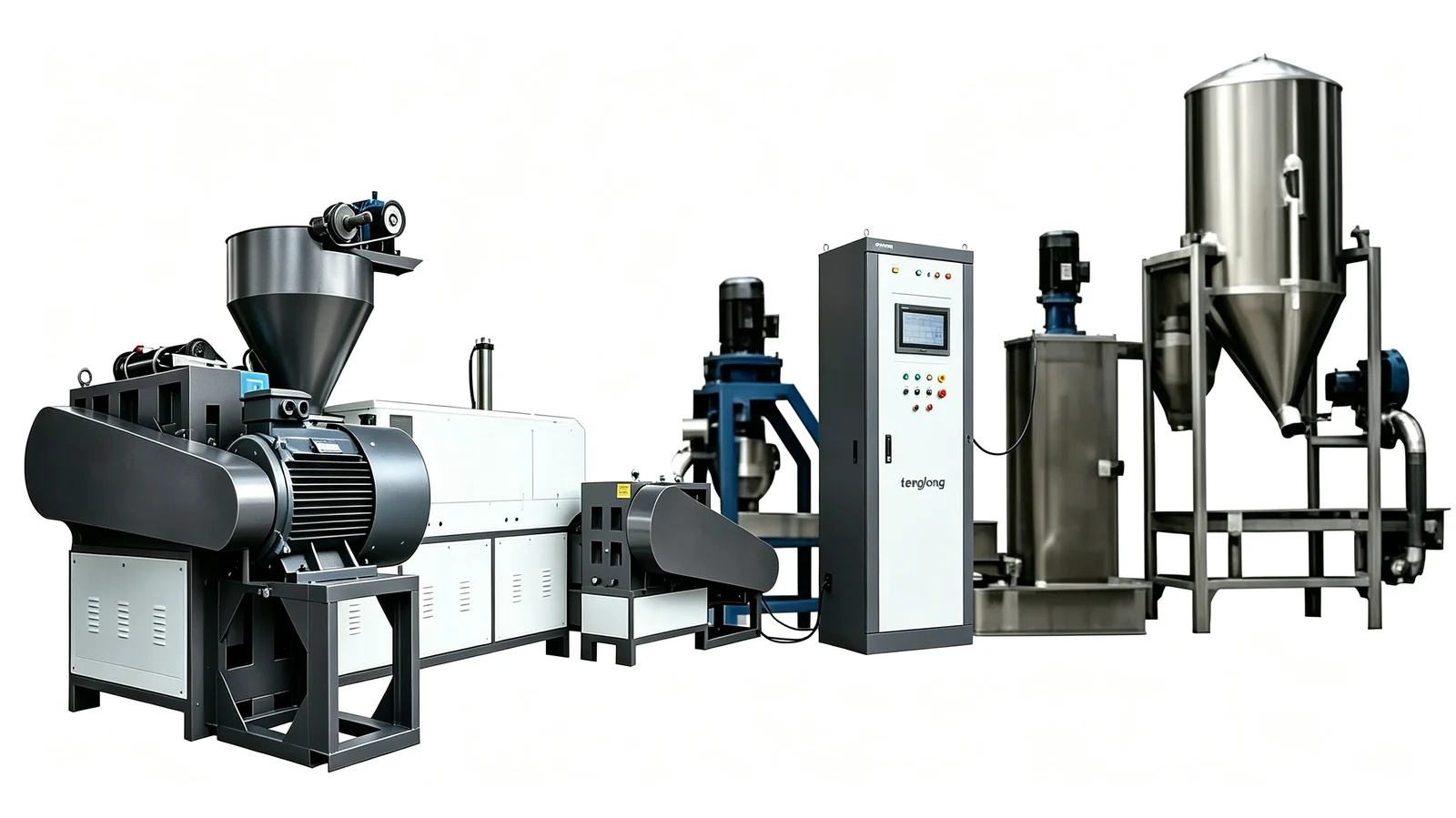
What the screw and barrel actually decide
The screw and the barrel are the two parts of an extruder that decide whether the melt stays steady from the feed throat to the die. The screw conveys, compresses and melts, and the barrel holds the melt against the pressure the screw generates while carrying heat into it. Everything upstream can be sloppy and everything downstream can be adjusted, but if melt pressure moves, pellet diameter moves with it.
Two published figures give the scale of what this pair controls. Specific energy across these lines runs 0.26-0.50 kWh/kg, and capacity across the range of platforms runs 100-3,000 kg/h. Both are quoted on finished bagged pellets averaged over four hours, which means a screw that is working hard for a week will look worse than a short test run suggests. The wear pair is where that energy goes.
TENGLONG Plastic Machinery began as a screw and barrel workshop serving local recycling plants in Linyi, so this is the part the company knows from the inside. Screws up to 4 m long and 220 mm in diameter are turned and milled in house, and barrels are cast bimetallic. That history shows up on a customer floor, because the wear part is the part that arrives late and stops the line.
The screw: feed, compression, metering

A screw is a shaft with a spiral flight cut into it, and the shape of that spiral is the design. Material enters at the feed section, where the channel is deep enough to swallow a light, low-density feed. It passes through the compression section, where the channel narrows and the material is sheared into a continuous melt. It leaves through the metering section, where the melt is pushed out at a steady rate.
What the flight does is push forward while resisting backward flow. A single screw builds pressure from the difference between the material going in and the material going out. Widen the metering section and pressure falls; narrow it and the screw stalls and shears harder than it should. That is why a screw and a barrel are sold as a set, and why a screw lifted out of another machine is rarely a drop-in replacement.
Length is written as L/D, the length of the screw divided by its diameter. The twin screw extruder line in this range is published at 40:1, which is a long screw in a modest bore. Length buys residence time, and residence time buys melting capacity and a stable pressure profile. It also buys shear, and shear is what turns a contaminated stream into a barrel that has to be pulled apart.
The barrel: bore, liner and heat
The barrel is the fixed half of the pair and it works on two fronts at once. Its bore holds the melt against the screw at a defined clearance, and its heating and cooling channels set the melt temperature along the length. A barrel that is out of round, or a liner worn below the screw’s flight, changes the compression ratio without any change to the screw at all.
The working surface is the part that wears, and the wear is what limits its life. Published service life for a barrel in high-filler PVC extrusion is 1-5 years, and that band is not a hedge, it is the honest width of the answer. Filler load, contamination, running hours and temperature all move the number, so the same barrel can sit at either end of the range depending on the mix.
Wear is never even. It concentrates where the melt is hottest and where filler is trapped, so the clearance between flight and bore opens first at the metering end. Behind the barrel the melt meets a screen pack that catches what the screw could not handle, and the die head then shapes the strands. On a masterbatch or film grade those downstream parts behave differently, but the wear pair upstream sets the conditions they work in.
How wear reaches the finished pellets
The first signal is fines. 0.5% fines is normal and 2% is a maintenance signal. Fines rise when the melt is sheared harder than it should be, which happens as the screw and barrel wear and the clearance opens, letting the screw slip more at lower pressure. The operator sees dust in the bag and usually blames the cutter, which is the more convenient suspect.
The second signal is contamination in the wrong place. A single screw tolerates about 2% non-melting contamination at 60-80 mesh, and a two stage line handles 5-8% at 100 mesh because the melt gets a second filtering and melting pass. Above 8% the published view is blunt, washing is cheaper than filtering. A worn screw will not solve that, and asking one to is how a screen pack ends up on the floor.
The third signal is in the pellet geometry itself. Strand cutting holds +/-0.2 mm and underwater cutting +/-0.15 mm, and those tolerances only hold if melt arrives at the die at a steady pressure and temperature. Once the flight and bore clearance has opened, melt pulsation comes through into strand diameter. You see oval pellets and a wider size spread, and no adjustment at the die will fix it. A water ring pelletizer cuts at the die face, so it inherits the same problem.
Where the wear pair sits in the line
The screw sits downstream of everything that decides how easy its job is. Washing sets the moisture and the label content. Crushing sets the particle size going in, with 25-30 mm the target after crushing for post-consumer material. A mixer homogenises bulk density and recipe so the feed does not arrive in slugs and starve the feed section. Each of those is a job on the auxiliary equipment list, and each makes the screw’s job easier or harder.
Downstream, the die head and the cutter decide pellet size. The die head is the plate at the end of the extruder that shapes the melt into strands or feeds a die-face cutter, and hole diameter and land length set the pellet size. Blade condition sets dust level. So the chain is fixed: feed preparation decides what the screw sees, the screw and barrel decide the melt, and the die and cutter decide the shape.
Which machine you run decides how much of that chain is your problem. A single screw granulator handles PP, PE and ABS regrind with a 90-150 mm nitrided screw. A twin screw extruder line runs at 40:1 L/D for filled and reinforced compounds. A two stage line is built for high-contamination waste at 60-100 mesh. Same wear pair, very different duty, and the duty decides when the screw comes out.
Screw and barrel terms, and what each one controls
A screw is a pump that also mixes, and a barrel is a pressure vessel that also heats. The table separates what each element of the pair is actually asked to do.
| Term | What it is | Why the buyer cares |
|---|---|---|
| Feed section | Deep channel that swallows the feed | Starves if bulk density is uneven |
| Compression section | Narrowing channel that melts the material | Wear here shows as unstable pressure |
| Metering section | Constant-volume channel at the end | Sets output and holds pressure |
| Flight and root | The spiral and the core it is cut into | Both wear, so the clearance opens |
| Barrel liner | The worn working surface inside the barrel | Life 1-5 years in high-filler PVC |
| Screen pack | Filtration at the end of the melt path | Change every 3-4 hours, 20 minutes |
Questions buyers ask about this machine
Q1: What does the extruder screw actually do in a plastic recycling line?
It conveys, melts and pressurises the material in sequence: a deep feed channel, a narrowing compression section and a constant-volume metering section at the die end. The pressure set in that metering section is what makes pellet diameter repeatable.
Q2: Why does a barrel wear faster in some applications than in others?
Filler is the abrasive. Published barrel service life in high-filler PVC extrusion is 1-5 years, and the width of that range is set by filler load, contamination, running hours and temperature rather than by any brand of steel.
Q3: Can a worn barrel be rebuilt instead of replaced?
Sometimes the liner can be renewed and the screw re-nitrided in house, since the company nitrides in its own plant. The deciding measurement is the wear depth against the 0.5-0.7 mm case, and that needs a gauge rather than an opinion.
Q4: How do I tell a wear problem from an upstream feed problem?
Check the melt condition and the screen pack before touching the screw. If the screen change interval has slipped past 3-4 hours, the filter is doing the screw’s job and the melt arrives inconsistent. Put the screen back on its interval first.
If you are working through the same machine family, these are the other Nitrided vs Bimetallic Extruder Screw: Which to Buy, Extruder Screw Diameter and Length: How to Match It, Screw and Barrel Cost: Replacement and Total Cost and Screw Inspection and Commissioning: A Working Routine.
About the author
Zhou Gong (周工) is a machinery engineer at TENGLONG Plastic Machinery, a 30-plus staff factory in Linyi, Shandong with 18,000 m² of floor space, 12 machine platforms and 820-plus installed lines. I keep a feeler gauge in my pocket when I walk a customer floor, because the gap between flight tip and barrel bore tells you more about a screw than any spec sheet. Where a number appears in this article it was taken from a test run or from a source with a date on it, and a figure we could not check has been left out entirely.
Ask for a recommendation rather than a quotation and we will work from your material, your contamination level and your target output. A model and a price range follow within one working day, the test on 10-20 kg of your material is free, and a result more than 5% below the agreed output leaves the deposit refundable.