A pellet storage silo is a buffer vessel between the pelletizer and the bagging station. It holds finished pellets so the pelletizer keeps running while bags are changed, and it is normally sold as auxiliary equipment rather than as a machine in its own right.
What makes the vessel interesting is that each part makes one decision: the shell sets the volume, the cone and outlet decide whether material leaves at all, the discharge system sets the rate, and the level instrumentation decides whether the plant knows what is inside. Get one of those wrong and the silo stops the line.
One part, one decision
- The silo buffers the pelletizer against the bagging station, not the other way round.
- A storage hopper is a different vessel: the small one above the feeder, usually with a crammer on film flake.
- Discharge decides the flow: gravity through a rotary valve, or aeration with a bin activator and a feeder.
- Grounding under 10 ohms and a conductive coating belong in the build, not in a later upgrade.
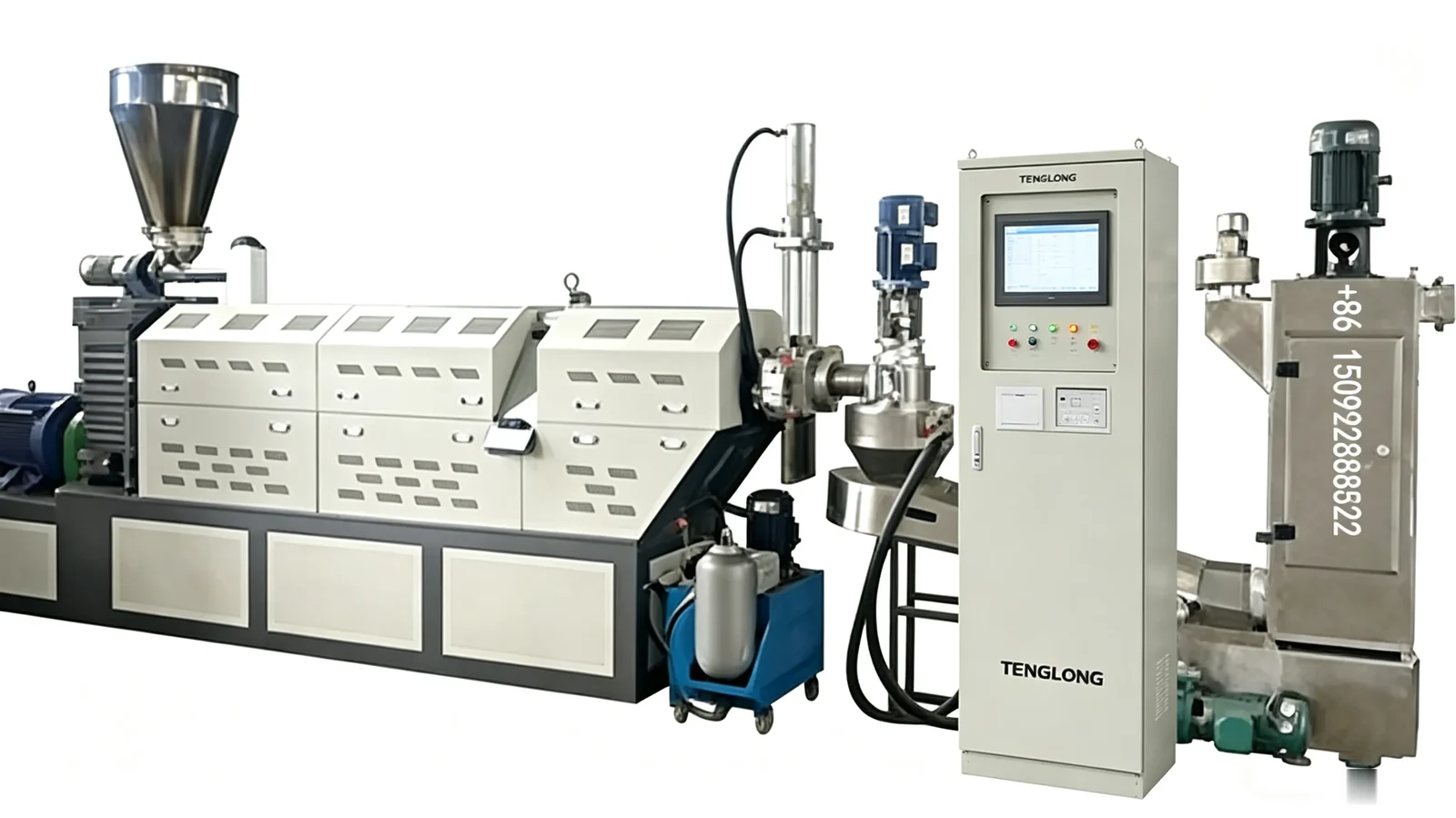
Where the Silo Sits and What It Buffers
A pellet storage silo is a buffer vessel that sits between the pelletizer and the bagging station, and its only job is to let the pelletizer keep running while bags are changed downstream. It holds finished pellets, not flake, and it processes nothing. The site lists it with the auxiliary equipment, because that is what it is: a vessel the line cannot do without and an item nobody specifies. The smaller vessel above the feeder is a different machine, a storage hopper, usually paired with a crammer on low-density film flake.
Both vessels exist because a pelletizer and a bagging station do not run at the same rate. The upstream machine works to a schedule of its own, and the downstream end works to bags, pallets and forklift slots. A silo absorbs the difference between the two. Upstream of the extruder the same problem appears in a different form, and that is what an auto loader solves: a vacuum conveyor that refills the hopper automatically from a bag or silo, keeping the feed throat at a constant level.
The scale of the buffer depends on which pelletizer it serves. The plastic granules production line runs at 500–3,000 kg/h as a turnkey package of crush, wash, dewater, dry and pelletize, while the underwater pelletizer sits at 300–2,000 kg/h for PET, PA and masterbatch. A vessel sized for the wrong end of that band is either a bottleneck or a space that never fills, and neither shows up in the machine specification.
The Vessel: Shell, Cone, Outlet and Support

The body of a silo is a cylindrical shell with a roof, carried on legs or on a support tower, with a conical section underneath that leads to the outlet. Each of those parts makes one decision. The shell sets the volume and takes the load of the material inside, the roof keeps water and dust out, and the cone decides whether the last of the material leaves the vessel.
Surface finish is the part that gets specified carelessly. Published practice calls for a wall finish of 2B or better on stainless steel. The reason is plain: anything rough enough to hold material is somewhere that material can stop moving. On a vessel that empties by gravity, that surface is the difference between a clean cone and a layer of pellets that stays where it landed.
Two smaller details decide whether the silo is convenient or awkward. Access has to be safe and workable, because somebody will eventually have to open it and stand on a ladder next to a vessel full of pellets. And the vessel has to be supported by something that does not sit in the middle of the bagging floor, because the forklift needs to work underneath it every day. The plastic pellets glossary defines the terms used in that specification.
What Sits at the Bottom: Discharge
Every silo has a discharge system, and there are two families of it. The simple one is gravity discharge through a rotary valve, which lets the pellets out under their own weight and meters them to the bagging station. It needs the material to flow, and it is the right answer for clean, free-flowing grades coming straight off a cutter.
The second family is for material that does not move on its own. Fluidised aeration pads inject air into the bed near the cone wall, a bin activator works the surface to break it up, and a screw feeder takes the material out at a controlled rate. That combination costs several times what gravity discharge costs, and it buys a discharge that does not depend on the pellets cooperating.
Choosing between them is not a style decision. Pellets that are spherical, dry and free-flowing run through gravity. Pellets from a masterbatch granulator carry pigment and can be slightly cohesive. Flakes from a flakes pelletizing machine have a shape that does not always want to move. Whichever route is chosen, it has to be written into the quotation by name, since a discharge left as an accessory is a discharge nobody has examined.
Level, Vent and Static
The silo has to know how much it is holding. That is the level measurement, and there is a difference between the bare minimum and a properly instrumented vessel: one switch that says the silo is full, or a package that reports the contents as a trend, alarms on high level and feeds the plant control system. The choice is a cost decision, and it belongs with whoever runs the shift rather than with the fabricator.
Dry polymer in a steel silo can charge to 10 to 20 kV, and that is not a theoretical number. The charge builds as material moves through the vessel, and what it attracts is the fine dust that every pelletizing line produces. Grounding to under 10 ohms, together with a conductive internal coating, is what keeps dust and streamers out of the product. It belongs in the build, not in the maintenance budget of the second year.
There is a second kind of dust problem, and it is mechanical rather than electrical. Fines settle in the cone and in the pipework, and if they are not drawn off they end up in the bag. The published benchmark is that 0.5% fines is normal and 2% is a maintenance signal, so ventilation and dust handling are not optional on a silo that handles dusty regrind.
What the Silo Does to the Shift
The condition that matters inside the vessel is moisture, because storage is where hygroscopic grades take on water they should not have. The published figure is storage moisture below 0.05% for hygroscopic grades, and a silo cannot dry anything. What it can do is keep material that was packaged dry from spending a week in a humid building, and it can keep that promise only if the vessel is sealed and the pellets were dry when they went in.
The value of that vessel is measured in shifts. Output is quoted as finished bagged pellets averaged over four hours, which tells you how the line is meant to be assessed: a bag change, a screen change and a level check all happen inside a four-hour window on a well-run line. The silo is what lets the four-hour average hold while the bagging end is occupied.
It is worth remembering how small this vessel is in the scheme of a plant. A silo is listed as auxiliary equipment, the same category as the conveyors, the blowers and the cutters, and it is bought as part of the package that makes a pelletizing line work rather than as a machine with a specification of its own. That is why it is often the least examined item on the site, and why the ones examined carefully are the ones that still run.
What each part of a pellet storage silo decides
A silo changes the shape of a pelletizing line, not just its length. The table sets out what the vessel does, what it costs to add, and what it takes away.
| Part | What it decides | What goes wrong without it |
|---|---|---|
| Shell and roof | Volume, structural load, exclusion of water | Rain ingress and a shell that has to be lined again |
| Cone | How the last material leaves the vessel | A layer of pellets that never moves |
| Outlet | Where material is presented for discharge | Bridging above the opening |
| Rotary valve or feeder | The rate the bagging station receives | Surges the bagger cannot take |
| Level instrumentation | How much the vessel holds | Overfilling, or a stop for no reason |
| Vent and dust handling | Where the fine fraction goes | Fines in the bag |
| Grounding and internal coating | What happens to static charge | Dust and streamers in the product |
Common questions, with short answers
Q1: Do I need a silo if the pelletizer feeds the bagger directly?
Not always. Direct feed works when the pelletizer and the bagging station run at the same rate and somebody is always there to change bags. A silo is bought for the hours when the two do not match.
Q2: What is the difference between a silo and a storage hopper?
A silo is a buffer vessel for finished pellets before bagging. A storage hopper is the smaller vessel above the feeder, usually paired with a crammer on low-density film flake. One holds product, the other holds feed.
Q3: Where does a silo sit relative to the pelletizer?
Downstream of the pelletizer and the pellet dryer, upstream of the bagging station. It holds finished pellets so the pelletizer can keep running while the downstream end is busy changing bags or waiting on a pallet.
Q4: Does a steel silo need grounding?
Yes. Dry polymer in a steel silo can charge to 10 to 20 kV, so grounding to under 10 ohms and a conductive internal coating are part of the build, not optional extras added later.
If you are working through the same machine family, these are the other Mass Flow vs Funnel Flow in a Pellet Storage Silo, How Big Should Your Pellet Storage Silo Be, Pellet Silo Cost: Vessel, Discharge and Installed Price and Silo Commissioning: Level, Discharge and Acceptance.
About the author
Zhou Gong (周工) is the recycling machinery engineer at TENGLONG Plastic Machinery in Linyi, Shandong — a plant of 18,000 m² with 30-plus staff, 12 platforms and 820-plus installations across 46 export markets. I have walked into too many plants where the silo was the one piece of equipment nobody quoted properly, and it was almost always the reason the line stopped. Where a figure is quoted here it has been measured or published with a date attached; nothing in this article is an estimate.
The quickest way to a real answer is to send the feed form, the contamination level and the throughput you need. A model and a price range come back within one working day, the trial on 10-20 kg of your material is free, and a result that misses the agreed output by more than 5% leaves the deposit refundable.