A pellet silo is accepted on three demonstrations: it holds and reports a measured level, it empties without bridging, and the pelletizer runs through a bag change without stopping. The evidence is a signed handover report with the readings on it, not a walk-around.
The two tests are easy to confuse. The free test on 10–20 kg of your own material proves the pelletizer, and the silo is proved afterwards, on your floor, with your pellets: level readings against measured quantities, a full draw-down, grounding under 10 ohms, and the first bags weighed against the pellets that went in.
Checks, readings, signed paper
- Compare every level reading against a measured quantity, and test the empty state as well.
- Run the vessel empty and watch the cone; bridging found at handover is the cheapest place to find it.
- Grounding under 10 ohms, storage moisture below 0.05% and silo temperature under 50 °C.
- Weigh the first bags against the pellets that went in to set the plant’s own loss baseline.
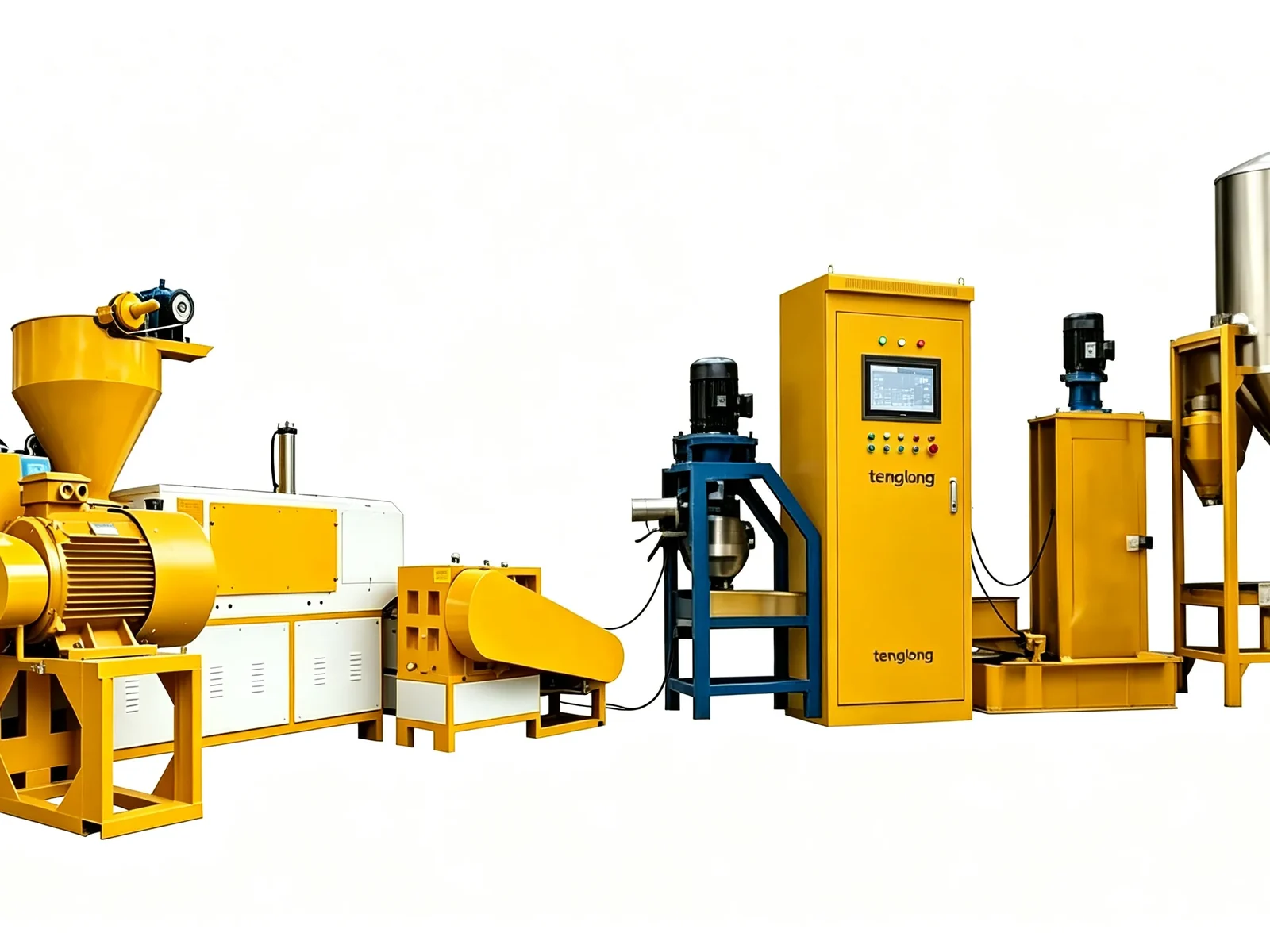
What You Are Actually Accepting
A silo is accepted when three things have been demonstrated: it holds a measured level and says so reliably, it discharges without a bridge forming, and the pelletizer can run through a bag change without stopping. The document that closes the job is a signed handover report, and the evidence behind it is a sequence of quality control checks written down as readings rather than a walk-around with a signature at the end.
Installation runs 7–10 days on site for a line and 3–5 days for a single machine, including commissioning, two days of operator training and a signed handover report. For a silo the commissioning window is short, which is a reason to insist on the checks rather than let them compress into the last morning. The vessel is simple; the paperwork is what protects the plant.
Keep the two tests apart. The free test on 10–20 kg of the buyer’s material, with video, measured output, specific energy and pellet photos sent before the balance is paid, proves the pelletizer, not the vessel. And if the test run misses the agreed output by more than 5%, the deposit is refundable. The silo is proven afterwards, on your floor, with your pellets, running behind the machine.
The Level Test

Level indication is checked against something the customer can measure. Fill the vessel in stages and compare each reading with a measured quantity, rather than accepting a switch that the fabricator tested on his own rig. An indication that reads high will overfill the vessel, and an indication that reads low will start the pelletizer into a silo that was already full.
The empty state deserves as much attention as the full one. The switch that fails at the low level is the one that stops the plant for no reason, and the alarm that does not sound when the silo is full is the one that costs a shift. Both are recorded on the handover sheet as what they were tested against and what they actually read.
Then check the level against the process, not only against the instrument. The silo sits between a pelletizer running at a steady rate and a bagging station working in bursts, so the useful reading is the rate of change as well as the level itself. Whether that comes from a continuous transmitter or from a simple switch is a cost decision, and it belongs in the instrument list agreed at quotation stage.
The Discharge Test
Open the discharge and let the vessel empty completely, then watch what the last of the material does. The bottom of the cone tells you more about the silo than any photograph taken at delivery. Material that leaves the cone as a curtain and material that leaves as a plug are different problems, and the plug is the one that will sit there for weeks.
If it bridges during the trial, that is a flow-pattern fault and it belongs on the handover report as an open item, not as a story for the plant to discover at two in the morning. Clearing a rathole by hand runs four to eight labour hours per incident at US$85 an hour, and the trial is the cheapest place in the whole project to find that out.
The rest of the discharge train gets the same treatment. A rotary valve is checked for shear and for a clean seal, an aeration pad is checked for even air distribution across the cone, and a screw feeder is checked against the rate the bagger can actually take. A discharge that runs too fast will not empty the bagger; a discharge that runs too slow will back up into the pelletizer.
Static, Moisture and Product
Static is checked with a meter and written down. Dry polymer in a steel silo can charge to 10 to 20 kV, so grounding to under 10 ohms is verified at the vessel, and the conductive internal coating is inspected for wear, because a coating that has scuffed through is a coating that is not there.
Moisture and temperature are checked against the storage figures rather than against the pellets themselves. Storage moisture for hygroscopic grades is below 0.05%, and silo temperature is held under 50 °C. Those are the numbers that make a silo safe for hygroscopic material, and a bag taken from the vessel after a weekend is the sample that proves them.
Product loss is weighed at the end of the first run, because bag handling loses 0.3 to 1.0% of the product. The first bags should be set aside and weighed against the pellets that went in, and the result becomes the plant’s own baseline rather than a figure from a supplier’s leaflet. Fines are the companion check: 0.5% fines is normal and 2% is a maintenance signal.
The Paperwork and the First Month
The warranty covers 18 months from commissioning or 24 months from shipment, whichever comes first, and wear parts are stocked for three years. Both figures are worth putting in the handover pack, because a silo is a slow-failing asset: nothing happens for months, and then a level instrument drifts or a lid seal lets dust through.
The first month is where the small faults appear, and they are worth writing down on the day of handover rather than rediscovering later. Expect to check the level calibration again after the first fills have settled the vessel, the discharge for signs of bridging at the first full draw-down, and the seals at every fill. A silo costs US$4,000 to US$8,000 a year to inspect, maintain and run, and that inspection is a routine with dates on it.
Most site-visit questions end up on the FAQ page, and the silo ones are always the same three. When you request a quotation for a silo, the useful answers are the material, the flow pattern, the discharge method and the instrumentation. The factory is in Linyi: 2.5 hours by high-speed train from Jinan, 1.5 hours by air from Shanghai, and a typical visit takes half a day. The test hall has material storage, water and a 500 kVA supply, with three simultaneous material runs.
The commissioning checks and what each one proves
Commissioning a silo is mostly about proving that it empties. The table is the sequence, and what each step proves.
| Check | How it is done | What it proves |
|---|---|---|
| Level indication | Compare each reading with a measured quantity | The vessel contents are known, not guessed |
| Low level and empty state | Test with the vessel emptied | The plant is not stopped for a false low reading |
| Discharge draw-down | Empty the vessel and watch the cone | Material leaves the cone instead of bridging |
| Discharge train | Check valve shear, aeration spread, feeder rate | The bagging station gets a steady feed |
| Grounding | Measure at the vessel against 10 ohms | Static charge has a path to earth |
| Moisture and temperature | Check stored material against storage figures | Hygroscopic grades are stored inside specification |
| First bag weight | Weigh first bags against pellets fed in | The plant’s own product loss baseline |
Common questions, with short answers
Q1: What does commissioning a pellet silo include?
Installation runs 7–10 days on site for a line and 3–5 days for a single machine, including commissioning, two days of operator training and a signed handover report with the readings attached.
Q2: How do you test a silo’s level system?
Fill the vessel in stages and compare each level reading against a measured quantity, then run it empty and full again. The switch that fails at the empty level is the one that will overfill the silo.
Q3: What happens if pellets bridge in the silo during the trial?
That is a flow-pattern fault, not a commissioning fault, and it goes on the handover report as an open item. Breaking a rathole by hand costs four to eight labour hours per incident at US$85 an hour.
Q4: What is covered after the silo is handed over?
The cover is 18 months from commissioning or 24 months from shipment, whichever comes first, and wear parts are stocked for three years. The handover report with its readings attached is what a later claim is argued from.
Three more notes from the same test floor: Pellet Storage Silo: What It Does on a Pelletizing Line, Mass Flow vs Funnel Flow in a Pellet Storage Silo, How Big Should Your Pellet Storage Silo Be and Pellet Silo Cost: Vessel, Discharge and Installed Price.
About the author
Zhou Gong (周工) has spent his working life on recycling machinery at TENGLONG Plastic Machinery in Linyi, Shandong, where 820-plus lines have been delivered across 46 export markets since 2016. I make the operator who will run the silo sign the handover sheet too, because they are the one who finds the faults in month two. Each figure quoted here is either measured on a machine or published with a date attached; nothing has been estimated to fill a gap.
Give our engineers the material form, the contamination level and the throughput, and the answer comes back within a working day as a model and a price range. Running 10-20 kg of your own material is free, and a measured output more than 5% under the agreed figure puts the deposit back in your hands.