A mixing tank is accepted on the buyer’s own material and on samples from the discharge, not on a photograph of the vessel. The published offer is a free test on 10–20 kg of that material, with video, measured output, specific energy and pellet photos sent before the balance is paid.
Installation runs 7–10 days for a line or 3–5 days for a single machine, including commissioning, two days of training and a signed handover report. The first-week faults are predictable: a tank ahead of the dryer, a batch that segregates at a stop, and a loader filter nobody cleans.
What acceptance must cover
- Ask for a free test on 10–20 kg of your own material before the balance is paid.
- A miss of more than 5% against the agreed output makes the deposit refundable.
- Sample the discharge through a full batch and weigh each handful, not just the colour.
- Put the tank after the dryer, and keep the loader filter on a cleaning schedule.

What the handover has to record
A mixing tank is accepted on the material the buyer will actually run, not on a photograph of the vessel. Under the published test offer the buyer sends 10–20 kg of material and receives video, measured output, specific energy and pellet photos before the balance is paid. A test run more than 5% short of the agreed output makes the deposit refundable. For a tank the sample is a blend, so ask for it to include both flake types and the colour.
A line takes 7–10 days on site and a single machine 3–5 days, and that time includes commissioning, two days of operator training and a signed handover report. On a tank the report should carry the batch weight, the inlet order, the agitator setting and the feeder accuracy, because those are the numbers the first month will be compared against. Have the lines filled in during the test, not after the machine has been shipped.
The warranty runs 18 months from commissioning or 24 months from shipment, whichever comes first, and the commissioning date belongs on the report for that reason. The warranty does not cover wear parts, although they are stocked for three years. On a mixer, paddles and seals are the parts worth naming in the handover, since a plant that knows the part number is not waiting on a drawing when it needs a replacement.
The test that proves the blend is uniform
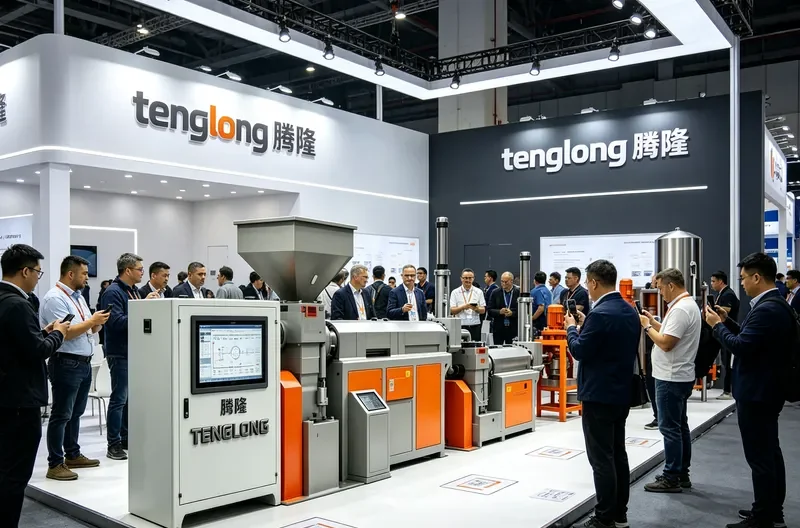
The acceptance test is a sampling test. Take a handful from the discharge at short intervals through a full batch and check that colour, texture and mass per handful stay within what the recipe allows. A tank that mixes well for the first few seconds and then delivers layers has failed the test, even though the average composition of the batch looks correct on paper. The test hall holds material storage, water and a 500 kVA supply, so three simultaneous material runs are possible.
Bulk density is the number to record alongside those samples. Washed PE film sits at 30-80 kg/m³ against 250-400 kg/m³ for rigid flakes, so a handful that weighs half of the previous one is telling you the blend has separated. Weigh each sample rather than judging by eye: the eye is good at colour and poor at density, and it is density that decides whether the screw starves. A simple cup and a scale settle the argument faster than a laboratory.
Start with the feeder price, because the choice changes what the test can prove: volumetric at US$2,000-8,000 with typical accuracy of plus or minus 1 to 2%, gravimetric at US$8,000-25,000 with typical accuracy of plus or minus 0.25 to 0.5% and automatic compensation for density changes. Run the recipe through both and compare the pellets; the difference is the value of the second machine. If the plant has only one feeder, record its accuracy so the drift can be measured.
Three faults that arrive in week one
The first fault is a tank that was placed too early. A vessel installed ahead of the dryer blends wet flake, and the dryer then pulls water out of the two ingredients at different rates; the effect only becomes visible once the pellets start coming out with inconsistent weight. Washed film enters a line at 50-70% moisture against 30-40% for rigid flake, so the dryer has to be given a single, known condition to work on. Moving the vessel is cheap in week one and costly afterwards.
The second fault is segregation at a stop. The agitator runs, the line pauses for a screen change or a bag change, and the light film rises while the rigid flake settles. When the line restarts the feeder receives a slug of one material followed by a slug of the other. The first slug starves the screw and the second floods it, and the operator sees an output swing with no obvious cause.
The third fault is a filter that is never cleaned. A vacuum loader needs its filter and its cyclone cleaned on a schedule, because a loaded filter cuts the suction and the loader starts starving the hopper, and the same neglect reaches the tank’s dosing system. A clogged inlet does not stop the mixer; it quietly removes one ingredient from the recipe, and the shade of the pellet is the only witness.
Records, spares and who owns the blend
The week after handover should produce a short log: batch weight, bulk density of a discharge sample, feeder setting, output and fines per shift. Normal running puts fines at 0.5% and treats 2% as a maintenance signal, and the log tells you which side of that boundary the blend is on. A single number taken on the first morning is not a baseline; a week of them is. Set the log beside the handover report and the drift becomes obvious.
Spares are straightforward. One spare screw, one die plate and two screen packs keep unplanned stops under 2% on the line, and for the tank itself a spare paddle set and a seal are the sensible additions. Wear parts are stocked for three years. A non-standard inlet or a purpose-built agitator is the item that takes longest to replace, so it is worth naming those parts during commissioning. The part number on the handover sheet saves a morning of telephone calls.
Ownership is the last thing to settle. The tank sits among auxiliary equipment, and on many projects nobody owns the blend: the dryer operator owns the dryer, the extruder operator owns the screw, and the recipe belongs to neither. Give one person the job of signing off the discharge sample, because a machine that is everybody’s responsibility is a machine whose settings drift by the end of the week. Name that person on the handover report, in writing.
The first month, and what counts as success
Success in the first month is a boring month. The tank is not the subject of a daily conversation, the feeder settings written at commissioning still stand, and the shade of the pellet is the same on Friday as on Monday. The quality control that matters here is a trend line rather than a single impressive reading, and the report signed at handover is the line it should follow. If the two diverge, the recipe has changed or the tank has.
For buyers who want to see the run before they commit, the test hall has material storage, water and a 500 kVA supply with three simultaneous material runs. Linyi is 2.5 hours by high-speed train from Jinan and 1.5 hours by air from Shanghai, and a typical visit takes half a day. Bring the flake, the powder and the colour you will actually use; a test on a substitute proves very little.
Working handovers are illustrated in the customer cases here, and the FAQ lists the figures the plant will be held to. Read them before the test, not after the first dispute. I will not sign a handover report whose settings cannot be reproduced by the operator trained that week, because a process nobody can repeat is not a process at all. A report that cannot be reproduced by the person who ran the test is a sales document.
The mixing tank acceptance sheet and its pass readings
The table sets out the mixing tank acceptance sheet and its pass readings. Each line is something the operator can verify with a sample cup.
| Check | What is measured | Passing value |
|---|---|---|
| Test on buyer material | Measured output against the agreed figure | Within 5%, or the deposit is refundable |
| Discharge sampling | Colour, texture and mass per handful through a batch | No layers appearing as the batch draws down |
| Discharge bulk density | Weight of a sample cup at short intervals | Steady against the 30-80 / 250-400 kg/m³ feed gap |
| Feeder accuracy | Gravimetric against volumetric accuracy | plus or minus 0.25 to 0.5% versus 1 to 2% |
| Tank position | Where the vessel sits relative to the dryer | Downstream of the dryer, upstream of the feeder |
| Handover report | Batch weight, inlet order, setting and accuracy | Filled in during the test and signed |
Common questions, with short answers
Q1: What should the mixing tank handover test include?
A free test on 10–20 kg of the buyer’s own material, with video, measured output, specific energy and pellet photos sent before the balance is paid, and a refundable deposit if the agreed output is missed by more than 5%. Installation includes commissioning, two days of operator training and a signed handover report.
Q2: How do I prove the blend is actually uniform?
Take a handful from the discharge at short intervals through a full batch and check colour, texture and mass per handful. Weigh each sample rather than judging by eye, because a tank that delivers layers has failed even if the batch average looks correct on paper.
Q3: What are the first faults to expect in week one?
A tank placed ahead of the dryer blends wet material and dries unevenly; a stop lets light film rise and heavy flake settle so the batch segregates; and a loaded loader filter or clogged inlet quietly drops an ingredient out of the recipe.
Q4: Which spares should be kept at the plant after handover?
Keep a paddle set and a shaft seal for the tank, then add the line spares that protect output: a screw, a die plate and screen packs, which together hold unplanned stops under 2%. Wear parts are stocked for three years; a purpose-built agitator takes longer than a standard one.
Read next, if the same model is going on your line: Mixing Tank: What It Contains and Why Feed Must Be Uniform, Bulk Density: The Specification That Decides the Blend, Sizing a Mixing Tank and What It Costs and Why Uniform Feed Decides Batch Accuracy in Pelletizing.
About the author
Zhou Gong (周工) is the recycling machinery engineer at TENGLONG Plastic Machinery in Linyi, Shandong — a plant of 18,000 m² with 30-plus staff, 12 platforms and 820-plus installations across 46 export markets. After commissioning I ask the operator who was trained that week to reproduce the blend from the report, and the result decides whether the signature means anything. Where a figure is quoted here it has been measured or published with a date attached; nothing in this article is an estimate.
The quickest way to a real answer is to send the feed form, the contamination level and the throughput you need. A model and a price range come back within one working day, the trial on 10-20 kg of your material is free, and a result that misses the agreed output by more than 5% leaves the deposit refundable.