Bulk density is the specification that decides a blend. A mixing tank exists to deliver one bulk density and one recipe to the force feeder, because washed PE film sits at 30-80 kg/m³ against 250-400 kg/m³ for rigid flake, and a screw cannot hold both conditions at one setting.
The tank belongs after the dryer and before the force feeder, so the extruder receives one recipe at one bulk density. Feeder accuracy is the second half of the decision: a volumetric unit holds plus or minus 1 to 2%, while a gravimetric one holds plus or minus 0.25 to 0.5% and compensates for density changes.
One property to control
- Bulk density at the extruder decides the blend, not vessel volume or motor power.
- Washed film holds 50-70% moisture against 30-40% for rigid flake, so mix after drying.
- The tank sits downstream of the dryer and upstream of the force feeder.
- Gravimetric feeding holds plus or minus 0.25 to 0.5% and compensates for density changes.
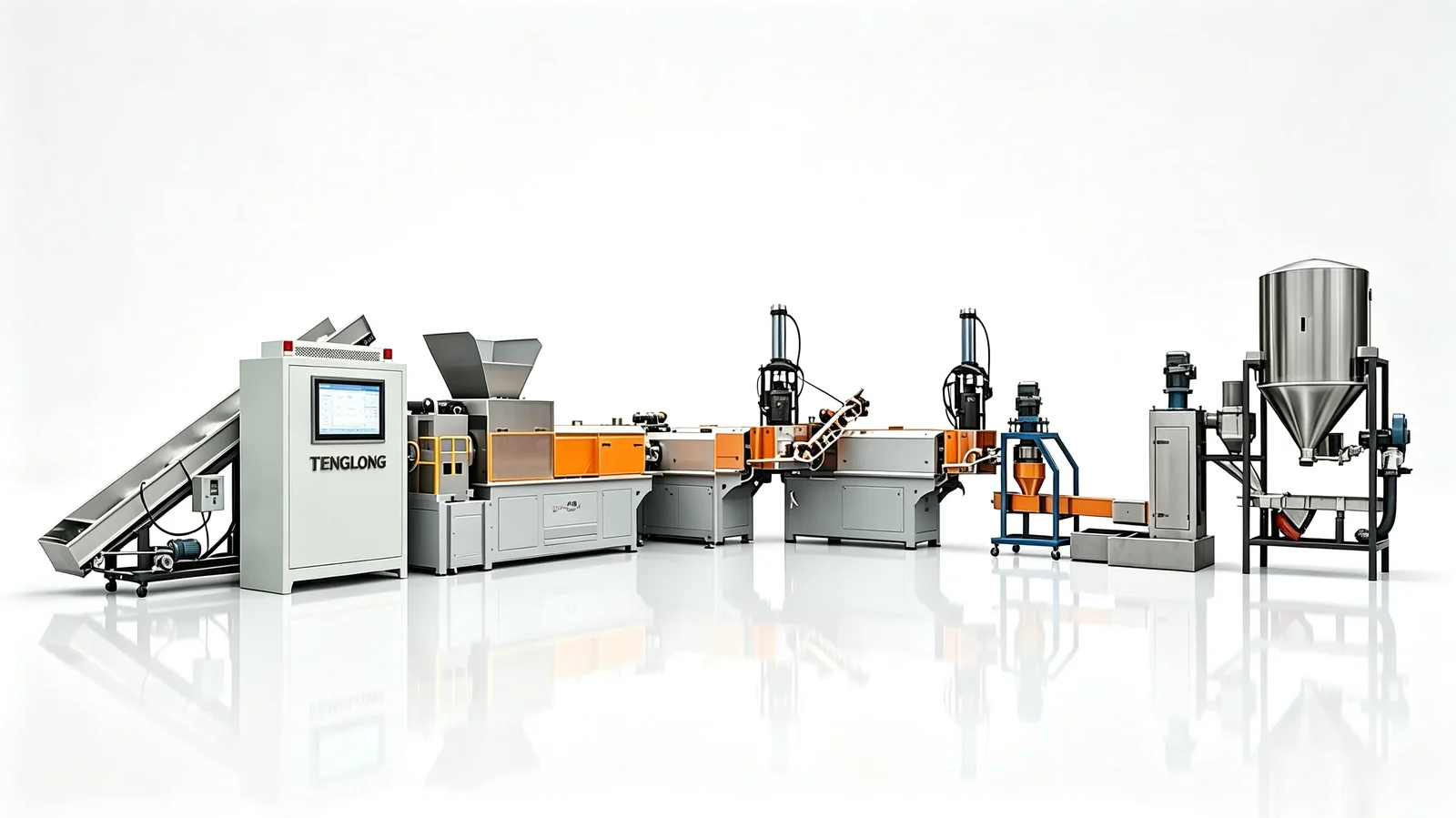
The specification that decides the blend
The bulk density arriving at the extruder is the specification that decides the blend, not the volume of the vessel and not the power of the motor. A mixing tank exists to deliver one bulk density and one recipe to the force feeder, shift after shift. Get that single property right and the rest of the line settles down; get it wrong and every downstream machine spends its time correcting the mistake.
The number that makes this concrete is the gap between the two common feedstocks. Washed PE film has a bulk density of 30-80 kg/m³ against 250-400 kg/m³ for rigid flakes, and washed film enters a line at 50-70% moisture against 30-40% for rigid flake. A recipe that alternates between them without mixing presents the screw with a density that changes by several times, and no feeder setting can cover both ends of that range.
This is why the specification belongs on the purchase order as a property of the output, not of the hardware. Write down the bulk density and the moisture the tank must hand to the feeder, and write down the tolerance the recipe can accept. A vessel described only by its volume in litres tells you nothing about whether those two numbers will be steady, and two suppliers quoting the same litres may be selling very different machines.
Why film and rigid flake will not mix themselves
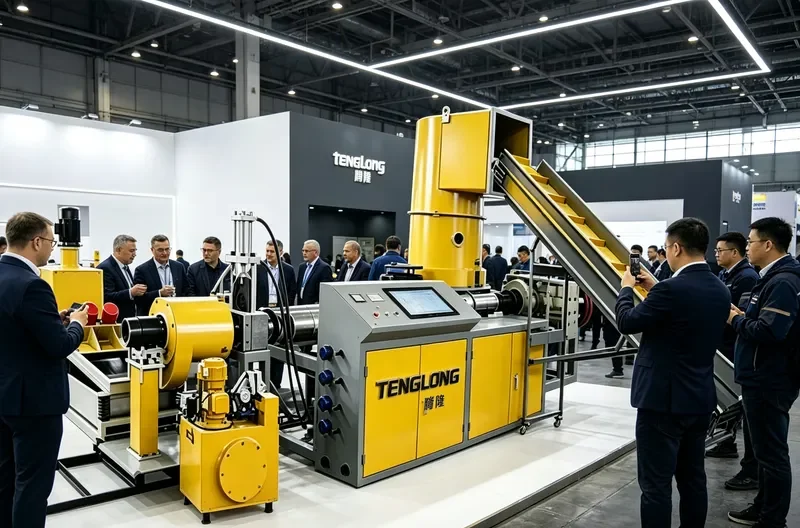
Light film and heavy rigid flake refuse to blend by density, and no amount of extra agitation erases the difference. Light film floats and heavy rigid flake settles, so a vessel that stops for even a short pause delivers the two in layers when it starts again. That is the moment a sample from the discharge looks correct for a few seconds and then changes as the layers pass through. A layer that reaches the feeder is a recipe that no setting can rescue.
Moisture adds a second axis to the same problem. Washed film at 50-70% moisture and rigid flake at 30-40% do not give up water at the same rate, so a blend made before the dryer arrives there with a water content that varies through the batch. Putting that tank ahead of the dryer is a different proposition: it blends wet material, and the dryer then removes water unevenly from the batch. The dryer cannot correct a blend that was never uniform.
Colour behaves the same way at a smaller scale. A masterbatch that has not been folded through the mass survives as streaks, and the streaks show up as a shade that drifts along the length of a production run. The fix is mechanical and simple: keep the agitator turning, keep the vessel full enough for the paddles to work, and sample the discharge rather than trusting the top of the batch.
The position is part of the specification
The mixing tank sits between the drying stage and the force feeder, so the extruder receives one recipe at one bulk density. That single sentence is the most useful line in the whole specification because it fixes what the machine can and cannot be asked to do. Upstream of the dryer it is a wet mixer with an uneven drying problem; downstream of the feeder it is too late to change what the screw receives.
A film granulating line and a flakes pelletizing machine reach that point by different routes, and the same tank serves both if the line is laid out honestly. On film the feed is light and the feeder needs all the help a uniform bulk density can give it; on washed rigid flake the density is already higher and the work is chiefly about colour and additive distribution. The by material index on the site groups those routes clearly.
The force feeder is the reason the position cannot be shifted. A screw feeder works by torque, not by speed, and it has to stall when the material is too dense and push when it is too light. Put the tank anywhere else and you hand that feeder a material whose density changes without warning, which is precisely the condition it was not designed to absorb. Layout is a specification decision here. Draw the tank on the drawing before the feeder is chosen, not after.
Accuracy at the inlet, and what it costs
Accuracy at the inlet is the second half of the same specification, because a uniform blend is no use if the recipe is dosed loosely. The published figures put a volumetric feeder at US$2,000-8,000 with accuracy typically plus or minus 1 to 2%. A gravimetric unit costs US$8,000-25,000, holds accuracy typically plus or minus 0.25 to 0.5%, and compensates automatically for density changes. The extra money buys exactly the property the tank is trying to deliver.
The published blender table spans 260 kg/h maximum throughput with a 3 kg batch and a 0.15 kW stirring motor at one end, and 4,850 kg/h with a 90 kg batch and a 2.2 kW motor at the other, on 4-6 bar compressed air with four hoppers and one screw rod per hopper. Those figures are the practical bounds of the batch approach. They tell you what the machine can hold and how fast it can turn a recipe around before the next batch is needed.
The choice between the two feeders is not a matter of preference. If the recipe is fixed and the bulk density is steady after the tank, a volumetric device is enough and the simpler machine is easier to keep clean. If the recipe changes or the density still moves, the gravimetric unit pays for itself by compensating rather than by hoping. The FAQ on the site states the accuracy figures plainly, and I would put them in the written scope.
What a density mismatch costs
Specific energy is published at 0.26–0.50 kWh/kg for the range, and a screw fed on alternating densities sits at the poor end of that band because the drive keeps correcting. The published output basis is finished bagged pellets averaged over four hours, and a line that swings between light film and heavy flake will struggle to reach its stated average. The two ends of that band are not a rounding error; they are a well-fed screw against a fighting one.
Fines sit at 0.5% in normal running and become a maintenance signal at 2%, and a bulk density that drifts through the shift produces both at different moments. An auto loader keeps the feed throat at a constant level but cannot correct what is in the hopper, so a steady level can conceal a wildly variable recipe. That is the trap I watch for on a line whose output looks numerically fine but whose pellets do not.
The cost is therefore not in the tank’s price but in what the tank prevents. Specify the bulk density at the discharge, place the vessel after the dryer, and choose a feeder whose accuracy matches the stability the tank can actually hold. Those three decisions cost nothing extra on the order and decide whether the line runs at the better end of its energy band or spends the week chasing a fault that lives in the hopper.
Bulk densities and feeder accuracy that decide a blend
The table sets out bulk densities and feeder accuracy that decide a blend. The density gap shown here is the reason the tank exists.
| Property | Published figure | What it decides |
|---|---|---|
| Washed PE film bulk density | 30-80 kg/m³ | Light feed that a volumetric device turns into low mass flow |
| Rigid flake bulk density | 250-400 kg/m³ | Heavy feed that floods the same feeder setting |
| Washed film moisture | 50-70% | Water load that must be settled before the tank is filled |
| Rigid flake moisture | 30-40% | The condition the dryer is calibrated around |
| Volumetric feeder accuracy | plus or minus 1 to 2% | Enough for a fixed recipe at a steady bulk density |
| Gravimetric feeder accuracy | plus or minus 0.25 to 0.5% | Compensates automatically as the blend density changes |
Frequently asked questions
Q1: What is the one specification that decides a blend?
The bulk density arriving at the extruder. A mixing tank exists to deliver one bulk density and one recipe to the force feeder, and the vessel volume or motor power does not tell you whether that property will stay steady through a shift.
Q2: Why can film flake and rigid flake not simply be mixed?
Because washed PE film sits at 30-80 kg/m³ against 250-400 kg/m³ for rigid flake. The light material rises and the heavy material settles whenever the vessel stops, so the discharge comes out in layers rather than as one blend.
Q3: Does the mixing tank go before or after the dryer?
After the dryer and before the force feeder. A tank placed ahead of the dryer blends wet material, and the dryer then removes water unevenly from the batch, which is a fault that no downstream mixing can put right.
Q4: Is a gravimetric feeder worth the extra money?
It is when the recipe changes or the density still moves. A volumetric feeder costs US$2,000-8,000 at plus or minus 1 to 2%, while a gravimetric feeder costs US$8,000-25,000 at plus or minus 0.25 to 0.5% and compensates for density changes.
The rest of this series covers the same equipment from different angles: Mixing Tank: What It Contains and Why Feed Must Be Uniform, Sizing a Mixing Tank and What It Costs, Mixing Tank Acceptance, Commissioning and First-Week Faults and Why Uniform Feed Decides Batch Accuracy in Pelletizing.
About the author
Zhou Gong (周工) is a recycling machinery engineer at TENGLONG Plastic Machinery in Linyi, Shandong, where 30-plus staff work across 18,000 m² and 12 machine platforms covering 100 to 3,000 kg/h. I have learned to distrust a hopper that looks full, because a steady level above the throat says nothing about the density of what is in it. Every figure used here has been measured on a machine or taken from a dated published source, not from a brochure.
Send the material form, the contamination level and your target output to our engineering team and you get a model and a price range within one working day. A test run on 10-20 kg of your own material is free, and if the measured output misses the agreed figure by more than 5%, the deposit is refundable.