An auto loader is a vacuum conveyor that refills the hopper from a bag or silo, keeping the feed throat at a constant level. That settles what the machine is and why a plant buys it, because the alternative is a hopper whose level depends on whoever topped it up last.
Inside it, a pump pulls material through a sealed line, a cyclone drops the heavy fraction out of the air, a filter catches the dust, and a level sensor calls the pump when the hopper runs low. Each part makes a decision you can check on the floor.
What the loader is made of
- An auto loader is a vacuum conveyor that keeps the feed throat at a constant level.
- The filter and cyclone must be cleaned on a schedule or the hopper starts to starve.
- Conveying distance cuts capacity by roughly 5 to 10% per 10 m.
- Vacuum loader power runs from 3 to 15 kW on a 380 V / 50 Hz three-phase supply.
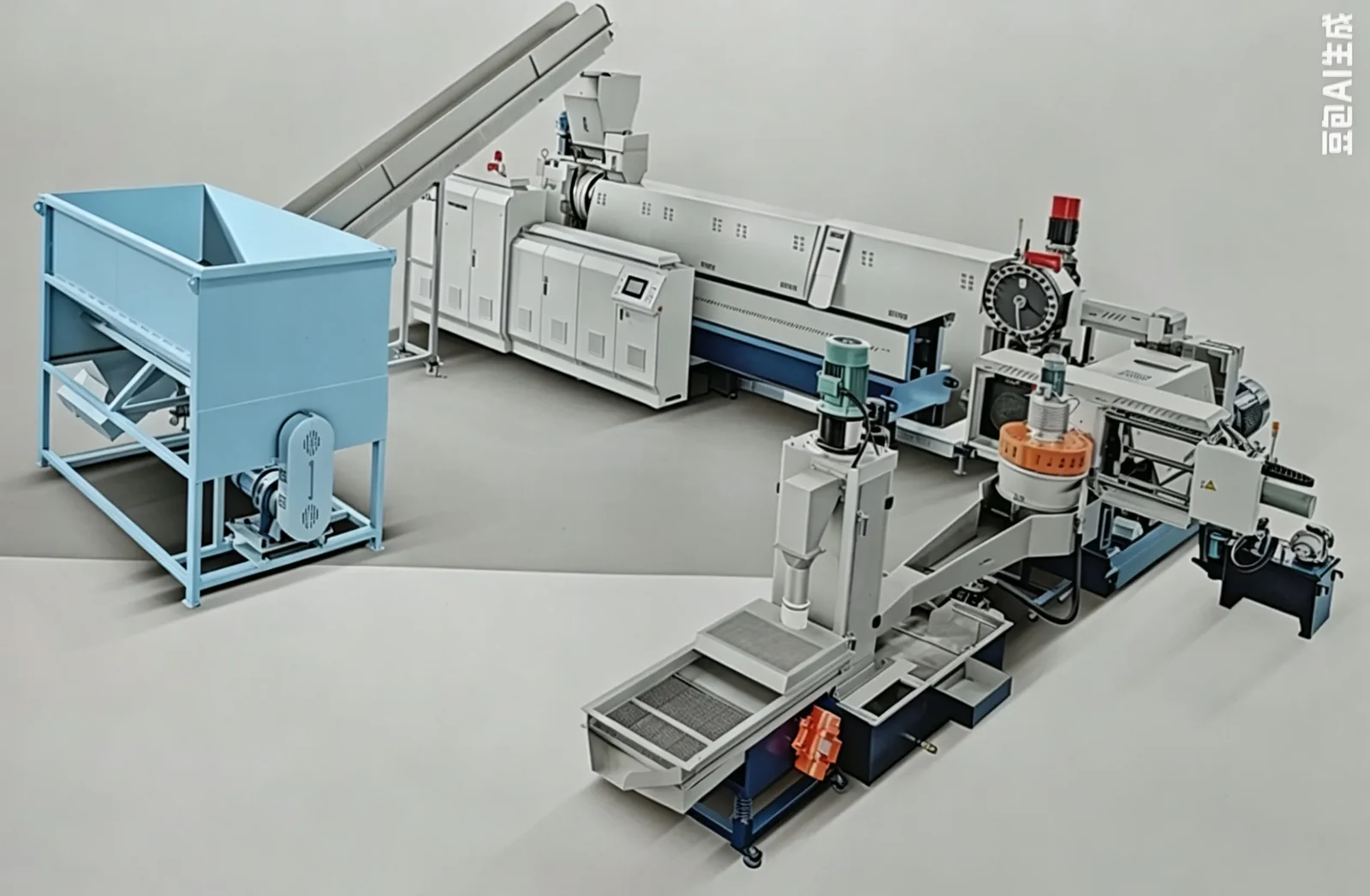
What an Auto Loader Is and Why the Hopper Level Matters
An auto loader is a vacuum conveyor that refills the hopper automatically from a bag or silo, keeping the feed throat at a constant level. That is the whole job, and it is worth stating first because the machine is usually described by what it looks like rather than what it does. A receiving hopper, a line and a pump impress nobody. A hopper that never runs dry does. The loader removes the operator from the loop, and the feed throat stops being a variable that shifts with every operator.
The distinction matters because a hand-topped hopper and a loader-fed hopper are two different machines as far as the extruder is concerned. A hopper topped up by hand runs at whatever level the last operator left, and the output follows the hopper rather than the screw. The operator becomes a control loop with a shift pattern and a memory, and the screw spends part of every shift seeing a head of material it was not set up for. That is the problem the loader is bought to remove.
Where the material comes from changes the shape of the installation but not the principle. A bag station suits a small machine; an upstream silo suits a line running around the clock. In either case the loader takes material from a source and delivers it to a receiving hopper above the feed throat, and it does so on a signal from a level sensor rather than on a timer. The storage hopper above the feeder is the smaller vessel, and it is the one the loader keeps full.
The Pump, the Line and the Cyclone
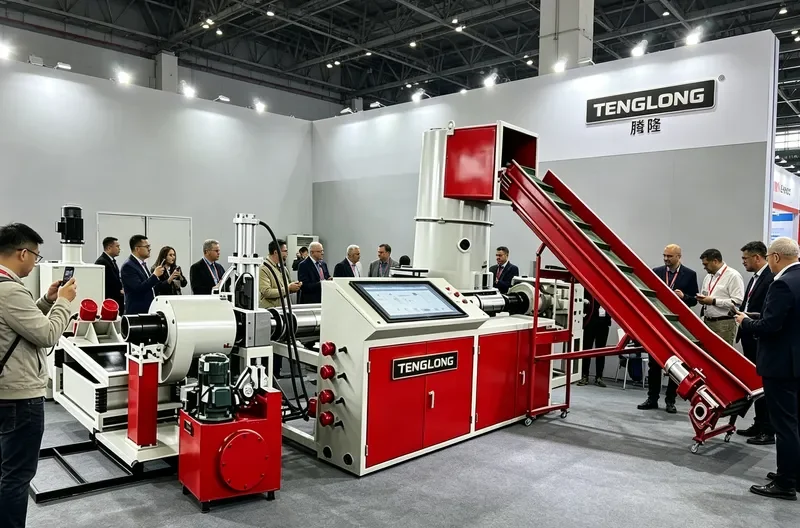
The suction side is a pump and a sealed line, and the whole idea depends on that line staying sealed. A vacuum loader is a pump that pulls air out of the receiving hopper, a line that carries the pellet or flake with that air, and a cyclone that separates the material from the air before it reaches the pump. Any leak in the line reduces the pressure difference the pump can hold, and the loader quietly loses capacity without raising an alarm on the panel.
Vacuum loader power is typically 3 to 15 kW depending on capacity and distance, and the pump is the item that sets that number. The electrical supply follows the same standard as the rest of the plant: 380 V / 50 Hz three-phase, with 415 V / 50 Hz, 440 V / 60 Hz and 220 V single-phase available where the site demands them, IE3 motors and IP54 panels. A pump chosen for a short line will struggle once that line is extended.
Distance is not free. Conveying distance reduces capacity by roughly 5 to 10% per 10 m, which is why the layout drawing belongs in the enquiry alongside the tonnage. A plant that moves the hopper to the far side of the building after the loader is ordered has bought a smaller loader than it thinks. The same air line that carries the material also has to be routed without tight bends, because every bend adds effective distance the pump has to pull the material through.
The Filter, the Cyclone and the Dust They Catch
A vacuum loader needs its filter and its cyclone cleaned on a schedule, because a loaded filter cuts the suction and the loader starts starving the hopper. This is the single most common cause of a loader that appears to have lost its capacity, and it is a maintenance issue rather than a mechanical failure. The filter is the part that does the separating, and as it loads with fines and dust the pressure drop across it rises until the pump can no longer pull material through the line.
The cyclone does the coarse work ahead of the filter. Material enters, the air spins, and the heavier pellet or flake drops out while the air and fine dust carry on to the filter element. On a line handling regrind the dust load can be considerable, and the published benchmark is that 0.5% fines is normal while 2% is a maintenance signal. A loader pulling material above that second figure will be cleaning its filter far more often than the written schedule allows.
Dry polymer in a steel silo can charge to 10 to 20 kV, and grounding to under 10 ohms plus a conductive internal coating is what keeps dust and streamers out of the product. The loader inherits that dust if the silo above it is not grounded properly, and the filter element becomes the place where the problem is finally noticed. Clean the filter on a schedule and check the ground at the same time, because one is a symptom and the other is often the cause.
The Level Sensor and the Control Loop
The control loop is simple: a level sensor in the receiving hopper, a controller, and a pump that runs until the hopper is full. The sensor decides when the loader starts and stops, and its placement decides whether the feed throat actually sees a constant level. Put the sensor too high and the loader cycles on a hopper that is barely empty; put it too low and the screw runs dry before the pump is called. Neither fault appears on the production report as a loader fault.
A gravimetric feeder costs US$8,000-25,000 with accuracy typically plus or minus 0.25 to 0.5% and compensates automatically for density changes, while a volumetric feeder costs US$2,000-8,000 with accuracy typically plus or minus 1 to 2%. The loader’s job is to keep that feeder supplied rather than to meter the material itself. Confusing the two leads buyers to specify a loader with a metering accuracy it was never built to deliver, and then to complain when the recipe drifts.
The control also has to respect the material. Film flake and rigid flake do not mix by density: washed PE film sits at 30-80 kg/m³ while rigid flake sits at 250-400 kg/m³, so unmixed feed starves the screw. A loader feeding a hopper that switches between those two materials will deliver a full hopper and an inconsistent bulk density, and the level sensor cannot see the difference. That is a mixing problem arriving at the loader’s door, and it belongs upstream.
Where the Loader Sits in the Line
The loader is listed with auxiliary equipment rather than among the granulator types, and it belongs in the same part of the plant as the hoppers, the blowers and the storage vessels. It does not size the flake, set the melt temperature or cut the pellet. What it does is guarantee that the machine downstream never waits for material, which is why a line running three shifts without one often finds its output limited by the operator rather than by the screw.
For context, the range covers 100-3,000 kg/h across 12 machine platforms, and a film granulating line at 200-800 kg/h is as likely to need a loader as a flakes pelletizing machine at 300-1,000 kg/h. The loader is bought against the consumption rate of the machine it feeds, not against the name of that machine. That is the number that belongs on the enquiry form, and it is the one most often left blank by buyers who assume the loader comes with the line.
The plastic recycling equipment pages keep the handling equipment separate from the size reduction and washing stages for exactly this reason: the loader serves all of them and belongs to none of them. The glossary on this site is worth reading before the enquiry, because a hopper, a silo and a cyclone are named differently in different quotations. On a turnkey line the loader is included as a matter of course, and it is the easiest unit on the plant to overlook during acceptance.
Parts of a vacuum auto loader and what each one decides
The table sets out parts of a vacuum auto loader and what each one decides. The rows describe a machine that is easy to overlook and hard to run without.
| Part | What it does | The fault when it is wrong |
|---|---|---|
| Pump and vacuum line | Pulls material through the sealed line | A leak cuts suction and capacity falls |
| Receiving hopper | Buffers material above the feed throat | Wrong size and the machine waits or bridges |
| Cyclone | Drops the heavy material out of the air | Fines carry through to the filter element |
| Filter element | Separates dust from the conveying air | A loaded filter starves the hopper |
| Level sensor | Calls the pump when the hopper is low | Bad placement gives a dry throat or short cycles |
| Grounding and coating | Bleeds static off a steel silo | Dust and streamers reach the product |
Frequently asked questions
Q1: What is an auto loader?
A vacuum conveyor that refills the hopper from a bag or silo, it keeps the feed throat at a constant level and takes the operator out of the loop. Output then follows the screw rather than the last level somebody left in the hopper.
Q2: Why does the filter matter so much?
Its filter and cyclone need cleaning on a schedule, because a loaded filter reduces suction and the loader then begins to starve the hopper. That is the usual reason a loader seems to lose capacity with no mechanical failure at all.
Q3: How much does conveying distance cost?
Conveying distance reduces capacity by roughly 5 to 10% per 10 m, so the layout drawing belongs in the enquiry with the tonnage. Moving a hopper after the loader is ordered can leave you with a machine smaller than the one the line needs.
Q4: What power does a vacuum loader use?
Vacuum loader power is typically 3 to 15 kW depending on capacity and distance, on a 380 V / 50 Hz three-phase supply as standard. Other voltages, IE3 motors and IP54 panels are available where the plant requires them.
If you are working through the same machine family, these are the other Auto Loader Hopper Level: The Setting That Decides Loading, Sizing an Auto Loader and What It Costs, Auto Loader Acceptance, Commissioning and First-Week Faults and Auto Loader: What Changes When Filling Stops Being Manual.
About the author
Zhou Gong (周工) commissions recycling machinery at TENGLONG Plastic Machinery in Linyi, Shandong, a factory of 18,000 m² and 30-plus staff that has delivered 820-plus lines across 46 export markets. I trace every starved hopper back to the filter before anyone blames the pump, because the cleaning schedule is the part nobody writes down. The figures here come from test-floor readings and from published sources dated 2026, and the ones we could not verify have been left out.
The material form is the whole conversation: send it and you get a model, a price range and a test plan back within a working day. The run on 10-20 kg of your material is free, and if it comes up more than 5% short of the agreed output, the deposit is refundable.