Colour is a dispersion problem, not a melting problem. Pigment arrives as agglomerates that have to be wetted, broken and distributed inside a residence time measured in seconds, or the customer sees specks in a 20 micron film. A masterbatch granulator is built around that sequence.
The TL-MB uses a 36:1 to 44:1 twin screw with two dispersion zones separated by a melt seal, so pigment sees high shear twice without overheating the carrier. Loss-in-weight dosing holds each component to plus or minus 0.3%, and a melt pump pushes through 200 mesh before a strand cutter makes 2 to 3 mm pellets.
Why dispersion decides the product
- Film drawing thins the carrier but not the agglomerate, so specks grow in relative size.
- Two dispersion zones separated by a melt seal give two shear events without overheating.
- Gravimetric dosing holds pigment, carrier, wax and additive to plus or minus 0.3%.
- Write the acceptance test as a speck count at a stated let-down and film gauge.

Colour is a dispersion problem
A masterbatch granulator is judged by what happens in a 20 micron film, not by what comes out of its die. Pigment at 30% loading arrives as agglomerates, not as individual particles. Every agglomerate that survives the barrel becomes a speck in the film, and a converter running a thin gauge sees it immediately.
Melting the carrier is the easy part. The work is wetting the pigment, breaking the agglomerates and distributing the fragments before the melt leaves the screw. That has to happen inside a residence time measured in seconds, which is why a general-purpose single screw does not do the job well.
The TL-MB platform is built around that requirement. It uses a 36:1 to 44:1 twin screw with two dispersion zones separated by a melt seal, so the pigment sees high shear twice without the carrier sitting hot long enough to degrade. Output runs from 20 to 500 kg/h depending on screw diameter.
What the two dispersion zones do
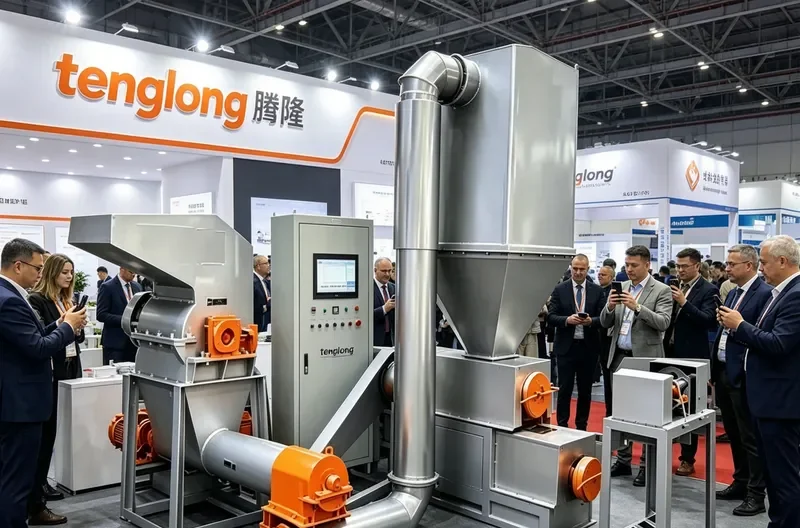
In the first kneading zone the pigment is wetted into the melted carrier. Wetting matters because a dry agglomerate surrounded by melt does not break efficiently; the liquid has to penetrate the cluster before shear can pull it apart. Loss-in-weight dosing feeds pigment, carrier, wax and additive to plus or minus 0.3% per component so the ratio stays stable while this happens.
The melt seal between the zones isolates the shear history. Without it, the first zone’s shear would be carried downstream and the carrier would overheat before dispersion finished. With it, the second zone applies fresh high shear to material that has already been wetted, breaking the remaining agglomerates below 20 microns.
A melt pump then pushes the melt through 200 mesh before the strand cutter, and the cutter produces pellets of 2 to 3 mm held to plus or minus 0.1 mm. High-pigment systems can run without a screen because the pressure drop through a fine pack at 60% loading is excessive. That choice is made against the formulation, not the machine.
Why film exposes the problem
A speck that is invisible in an injection moulding can dominate a 20 micron film. The film drawing process thins the material without changing the size of the pigment agglomerate, so a defect that was a small fraction of the pellet becomes a large fraction of the film thickness.
That is why speck counts are the acceptance test for a masterbatch line. A buyer will run a sample at a 2% let-down ratio and count defects per square metre. If the dispersion section is not doing its job, the count rises sharply and no amount of downstream filtration fixes it, because filtration removes particles larger than the mesh rather than de-agglomerating them.
The practical check is a magnification comparison. Look at a pellet cross-section and then at the drawn film. If the same pigment clusters appear in both, the masterbatch has not dispersed them. If the film is clean, the dispersion section is working and the fault lies elsewhere.
Loading changes the physics
At 20% pigment the carrier dominates the rheology and the screw behaves predictably. At 50% the pigment dominates, the melt viscosity rises, and the same screw speed delivers less output. Above 60% the relationship breaks down further and the practical limit arrives.
White masterbatch at 70% TiO2 is possible on the TL-MB-65 and 75 with a side feeder and a deeper-flighted screw, but output drops by roughly 40%. Most plants run 50 to 60% instead and reach the same let-down ratio with better dispersion. The extra pigment is not free: it costs output, raises torque and makes the product harder to disperse.
Black masterbatch at 30 to 50% carbon black behaves differently again, because carbon black is a low-density powder that needs a side feeder to avoid bridging at the main hopper. The machine configuration follows the pigment, which is why a masterbatch granulator is specified around a formulation rather than around a nominal throughput.
Specifying dispersion rather than output
Write the acceptance criterion as a speck count at a stated let-down ratio and film gauge. A buyer who orders ‘500 kg/h of masterbatch’ has specified the easy number and left the hard one undefined. Two suppliers will quote the same output and deliver very different film quality.
Then state the colour set and the changeover sequence. A line running eight colours a day needs the hydraulic barrel opening and the fifteen-minute screw extraction that the TL-MB provides. A line running one black grade all week does not, and should not pay for the changeover hardware.
Our granulator types page and twelve-platform comparison both set out where the masterbatch platform sits against general compounding lines. The distinction is useful: a compounding line is built for tonnage, and a masterbatch granulator is built for colour change and dispersion.
Pigment from powder port to film
Film specks are a dispersion measurement. The table follows the pigment from the powder port to the final let-down ratio.
| Stage | What happens | Measured result |
|---|---|---|
| Loss-in-weight dosing | Pigment, carrier, wax, additive weighed | +/- 0.3% per component |
| First kneading zone | Pigment wetted into melt | Agglomerates surrounded |
| Melt seal then second zone | Fresh high shear | Below 20 microns |
| Melt pump and 200 mesh | Pressure-stable filtration | Speck-free film grades |
| Strand cutter | Cube pellets cut | 2-3 mm, +/- 0.1 mm |
Questions buyers ask about this machine
Q1: Why does a masterbatch need a twin screw?
Dispersion needs two high-shear events separated by a melt seal, which a single screw cannot provide without excessive residence time. The TL-MB uses 36:1 to 44:1 twin screws with two dispersion zones so pigment breaks below 20 microns while the carrier stays cool.
Q2: What does 20 microns mean in practice?
It is the agglomerate size below which a pigment particle stops being visible as a speck in a thin film. Film drawing thins the carrier but not the agglomerate, so a cluster that is harmless in a pellet becomes a visible defect in a 20 micron film.
Q3: Can this line run 70% TiO2 white masterbatch?
On the TL-MB-65 and 75, yes, with a side feeder and deeper-flighted screw. Output drops about 40% and 70% is the practical limit. Most plants run 50 to 60% and reach the same let-down ratio with better dispersion.
Q4: Should a masterbatch line use strand or underwater cutting?
Strand is standard because buyers want cubic pellets that disperse predictably and changeover is easy to verify. Underwater is offered for 1.5 mm micro-pellets and pigments that smear in a strand bath. Both use the same frame, so the choice can be revisited later.
Related pages on this site: the twelve-platform comparison.
If you are working through the same machine family, these are the other Masterbatch Colour Change in 40 to 60 Minutes, Loss-in-Weight Dosing for Masterbatch: Hitting 0.3%, How Much TiO2 Can a Masterbatch Granulator Carry and Minimum Masterbatch Batch Size: 25 kg on the MB-35.
About the author
Zhou Gong (周工) is the recycling machinery engineer at TENGLONG Plastic Machinery in Linyi, Shandong — a plant of 18,000 m² with 30-plus staff, 12 platforms and 820-plus installations across 46 export markets. A pellet can look perfect and still fail in a thin film. I always ask to see the drawn sample, not the pellet. Where a figure is quoted here it has been measured or published with a date attached; nothing in this article is an estimate.
The quickest way to a real answer is to send the feed form, the contamination level and the throughput you need. A model and a price range come back within one working day, the trial on 10–20 kg of your material is free, and a result that misses the agreed output by more than 5% leaves the deposit refundable.