A two-stage granulating line gives melting and filtration to a 25:1 stage-one screw and pressure build-up to a short 12:1 stage-two screw. Stage one filters at modest pressure through an 80 to 100 mesh pack; stage two rebuilds the 80 to 120 bar the die needs.
Because die pressure is independent of screen condition, pellet size stays within plus or minus 0.2 mm as the pack loads. That is the difference between pellets a blown-film line accepts and pellets an injection moulder accepts.
Why the second screw exists
- Stage one melts, vents and filters at low, stable pressure.
- Stage two rebuilds 80 to 120 bar from clean melt.
- Screen life reaches four to six hours on dirty film.
- Energy is 5 to 8% higher on clean feedstock, lower per good tonne on dirty film.
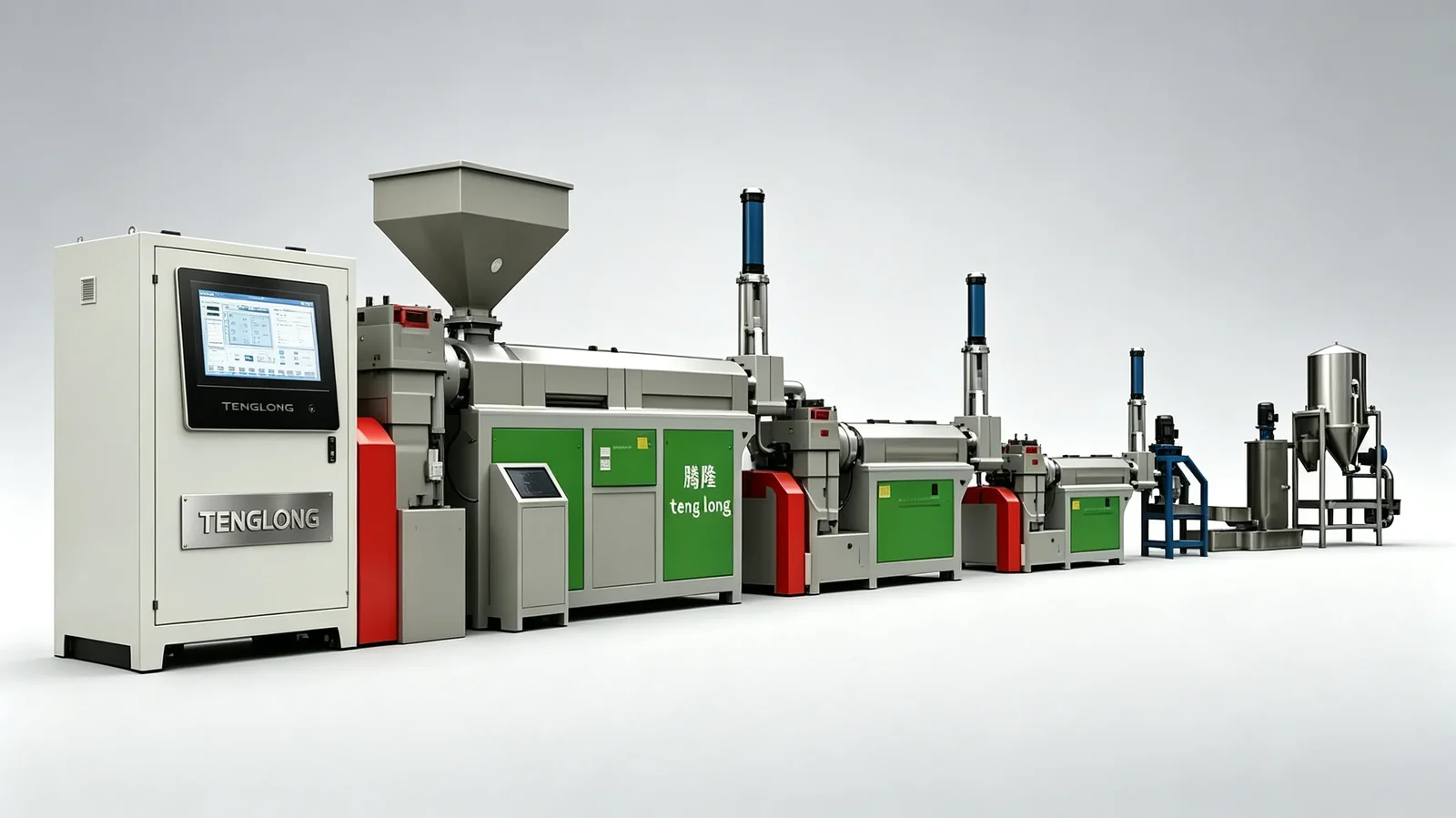
Two jobs, two screws
A single extruder asked to melt, vent, filter and pressurise dirty film has to do all four in one pass. As the screen loads, the pressure available at the die changes, and the pellet changes with it. A two-stage granulating line gives melting and filtration to the first screw and pressure build-up to the second.
The TL-2S stage one is a 25:1 grooved-feed extruder with a large-diameter screw and a hydraulic cutter-compactor feeding it directly. It melts at low shear, around 190 to 210 degrees C for LDPE, and pushes the melt through the screen changer at modest pressure.
Stage two is a short 12:1 screw that receives filtered melt at near atmospheric pressure and rebuilds the 80 to 120 bar the die needs. Because that pressure is independent of screen condition, pellet size stays within plus or minus 0.2 mm as the screen loads.
Why decoupling matters to the customer

The practical difference shows up at the receiving line. A blown-film customer needs pellets that melt at a predictable rate, and an injection moulder needs consistent volume per pellet. Both depend on pellet geometry being stable across the whole batch, not only at the start.
On a single extruder, pellets produced just after a screen change differ from those produced four hours later. The difference is small but measurable, and a customer running a tight process will find it. Decoupled pressure removes that variation.
The result is a product that can be sold to more demanding buyers. Our product page puts it plainly: the difference between selling to a blown-film line and selling to an injection moulder is whether pellet size holds as the screen loads.
Screen life is part of the same story
Stage one pushes melt through a 60 to 100 mesh pack at modest pressure, which is why the pack survives four to six hours on dirty film. A single long extruder pushing the same pack at higher pressure blinds it every 20 to 30 minutes.
Longer screen life changes the economics of the line. Fewer changes mean less off-specification product, less operator time and a steadier melt history for the material that stays in the barrel.
An automatic back-flush screen changer is offered for 100 mesh and finer duty, and a melt pump on stage two tightens pellet weight to plus or minus 0.3%. Each is an refinement on a design whose main advantage is already structural.
Where the two stage arrangement costs more
Energy is the honest trade. A two-stage line uses 5 to 8% more energy than a single stage on clean feedstock, because the second screw has to re-pressurise melt that a single screw would have handled in one pass.
On dirty film the comparison reverses. Specific energy per tonne of good pellets is usually lower on a two-stage line because there are far fewer production stops. The relevant metric is energy per saleable tonne, not kilowatts at a given moment.
Floor space and capital are also higher. The TL-2S-180 occupies 18 by 3 m and carries a 200 plus 90 kW motor pair, against a single line doing comparable clean-feed output. The extra stage has to earn its place through feedstock difficulty.
Sizing the two screws together
The published pairings are 120/130 mm at 300 to 400 kg/h with 75 plus 45 kW, 150/120 mm at 600 to 800 kg/h with 132 plus 55 kW, and 180/130 mm at 1,000 to 1,200 kg/h with 200 plus 90 kW. The second screw is shorter and smaller because it only builds pressure.
An interlocked start sequence prevents cold melt reaching the die, which matters more on a two-stage line because stage two can be pressurised while stage one is still heating. The interlock is a safety feature and a product-quality feature.
Ask for the pressure profile from the factory trial. A stable stage-two pressure trace is the clearest evidence that the design is doing what it should, and it becomes the baseline for later troubleshooting.
What each stage is responsible for
Two stages exist to keep die pressure independent of the screen. The table shows what each stage is responsible for.
| Stage | Screw | Job | Result |
|---|---|---|---|
| Stage 1 | 25:1, 120-180 mm | Melt, vent, filter | Low shear, 4-6 h screen life |
| Stage 2 | 12:1, 100-130 mm | Rebuild 80-120 bar | Pellet size +/- 0.2 mm |
| Changer | 60-100 mesh | Hold back contamination | Double-piston hydraulic |
| Cutter | Water ring | 2-4 mm pellets | Below 0.3% moisture |
| Interlock | Start sequence | Prevent cold melt at die | Protected product |
What buyers ask us before they order
Q1: Why does a two-stage line hold pellet size better?
Because die pressure is rebuilt by a second short screw after filtration. As the screen loads on a single extruder, pressure at the die falls and pellet geometry changes. The TL-2S holds 80 to 120 bar independently of screen condition.
Q2: How long does a screen last on dirty film?
Four to six hours with an 80 to 100 mesh pack on the TL-2S. A single long extruder on the same feedstock can blind the pack every 20 to 30 minutes. Stage one filters at modest pressure, which is the reason for the difference.
Q3: Does two-stage use more energy?
About 5 to 8% more than single stage on clean feedstock. On dirty film it is usually lower per tonne of good pellets, because there are far fewer production stops. Compare energy per saleable tonne rather than instantaneous power.
Q4: Can stage two be cleaned quickly?
Yes. The stage two screw can be pulled in about 30 minutes for cleaning or material change. That matters on a line handling printed film and frequent grade changes.
Related pages on this site: twin screw granulator, the twelve-platform comparison and factory testing.
If you are working through the same machine family, these are the other What a Cutter-Compactor Does: 60 to 300 kg/m3, How Wet Can Film Be Before You Need a Press, Screen Life on Dirty Film: Four to Six Hours and When a Single Screw Beats a Two-Stage Line.
About the author
Zhou Gong (周工) is a recycling machinery engineer at TENGLONG Plastic Machinery in Linyi, Shandong, where 30-plus staff work across 18,000 m² and 12 machine platforms covering 100 to 3,000 kg/h. The second screw is not there for output. It is there so the screen never decides your pellet size. Every figure used here has been measured on a machine or taken from a dated published source, not from a brochure.
Send the material form, the contamination level and your target output to our engineering team and you get a model and a price range within one working day. A test run on 10–20 kg of your own material is free, and if the measured output misses the agreed figure by more than 5%, the deposit is refundable.