The working floor for a masterbatch batch is about 25 kg on the TL-MB-35, enough to fill the barrel and hold a stable strand for roughly ten minutes. Below that, the material retained in the flow path is a large share of the batch value.
Three losses set the floor: the heel left in the machine, the purge needed for the next colour and the off-spec product made while temperature stabilises. The calculation is more useful than a nominal minimum because it reflects your pigment prices and your colour sequence.
Finding your own minimum
- Add heel, purge and startup off-spec in kilograms, then value them at formulation cost.
- Divide by saleable kilograms to get the loss per kilogram of product.
- Running light to dark in sequence reduces the purge loss on every batch.
- Match barrel volume to the batch; a larger machine holds proportionally more.

The small-batch question
Masterbatch buyers with many colours often need short runs. The question is not whether the machine can make five kilograms of a colour, but whether the material left in the machine at the end is worth more than the batch. That is the point where a run stops being economical.
The published working floor is about 25 kg on the TL-MB-35. That quantity fills the barrel and holds a stable strand for roughly ten minutes. Below it, the material retained in the screw and barrel during changeover exceeds a useful share of the batch value.
The number is not a hard limit. It is an economic boundary that moves with the pigment price and the cost of the purge carrier. A run of an expensive speciality pigment has a higher floor than a run of standard black, because the value of the lost material is higher.
Where the loss happens
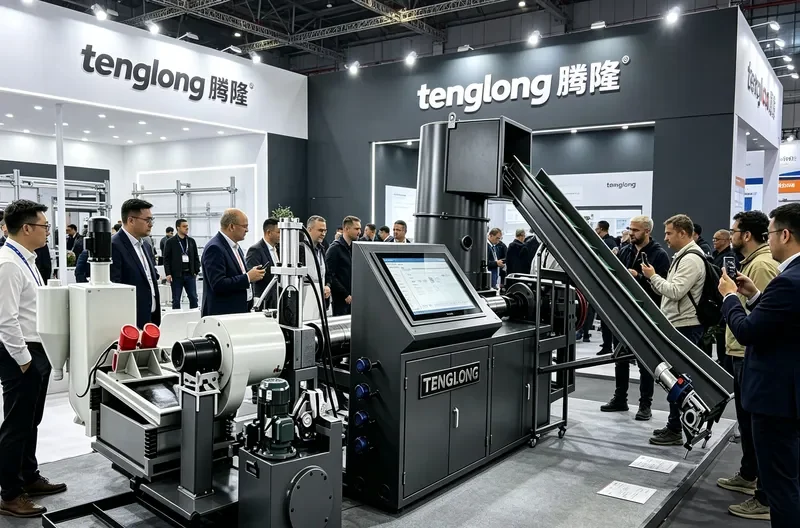
The first loss is the heel left in the feeders and the barrel when a run ends. The polished, dead-corner-free flow path on the TL-MB reduces this, but it cannot eliminate the material inside the screw channels at the moment the feed stops.
The second loss is the purge. A full dark-to-light change takes 40 to 60 minutes including purging with carrier, and the purge material is consumed rather than sold. On a short run the purge can be a larger mass than the batch itself.
The third loss is the startup off-specification material produced while temperature and strand stabilise. Twenty recipe memories on the PLC reduce this by recalling the correct profile, but a few minutes of product still fall outside tolerance at the start of every run.
Working out your own floor
Add the three losses in mass terms: heel, purge and startup off-spec. Then express each as a value using the actual formulation cost. Divide the total by the number of good kilograms in the batch, and you have the loss per kilogram of saleable product.
Compare that figure with the margin on the batch. If the loss per kilogram is a large fraction of the margin, the run is uneconomic regardless of what the machine can physically do. This calculation is more useful than a nominal minimum batch figure because it reflects your pigments and your prices.
The calculation also shows why sequencing matters. Running light to dark in sequence cuts changeover roughly in half, which reduces the purge loss on every subsequent batch. A well-planned schedule can move the economic floor downward without changing the machine.
Choosing the model for short runs
The TL-MB-35 is the smallest platform at 20 to 60 kg/h with a 35.6 mm screw and 4.5 by 1.2 m footprint. Its small barrel volume is what makes a 25 kg batch viable. A larger machine with the same batch would hold proportionally more material in the flow path.
The TL-MB-52 runs 100 to 180 kg/h, the MB-65 runs 250 to 350 kg/h and the MB-75 runs 400 to 500 kg/h. Each has a larger minimum economic batch because each holds more material. Buying a larger machine for occasional short runs is a common and expensive mistake.
If a plant needs both long runs of one grade and short runs of many colours, two machines are often cheaper than one large machine compromises. Our granulator types page discusses the trade between platform size and product mix.
Talking about minimums with a supplier
Ask a supplier to demonstrate the minimum batch with your pigment and to measure the output at the end of the run. A number quoted without a material and a purge specification is not a useful commitment.
Include the purge procedure in the acceptance test. The test should show how many kilograms of carrier are needed to return the melt to clear after a dark colour, because that number drives the economics of every short run.
Our engineering team returns a configuration and an output estimate within one working day when the pigment, carrier and colour sequence are supplied. The colour sequence matters as much as the formulation when the batches are short.
Working floor by model
Below a certain mass the machine consumes more than the batch is worth. The table gives the working floor by model.
| Model | Output range | Screw | Practical use |
|---|---|---|---|
| TL-MB-35 | 20-60 kg/h | 35.6 mm | About 25 kg minimum batch |
| TL-MB-52 | 100-180 kg/h | 51 mm | Medium runs, fewer colours |
| TL-MB-65 | 250-350 kg/h | 62.4 mm | High loading, 70% TiO2 |
| TL-MB-75 | 400-500 kg/h | 71 mm | Long runs, high output |
| Loss components | Heel + purge + startup | – | Value against batch margin |
Questions buyers ask about this machine
Q1: What is the smallest economical masterbatch batch?
Around 25 kg on the TL-MB-35, enough to fill the barrel and pull a stable strand for about ten minutes. Below that, material retained in the machine exceeds a useful share of the batch value.
Q2: Why does a short batch lose so much material?
Three losses apply: the heel left in the flow path, the purge needed for the next colour, and off-spec material produced while temperature and strand stabilise. On a short run the purge can be larger than the batch.
Q3: Does colour sequence change the minimum batch?
Yes. Running light to dark in sequence cuts changeover roughly in half, which reduces purge loss on every subsequent batch. A planned schedule moves the economic floor down without changing hardware.
Q4: Should I buy one large line or two smaller lines?
If the plant needs both long runs of one grade and short runs of many colours, two machines are often cheaper than one large machine that compromises both. Match the barrel volume to the batch, not to the theoretical maximum output.
Also worth reading: plastic pellet mill and request a quotation.
Three more notes from the same test floor: Masterbatch Dispersion: Why 20 Microns Decides Quality, Masterbatch Colour Change in 40 to 60 Minutes, Loss-in-Weight Dosing for Masterbatch: Hitting 0.3% and How Much TiO2 Can a Masterbatch Granulator Carry.
About the author
Zhou Gong (周工) is a recycling machinery engineer at TENGLONG Plastic Machinery in Linyi, Shandong, where 30-plus staff work across 18,000 m² and 12 machine platforms covering 100 to 3,000 kg/h. A five kilogram run is physically possible. It is just rarely worth doing once you count the purge. Every figure used here has been measured on a machine or taken from a dated published source, not from a brochure.
Send the material form, the contamination level and your target output to our engineering team and you get a model and a price range within one working day. A test run on 10–20 kg of your own material is free, and if the measured output misses the agreed figure by more than 5%, the deposit is refundable.