Seventy percent TiO2 is the practical loading limit on the TL-MB-65 and 75, with a side feeder and a deeper-flighted screw. It is possible, but output drops about 40% and dispersion becomes harder, which is why most plants run 50 to 60% and reach the same let-down with better product.
Loading is a trade, not a target. More pigment in the pellet reduces the carrier shipped, but it raises melt viscosity, shortens the dispersion window and slows purging. If dispersion worsens, the customer may need a higher let-down, which cancels the freight saving.
Where loading stops paying
- Seventy percent TiO2 needs a side feeder and deep screw, with about 40% output loss.
- At 50 to 60% the carrier still dominates rheology and dispersion stays stable.
- Carbon black at 30 to 50% is a feeding problem rather than a viscosity problem.
- Specify pigment, loading, speck count and minimum output together.
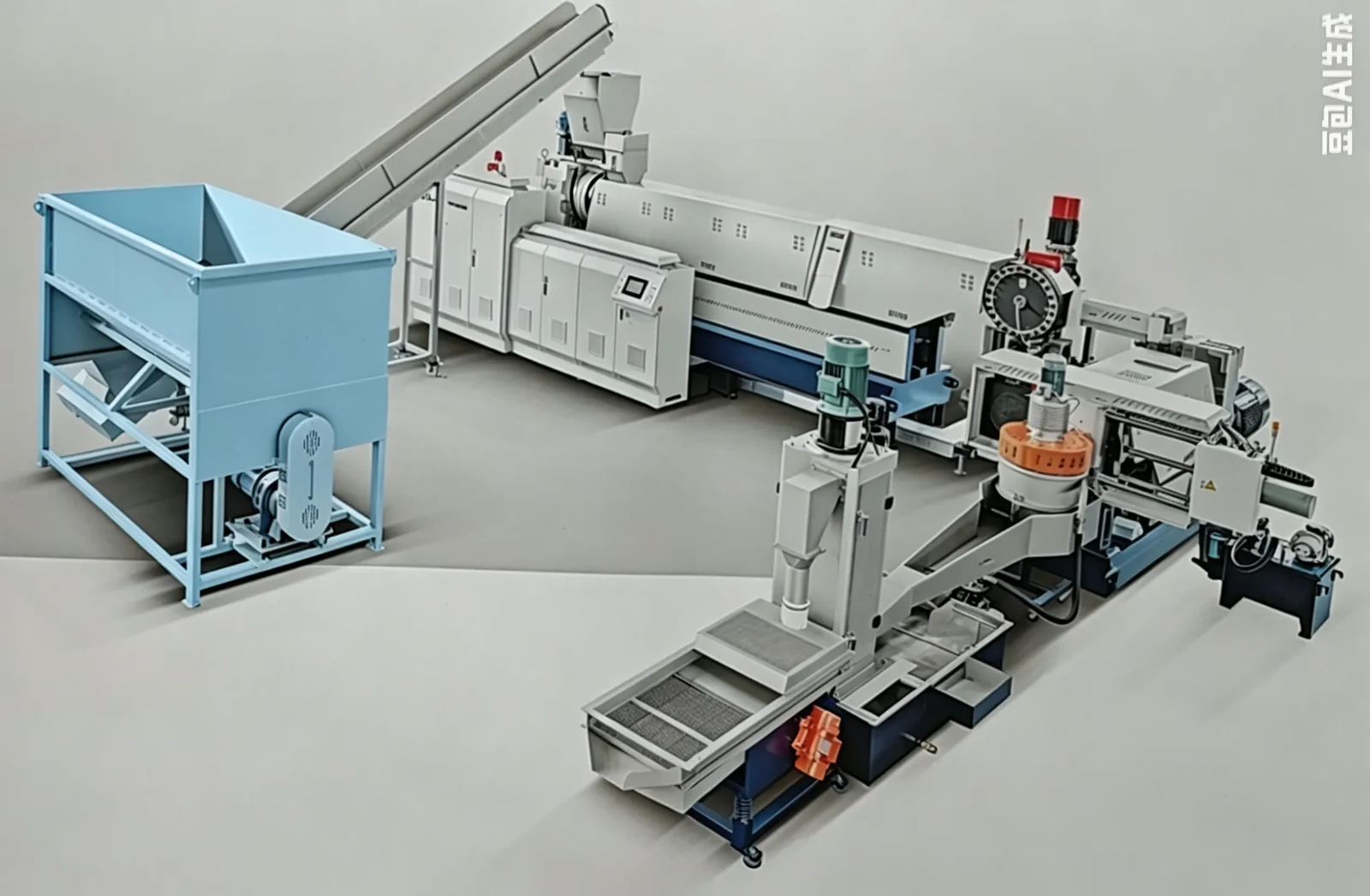
Loading is a trade, not a target
Buyers often ask for the highest pigment loading a line can reach, as if the number were a measure of machine quality. It is a trade. More pigment in the pellet means less carrier shipped to the customer, but it also means higher melt viscosity, more torque and a shorter residence window for dispersion.
The TL-MB is designed for 20 to 60% pigment loading. That range is where dispersion, output and changeover speed can all be held at acceptable levels. Outside it the machine still runs, but one of those three properties gives way.
White masterbatch is the clearest example. TiO2 at 50 to 70% is a common target because white is expensive to ship as a dilute pellet. The practical question is not whether the screw can carry it, but what happens to output and speck count at that loading.
The 70 percent case

The published answer is that TL-MB-65 and TL-MB-75 machines can run 70% TiO2 white masterbatch with a side feeder and a deeper-flighted screw. The side feeder is needed because TiO2 at that loading will not enter the main throat reliably alongside the carrier pellets.
The cost is a roughly 40% drop in output. A machine rated at 250 to 350 kg/h on a standard formulation will produce substantially less at 70% white, and the torque draw will be higher. The deeper-flighted screw helps convey the powder but does not remove the viscosity penalty.
Seventy percent is described as the practical limit, not a recommended setting. Above it, dispersion deteriorates faster than the shipping saving grows. Most plants run 50 to 60% and reach the same let-down ratio with better dispersion and more stable output.
Why 50 to 60 percent often wins
At 50 to 60% the carrier still dominates the melt rheology enough for the two dispersion zones to work as designed. Agglomerates break below 20 microns, the melt pump holds pressure through the screen, and the strand cutter produces consistent pellets.
The shipping calculation also favors the middle range more than it first appears. A customer using a 2% let-down needs the same amount of pigment regardless of its concentration in the masterbatch. Moving from 50% to 70% reduces the carrier shipped, but if dispersion worsens the customer may need a higher let-down to reach the same opacity, which cancels the saving.
Changeover is the third factor. High-loading white purges more slowly because the pigment content of the residual melt is high. A line running eight colours a day pays that purge cost on every change, which can outweigh the freight saving on a single grade.
Other pigments, other limits
Carbon black at 30 to 50% behaves differently. It is low-density and aerated, so the problem is feeding rather than viscosity. A side feeder and vacuum loading on the powder port prevent bridging, and the resulting masterbatch disperses well at moderate loading.
Filler masterbatch for PE film, typically calcium carbonate, can run at high loading because the filler is not a pigment and the dispersion requirement is different. The melt pump and screen are sized for the abrasive filler, and wear becomes the limiting factor rather than dispersion.
Additive masterbatches such as anti-block, UV and flame retardant are limited by the active package’s compatibility with the carrier rather than by loading alone. The formulation is usually supplied by the additive vendor and should be treated as fixed when the machine is specified.
Specifying loading in the contract
State the pigment, the loading, the acceptable speck count and the minimum output together. A quote that names only a loading figure is incomplete, because the same machine will deliver different output and quality for TiO2, carbon black and calcium carbonate.
Ask for a trial on your own pigment at the intended loading. Pigments from different suppliers have different agglomerate strength, and the dispersion result cannot be inferred from the chemical name. Our factory test procedure includes customer-material trials, and the result should be part of the acceptance record.
Our twelve-platform comparison shows where the masterbatch line sits against general compounding systems. If the target is high-volume filled compound rather than frequent colour change, a twin screw granulator may be the more appropriate platform.
Pigment loading and its consequences
Pigment loading has a practical ceiling where output and dispersion start to fight each other. The table marks where that happens.
| Loading | Configuration | Effect |
|---|---|---|
| 20-30% | Standard twin screw | Stable output, easy dispersion |
| 50-60% | Standard with side feed option | Common commercial range |
| 70% TiO2 | MB-65/75, side feeder, deep screw | Output down about 40% |
| 30-50% carbon black | Side feeder, dust extraction | Feeding is the limit |
| High filler | Melt pump, wear-resistant path | Wear is the limit |
Frequently asked questions
Q1: What is the maximum TiO2 loading on this line?
Seventy percent is the practical limit on the TL-MB-65 and 75 with a side feeder and a deeper-flighted screw. Output drops about forty percent at that loading, which is why most plants run 50 to 60% instead.
Q2: Why not always run the highest loading?
Higher loading raises viscosity and torque, shortens the dispersion window and slows purging. If dispersion worsens, the customer may need a higher let-down to reach the same opacity, which cancels the freight saving.
Q3: Does carbon black behave like TiO2?
No. Carbon black at 30 to 50% is mainly a feeding problem because it is light and aerated. A side feeder and dust extraction on the powder port solve it. TiO2 at high loading is mainly a viscosity and dispersion problem.
Q4: What should I put in the purchase specification?
Name the pigment, the loading, the acceptable speck count at a stated let-down and film gauge, and the minimum output together. Loading alone does not define the job, because different pigments behave very differently in the same screw.
Where this fits in the wider range: twelve-platform comparison.
Read next, if the same model is going on your line: Masterbatch Dispersion: Why 20 Microns Decides Quality, Masterbatch Colour Change in 40 to 60 Minutes, Loss-in-Weight Dosing for Masterbatch: Hitting 0.3% and Minimum Masterbatch Batch Size: 25 kg on the MB-35.
About the author
Zhou Gong (周工) is the recycling machinery engineer at TENGLONG Plastic Machinery in Linyi, Shandong — a plant of 18,000 m² with 30-plus staff, 12 platforms and 820-plus installations across 46 export markets. Ask for the maximum loading and I will ask what you are willing to lose in output. That is the real question. Where a figure is quoted here it has been measured or published with a date attached; nothing in this article is an estimate.
The quickest way to a real answer is to send the feed form, the contamination level and the throughput you need. A model and a price range come back within one working day, the trial on 10–20 kg of your material is free, and a result that misses the agreed output by more than 5% leaves the deposit refundable.