Hole diameter and land length set the pellet size, and every other figure in a die specification is subordinate to those two. Published hole ranges run 2.2–3.0 mm for rPET and 3.0–4.5 mm for filled compounds, and the land ratio runs 8–12 for rPET against 4–8 for rLDPE and rLLDPE.
The die shapes the strand and the cutter cuts it, so a fault on the die shows up as a size spread rather than as a broken pellet. Knowing which of the two you are looking at is what stops a week of blade changing on a die that was never the problem.
Two numbers decide the pellet
- Hole diameter sets the strand: 2.2–3.0 mm for rPET, 3.0–4.5 mm for reinforced compounds.
- Land ratio is 8–12 for rPET and 4–8 for rLDPE and rLLDPE.
- A long land strengthens the strand but traps heat, which hurts sensitive grades.
- Cutting adds ±0.2 mm for strand and ±0.15 mm for underwater, and that is the cutter.
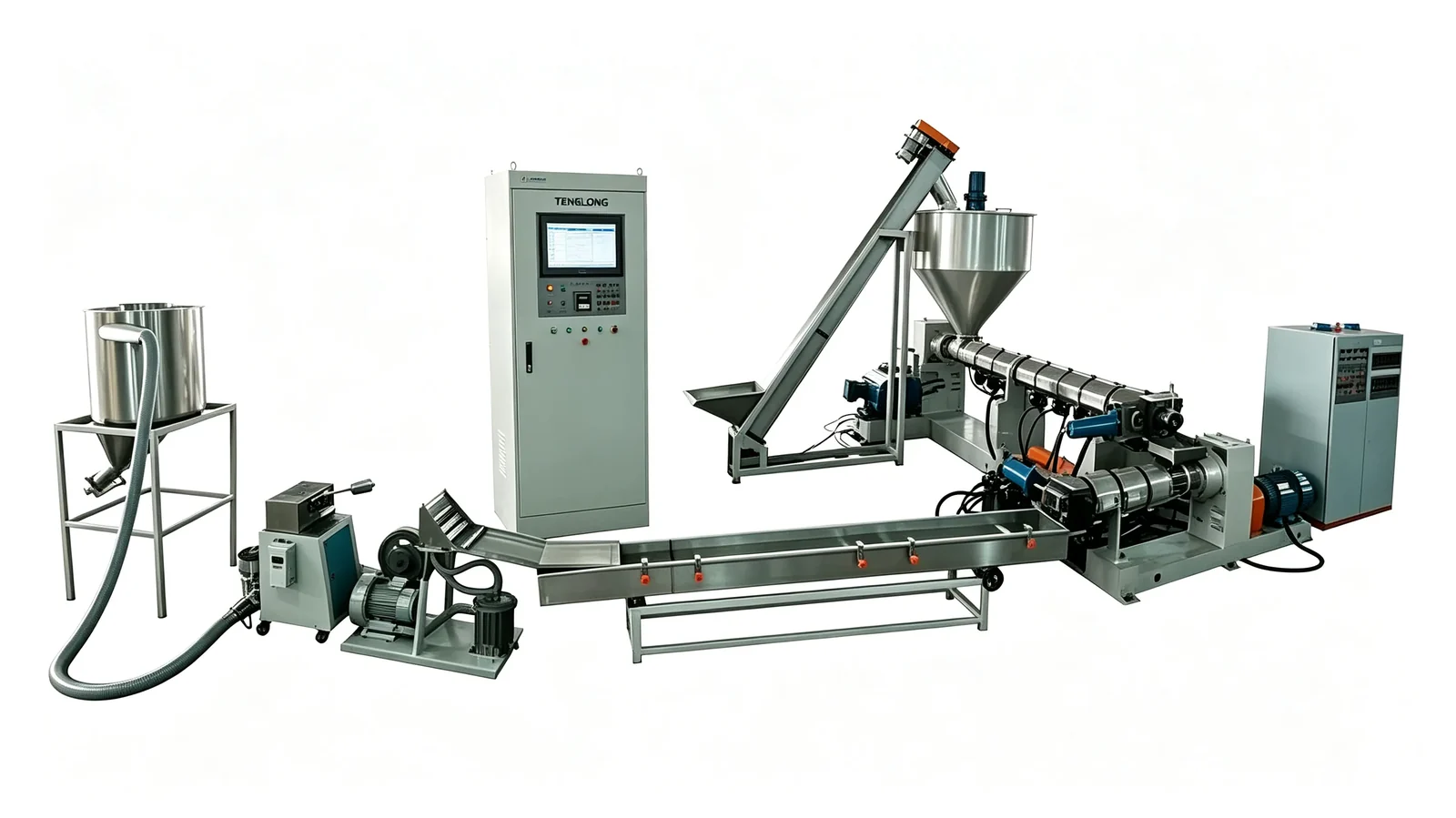
Hole Diameter Is the Pellet Size Being Bought
Hole diameter sets the strand diameter, and the strand diameter is what the cutter turns into a pellet. The published ranges are given by material, and they are specific: hole diameter is 2.2–3.0 mm for rPET, 2.5–3.5 mm for rigid rHDPE and rPP, 2.8–3.8 mm for rLDPE and rLLDPE, 2.0–3.0 mm for rPS and ABS and 3.0–4.5 mm for filled and reinforced compounds.
The logic behind the ranges is the market rather than the machine. Pellet size is 3 mm by default for injection and blow moulding, 2–2.5 mm for film and cable, and 4 mm for large mouldings; ±0.2 mm strand cutting and ±0.15 mm underwater cutting. A die that makes a 3.5 mm strand cannot be sold into a 2–2.5 mm market, however clean the melt is.
Hole diameter is also a pressure decision. A small hole at a given output needs a higher pressure drop across the land, which means more screw torque and more heat held in the melt. Choosing the hole to match the grade is cheaper than choosing the grade to match the hole.
Land Length Decides How Fast the Melt Leaves

The land is the straight bore behind the hole entry, and its length decides how much the melt is slowed down before it is cut. A longer land produces a stronger, more cylindrical strand because the melt is held back longer, and the same slowing keeps heat in the melt, which is where heat-sensitive grades begin to suffer.
The land length to diameter ratio runs 8–12 for rPET and 4–8 for rLDPE and rLLDPE in the published guidance. PET sits at the top of that range because a strand leaving the die too fast arrives at the cutter still soft and deforms; film sits lower because the same strand is cooled in water and needs less support.
Heat-sensitive grades are where a long land turns into a fault. Melt comes out of the die hotter and slower than it went in, and the residence time in the land is time the polymer spends at temperature with no shear to help it. On masterbatch pigments and PVC-based compounds I would shorten the land before I would cut the output.
Where the Die Ends and the Cutter Begins
The die does not cut; it shapes. The pellet cutter is the blade assembly after the die or water bath: 12-blade strand cutters, water ring die-face cutters or underwater cutters; blade condition sets dust level. Cutting accuracy is ±0.2 mm for strand and ±0.15 mm for underwater cutting, and both figures assume a clean blade cutting a steady strand.
A die that makes a 3.0 mm strand with a poor manifold does not produce 3.0 mm pellets; it produces a mixture. On a strand line you can see the problem on the strand itself. On a water ring pelletizer the die face is the cut surface, so a wandering strand becomes a short pellet with a tail on it.
The way to separate a die fault from a cutter fault is to look at the pellet. Melt strength problems, a pitted edge and a long tail belong to the die; a dusty face, a fuzzy cut and a lot of fines belong to the cutter. A fines level of 0.5% is the normal condition, and 2% is where a maintenance signal appears.
Changing Pellet Size on an Existing Die
Most plants do not buy a new die to change grade. They change the plate. A spare die plate changes the hole configuration without replacing the die body, and it is quoted at roughly 20 to 30% of the die cost. A plant running two grades should carry one spare plate for the grade it runs most.
The practical limit is the plate itself. A die plate is specified at 120–500 mm diameter, 10–100 holes and an aperture of 0.7–3.5 mm. Moving from 2.2 mm holes to 3.5 mm holes in the same plate means fewer holes or a bigger plate, and the bigger plate has to fit the die body already on the floor.
Land length is harder to change than hole diameter, because the land is machined into the plate or into the die body depending on the design. That is the practical reason the land ratio matters at quotation stage: once the die is made, the land is the number you cannot alter without pulling the head apart.
Specifying a Die That Makes the Grade You Want
Put hole diameter and land ratio in the purchase specification on the same line, and specify them per grade rather than per machine. The published die hole figures are given by material, so the specification belongs to the material: this plant runs rPET at 2.2–3.0 mm, that one runs rLLDPE at 2.8–3.8 mm.
State the tolerance you are buying. ±0.2 mm strand cutting and ±0.15 mm underwater cutting are published cutting figures, and they are what the cutter delivers, not what the die can promise on its own. On a PET pelletizing line for food-grade output, that gap is exactly why the die face is held to plus or minus 1 °C across the face under load.
The comparison of 12 models shows which platforms use which cutting arrangement, and the plastic pellets glossary defines the terms used in the specification. If a quotation does not state hole diameter, land ratio and cutting tolerance, it is selling a shape rather than a pellet, and the two are not the same product.
The published die figures, and what each one applies to
The table sets out the published die figures, and what each one applies to. One row here decides whether the strand holds together at the cutter.
| Published figure | Value | Applies to |
|---|---|---|
| Hole diameter for rPET | 2.2–3.0 mm | Bottle-grade recycled PET |
| Hole diameter for rigid rHDPE and rPP | 2.5–3.5 mm | Rigid regrind grades |
| Hole diameter for rLDPE and rLLDPE | 2.8–3.8 mm | Film grades |
| Hole diameter for rPS and ABS | 2.0–3.0 mm | Styrene grades |
| Hole diameter for filled and reinforced compounds | 3.0–4.5 mm | Compounds carrying filler or reinforcement |
| Land length to diameter ratio for rPET | 8–12 | Long land, strong cylindrical strand |
| Land length to diameter ratio for rLDPE and rLLDPE | 4–8 | Shorter land, higher pass rate |
| Cutting tolerance added by the cutter | ±0.2 mm strand, ±0.15 mm underwater | What the blade adds to the die |
Common questions, with short answers
Q1: What hole diameter gives a 3 mm pellet?
Published guidance puts hole diameter at 2.2–3.0 mm for rPET, 2.5–3.5 mm for rigid rHDPE and rPP, 2.8–3.8 mm for rLDPE and rLLDPE and 3.0–4.5 mm for filled and reinforced compounds. The strand leaves the die at the hole diameter, and the cutter sets the pellet from it.
Q2: What is the land length to diameter ratio for rPET?
The published ratio is 8–12 for rPET and 4–8 for rLDPE and rLLDPE. More land gives a stronger, more cylindrical strand and holds more heat in the melt, which is why heat-sensitive grades run shorter lands.
Q3: Does the die or the cutter decide the final pellet size?
The die sets the strand and the cutter cuts it. Strand cutting is held to ±0.2 mm and underwater cutting to ±0.15 mm, and the published range for normal fines is 0.5% with 2% treated as a maintenance signal.
Q4: Can the pellet size be changed after the die is delivered?
Hole diameter can be changed by fitting a different plate, and a spare die plate is quoted at roughly 20 to 30% of the die cost. Land length is harder, because it is machined into the plate or the body, so it should be fixed at quotation stage.
The rest of this series covers the same equipment from different angles: Die Head: What It Contains and How It Shapes the Melt, Sizing a Die Head and What It Costs, Die Head Acceptance and First-Week Faults and Choose a Die Head by Starting With the Pellet You Need.
About the author
Zhou Gong (周工) has spent his working life on recycling machinery at TENGLONG Plastic Machinery in Linyi, Shandong, where 820-plus lines have been delivered across 46 export markets since 2016. I keep a caliper in my pocket during commissioning, because two strands that look identical on the floor can still fill the bag with a different pellet. Each figure quoted here is either measured on a machine or published with a date attached; nothing has been estimated to fill a gap.
Give our engineers the material form, the contamination level and the throughput, and the answer comes back within a working day as a model and a price range. Running 10-20 kg of your own material is free, and a measured output more than 5% under the agreed figure puts the deposit back in your hands.