A die head is usually specified in the wrong order. Buyers start with the extruder and ask which plate fits, when the useful question runs the other way: what pellet has to leave the cutter, and what hole, land, manifold and heating arrangement will produce it consistently under the pressure the line can deliver.
Worked backwards this way, the specification becomes a short list of decisions rather than a catalogue number. The polymer sets the hole band, the grade sets the land and the steel, and the extruder sets the pressure rating the plate has to survive without bulging.
Writing a die specification that holds up
- Start from the pellet the customer buys, then set hole diameter and land length backwards from it.
- rPET sits at 2.2-3.0 mm holes; filled compounds at 3.0-4.5 mm with a harder plate.
- A twin screw can deliver 200-300 bar, so match the plate rating to the extruder, not to the polymer.
- A spare plate is roughly 20 to 30% of the die cost and avoids replacing the whole die body.

Start at the bagging point and walk backwards
The die head is the plate at the end of the extruder that shapes the melt into strands or feeds a die-face cutter. Hole diameter and land length set the pellet size, which means the specification should begin with the pellet the customer will actually buy, not with the extruder that happens to be on the floor.
That reversal matters in a recycling plant. Bottle-to-bottle rPET usually runs 8-12 mm flake upstream, but the pellet leaving the die is a different thing again, and the die is judged on the pellet rather than the flake. A die plate specified by diameter, hole count and hole diameter tells the supplier what is being made; a request for a general-purpose die does not.
The land length behind each hole decides how much the melt is slowed down before it is cut. A long land gives better melt strength and a more cylindrical strand, but it also holds heat in the melt, which is a problem for heat-sensitive grades. The right land is therefore a property of the material as much as of the pellet shape.
Read the hole table before the price table
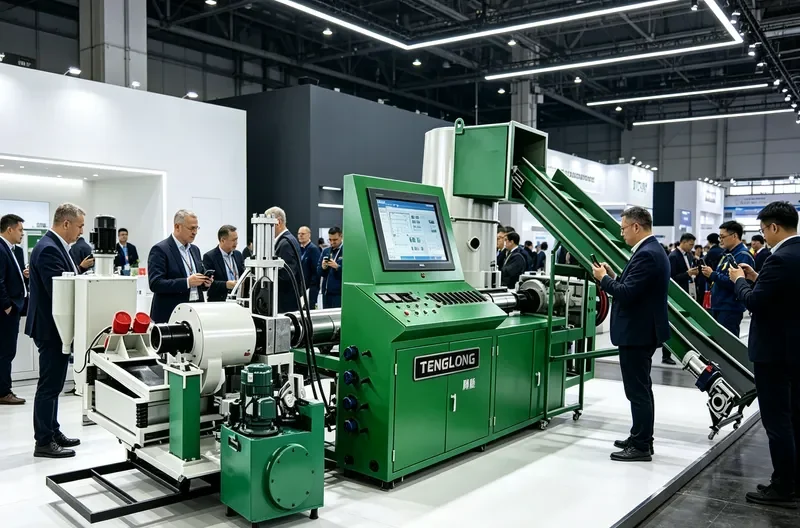
Published die hole guidance puts rPET at 2.2-3.0 mm, rigid rHDPE and rPP at 2.5-3.5 mm, rLDPE and rLLDPE at 2.8-3.8 mm, rPS and ABS at 2.0-3.0 mm, and filled and reinforced compounds at 3.0-4.5 mm. The land-to-diameter ratio runs 8-12 for rPET and 4-8 for rLDPE and rLLDPE.
Those bands are a starting point, not a permission to guess. The same guidance is given as an aperture of 0.7-3.5 mm with 10-100 holes on plates from 120-500 mm diameter, which is a wide enough range that two suppliers can quote genuinely different machines from the same one-line enquiry.
A spare die plate lets a plant change hole configuration without replacing the whole die body, and it is quoted at roughly 20 to 30% of the die cost. For a plant that runs more than one polymer, that is usually cheaper than trying to find one hole arrangement that compromises between all of them.
Pressure and manifold decide whether the holes stay even
A twin screw extruder can generate 200-300 bar and some high-torque lines exceed 400 bar, so a die that is not rated for the pressure bulges and loses dimensional accuracy. The pressure rating is a line in the specification that should be checked against the machine driving it, not against the general expectation for the polymer.
A coat-hanger or T-type manifold is what gives every hole the same pressure and temperature. A die without one produces uneven strands that the cutter turns into uneven pellets, and no downstream setting can repair the variation once the melt has been divided badly.
A basic die has 2 heating zones while a high-precision film die has 10 or more with independent control, and the die face should hold plus or minus 1 °C across the face under full operating load. Heat is the part that is easiest to under-specify and hardest to fix after installation.
Material decides how long the plate lasts
Standard tool steels such as P20 and H13 suit most polyolefins. Powder metallurgy steels cost 2-3 times more but last 5-10 times longer on abrasive compounds, nitriding raises surface hardness for abrasive filled materials, and hard chrome plating suits sticky polymers such as PVC.
The choice is an arithmetic question once the abrasion level is known. A plate that lasts five times longer for three times the price is worth considering on a filled grade running continuously, and it is hard to justify on a clean polyolefin line that changes colour more often than it wears out a plate.
Die plates are quoted at US$4,000-12,000 for standard tool steel, US$12,000-25,000 for mid-tier stainless and nitrided versions, and US$25,000-60,000 or more for premium specification plates. A standard 150 mm strand die for masterbatch runs US$5,000-15,000, while a complex 300 mm underwater die with an automatic screen changer can exceed US$50,000.
How to write the enquiry so one number is not misread
State the polymer, the target pellet diameter, the throughput and the die-face arrangement you intend to use. Add the maximum pressure the extruder can deliver and whether the grade is filled, reinforced or heat-sensitive, because those four details decide the hole band, the land, the steel and the number of heating zones.
Then ask the supplier which of those assumptions the quoted die is built for. A die built for rPET at one land ratio is not a die built for a filled compound, and a plate rated for a general extrusion line is not automatically rated for a high-torque twin screw.
Ask for the delivery term in the same breath. A published die plate listing gives delivery 25 days after the deposit is received, and a spare plate ordered later can hold up a hole change for longer than the change itself takes. Put the spare on the original order if the plant runs more than one recipe.
Die head specification by end use and polymer
The table sets out die head specification by end use and polymer. Start from the pellet you need and read the table upwards.
| End use or polymer | Hole and land guidance | The decision it drives |
|---|---|---|
| rPET | 2.2-3.0 mm holes, land-to-diameter 8-12 | Long land for melt strength without holding excess heat |
| Rigid rHDPE and rPP | 2.5-3.5 mm holes | General-purpose plate for a clean rigid feed |
| rLDPE and rLLDPE | 2.8-3.8 mm holes, land-to-diameter 4-8 | Shorter land for a grade that holds heat |
| Filled and reinforced | 3.0-4.5 mm holes; nitrided or powder metallurgy steel | Abrasion resistance and pressure rating come before price |
| PVC | Specialist material choice such as hard chrome plating | Sticky polymer behaviour, not hole size, sets the plate |
Questions buyers ask about this machine
Q1: What decides the pellet size from a die head?
Hole diameter and land length. Published bands run from 2.0-3.0 mm for rPS and ABS to 3.0-4.5 mm for filled compounds, with the land length deciding how much the melt slows before the cutter reaches it. Start from the pellet you need.
Q2: Does a die head need a manifold?
For consistent pellets, yes. A coat-hanger or T-type manifold equalises pressure and temperature across every hole. Without that equal flow the strands vary across the face and the cutter turns the variation into a size spread that no downstream setting can repair.
Q3: How hot does the die face have to be?
The face should hold within plus or minus 1 °C across it under full operating load. A basic die has 2 heating zones and a high-precision film die has 10 or more with independent control, so specify the zones for the grade being run.
Q4: Is a spare die plate worth buying with the machine?
Usually, if the plant runs more than one polymer. A spare plate is about 20 to 30% of the die cost and lets you change hole configuration without replacing the die body. Ordering one later can add 25 days or more to a recipe change.
Also worth reading: product range and granulator types.
Three more notes from the same test floor: Die Head: What It Contains and How It Shapes the Melt, Die Head Hole Size and Land Length: What Sets the Pellet, Sizing a Die Head and What It Costs and Die Head Acceptance and First-Week Faults.
About the author
Zhou Gong (周工) builds recycling lines at TENGLONG Plastic Machinery, a factory in Linyi, Shandong, with 18,000 m² of floor area, 30-plus staff and 820-plus lines delivered to 46 export markets. On the test floor I judge a die by the handful of pellets from the far end of the strand, because one uneven hole shows up there long before it shows up on a gauge. The numbers in this article come from test runs and from dated published sources, not from a sales sheet.
If you want a recommendation rather than a catalogue, send the material form, the contamination level and the target output. We return a model and a price range within one working day, and the test run on 10-20 kg of your own material is free before the balance is paid.