Filter area follows from one relationship: the filter area in square centimetres equals the melt flow in kg/h divided by the product of the filter factor, between 0.2 and 0.6, and the material density in g/cm³. A 500 kg/h HDPE melt needs about 250 cm² of filter area, and the same 500 kg/h of a lower-density polymer needs proportionally more.
The gauge on the filter tells you when the screen has done its job. Differential pressure across a clean screen is a steady baseline; a rise over a few hours means the screen is loading, and a jump means something solid is in the melt. Neither the extruder screw nor the die temperature explains a pressure curve that only moves at the filter.
The calculation and the reading
- Filter area (cm²) = melt flow (kg/h) ÷ (filter factor 0.2–0.6 × density in g/cm³).
- 500 kg/h of HDPE needs about 250 cm²; the same mass of a lighter polymer needs more.
- Change the screen on the differential pressure reading, not on a fixed clock.
- If the pressure moves but the filter gauge does not, the restriction is elsewhere — check the die and the screw before replacing screens.

The formula, and where the factor comes from
Filter area is the number that sizes a screen changer, and the industry-standard working rule is short enough to memorise: filter area (cm²) = melt flow (kg/h) ÷ (filter factor 0.2–0.6 × material density (g/cm³)).
The filter factor is the part people get wrong. It is not a constant — it rises as the material gets dirtier and as the mesh gets finer, because a fouled screen or a fine weave passes less and pushes harder. A clean, coarse screen on clean PE sits near the bottom of the range; a fine mesh on contaminated regrind sits near the top.
So the formula gives you a starting point, and the correct procedure is to calculate at the pessimistic end of the factor range for your duty, then confirm with the supplier using your actual material and your actual melt temperature.
Three worked examples
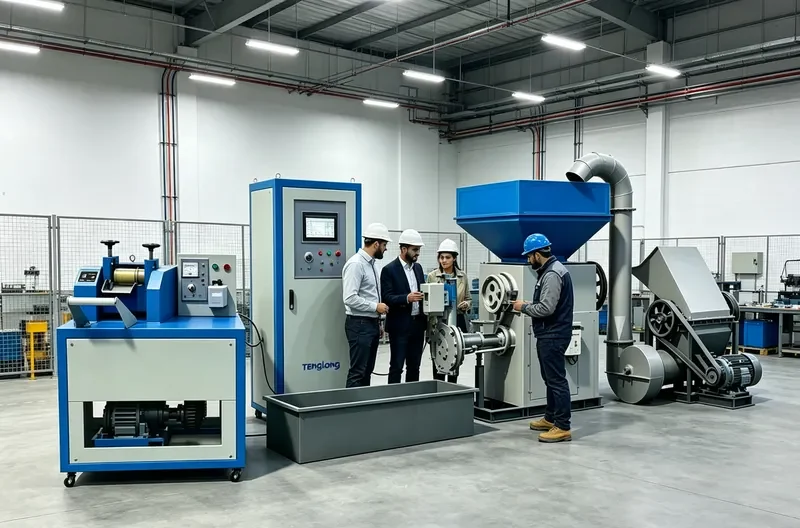
Example one — HDPE at 500 kg/h. Density around 0.95 g/cm³. With a filter factor of 0.3, the area is 500 ÷ (0.3 × 0.95) = about 1,754 cm². With a factor of 0.5, it doubles to about 2,900 cm². The guidance figure of roughly 250 cm² applies to the 0.2 factor case with a typical density, so read that number as the clean-feed floor rather than the answer for dirty regrind.
Example two — PP at 300 kg/h with fine mesh. Density around 0.90 g/cm³, factor 0.5 because of the mesh and the contamination. Area = 300 ÷ (0.5 × 0.90) = about 667 cm². On a two-stage line this splits into two roughly equal stages, which is why the second stage is specified independently rather than as a spare.
Example three — PET flake at 800 kg/h. Density around 1.38 g/cm³ and a moderate factor of 0.25. Area = 800 ÷ (0.25 × 1.38) = about 2,320 cm². PET sits at a higher density than polyolefins, which means the same area number covers less mass flow — worth checking, because PET lines are often specified on volumetric rather than mass flow.
Reading the differential pressure gauge
A screen changer that has a differential pressure indication lets you run to condition rather than to calendar, and that is the difference between predictable and reactive maintenance.
The pattern to learn is the shape of the curve, not one number. A screen that starts clean, rises slowly for the first few hours and then climbs steeply is behaving normally. A screen that jumps sharply within an hour is telling you something has arrived that the filter was not designed for — contamination, a film of degraded polymer, or a melt temperature that has drifted.
A screen whose pressure falls before it rises is usually a bypass or a seal problem rather than a fouling problem, and it is worth checking before assuming the filter needs changing.
Set the changeover trigger at a pressure where the extrusion is still running cleanly, with margin. Changing the screen at the point where the die pressure has already started to swing costs you the batch you were trying to protect.
Where pressure goes when it is not the filter
Rising die pressure is often blamed on the filter, and sometimes it is the filter. Sometimes it is not.
A narrowing die or a die plate with a partly blocked hole will produce the same rising pressure as a fouling screen, but it will not respond to a screen change. Check the die plate first if the pressure rises fast and the filter was changed recently.
Melt temperature drift changes viscosity and therefore pressure. A thermocouple that has drifted reads a setpoint it is not achieving, and the polymer is thicker than the panel says.
And on a line running multiple polymers, a recipe left in the PLC from the previous batch is a real and common cause: PP runs 10–15 °C hotter than LDPE, and running the wrong recipe changes both the melt pressure and the screen loading.
Filter area calculation worked through
Three real cases, worked through with the same formula, so the answer can be checked against your own numbers.
| Case | Melt flow | Density | Factor | Area needed |
|---|---|---|---|---|
| HDPE, clean feed | 500 kg/h | 0.95 g/cm³ | 0.2 | ≈ 2,630 cm² |
| HDPE, moderate contamination | 500 kg/h | 0.95 g/cm³ | 0.3 | ≈ 1,754 cm² |
| PP, fine mesh | 300 kg/h | 0.90 g/cm³ | 0.5 | ≈ 667 cm² |
| PET flake | 800 kg/h | 1.38 g/cm³ | 0.25 | ≈ 2,320 cm² |
What buyers ask us before they order
Q1: How do I calculate the filter area I need?
Area in cm² = melt flow in kg/h ÷ (filter factor 0.2–0.6 × material density in g/cm³). Use the pessimistic end of the factor range for contaminated material and fine mesh, then confirm with the supplier against your actual material and melt temperature.
Q2: What differential pressure should I change the screen at?
There is no universal number, because it depends on the filter factor you chose. The correct procedure is to log the pressure at the start of a clean interval and set the trigger at roughly 1.5 times that value, while the extrusion is still running cleanly. Change on the reading, not on the calendar.
Q3: Does filter area change with melt temperature?
Yes. Viscosity falls with temperature, so a hotter melt filters more easily and the same screen lasts longer. If the melt temperature drifts upward on a long run, expect the pressure curve to change shape, and check the thermocouple before you start changing screens more often.
Q4: Should every extruder have a two-stage filter?
Not every extruder, but every extruder running high-contamination feed. The second stage on a two-stage line is what decouples filtration pressure from die pressure, which is what allows the line to hold die pressure stable through a shift. On clean regrind a single hydraulic stage is enough.
The pages that come up most often alongside this one: auxiliary equipment index, twin screw extruder line and FAQ on output and energy.
The companion write-ups for this machine family are: Screen Changer for Plastic Extrusion: What It Does, Manual, Hydraulic or Continuous Screen Changer: Which?, Screen Change and Maintenance Routine for Plastic Extruders and Screen Changer Cost: What It Costs and What It Saves.
About the author
Zhou Gong (周工) builds recycling lines at TENGLONG Plastic Machinery, a factory in Linyi, Shandong, with 18,000 m² of floor area, 30-plus staff and 820-plus lines delivered to 46 export markets. The filter factor of 0.2 to 0.6 is not a constant. I quote the figure for the contaminated regrind case, because a 0.6 factor on clean virgin-grade melt is how you end up buying a filter twice the size you need. The numbers in this article come from test runs and from dated published sources, not from a sales sheet.
If you want a recommendation rather than a catalogue, send the material form, the contamination level and the target output. We return a model and a price range within one working day, and the test run on 10–20 kg of your own material is free before the balance is paid.