Size an agglomerator on kilograms per hour, and size it on the peak rather than the average. A plant that runs 400 kg/h for eight hours and 800 kg/h for two is not a 400 kg/h machine with a surge problem; it is an 800 kg/h machine that is idle half the time, and the published figures make that difference expensive.
The working rule in the 2026 supplier listings is simple: rotor power scales with throughput at roughly 0.2 kW per kg/h, and the rated rate assumes a bulk density close to 300 kg/m³. Loose agricultural film at 60 kg/m³ will not reach the catalogue number no matter which supplier writes it.
What actually decides the machine size
- Peak feed, not daily average. Size for the busiest hour the plant will see.
- Published 2026 range: 300 L at CNY 32,000, 500 L at CNY 52,000, 800 L at CNY 65,000, paired with 55 / 90 / 110 kW and a 1,000 rpm rotor.
- Three corrections move the number most: bulk density, contamination level, and how much of the run is film rather than rigid regrind.
- Two machines at half size usually beat one machine at full size on uptime, because a knife change on one unit does not stop the line.
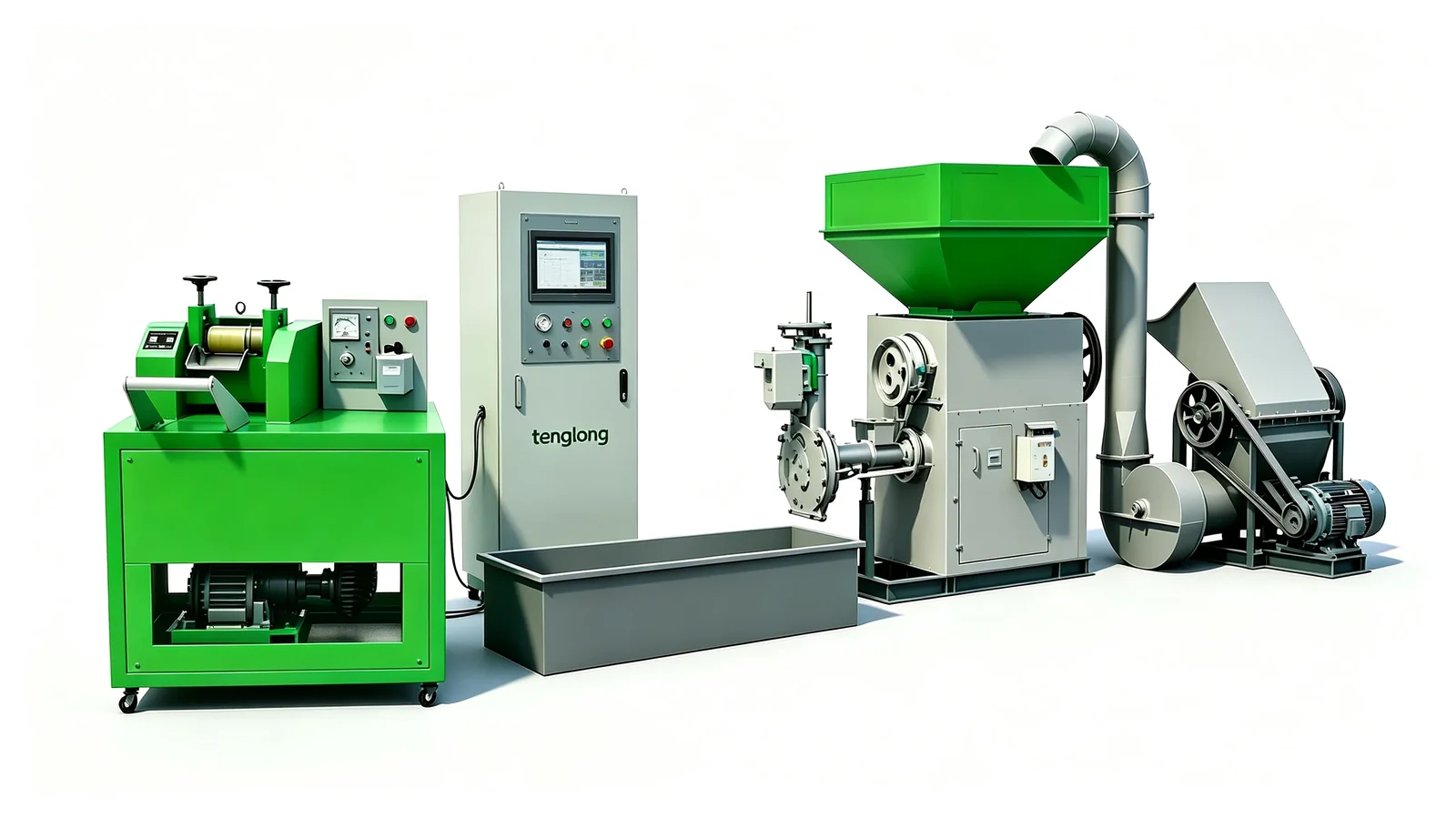
Start from the mass, not the volume
Sizing an agglomerator wrongly usually starts from the bale count. A buyer says “we have four tonnes of film a week”, and a machine is quoted on that number. But an agglomerator is rated in mass per hour, and the mass is what you have — the volume is a function of the material, not a fixed property you control.
So the calculation starts with the two numbers you can actually pin down: your peak feed rate in kg/h, and the bulk density of that feed in kg/m³. Peak matters more than average. A line that runs 500 kg/h for four days and 1,500 kg/h for the fifth needs a machine that can hold the fifth, because buying a second agglomerator costs more than the power you waste running a large one at 40% load.
Turn peak feed into the numbers the supplier quotes

Suppliers in this market quote three numbers: chamber or bowl volume in litres, installed motor power in kW, and rated throughput in kg/h. The relationship between them is close enough for first-pass sizing and worth understanding, because it is what lets you compare quotations that quote different things.
From published 2026 listings, the common pattern is a 300 L chamber with 55 kW at about 300 kg/h, a 500 L chamber with 90 kW at about 400 kg/h, and an 800 L chamber with 110 kW at about 500 kg/h, with rotor speeds around 1,000 rpm. Read that as roughly 55–70 kg of throughput per kW of installed power, and roughly 0.6–0.7 kg of capacity per litre of chamber volume.
So for a peak feed of 1,000 kg/h of dry, loose agricultural film, the arithmetic points at roughly 1,400–1,800 L of chamber and 1,500–1,800 kW of installed power — which means a machine at the top of the published range, or two smaller machines running in parallel.
Divide by two if you are unsure whether your quoted figure is screw throughput or finished output. We quote finished, bagged pellets averaged over four hours, which runs 3–6% below extruder throughput because of fines, purges and start-up. A supplier quoting screw throughput is quoting a different, larger number, and comparing the two directly is how buyers end up short.
Adjust for the three factors that move the number most
Three variables change the answer materially, and all three should be discussed explicitly rather than absorbed into a single fudge factor.
Moisture. Water has to be driven off before the material will hold a chunk, and that takes heat and time. A 500 kg/h figure quoted for 3% moisture does not hold at 8%. If your material arrives wet, either dewater it before the agglomerator or accept a lower rate.
Bulk density of the incoming feed. Denser feed means less volume per kilogram, so the same chamber handles more mass per cycle. Loose film at 20 kg/m³ is a harder duty than baled film at 60 kg/m³.
Contamination. Sand, paper and grit act as an abrasive against the knives and the chamber wall. Above roughly 8% contamination, washing before densification is cheaper than replacing wear parts faster — the same threshold we use across the whole plant.
Two sizing mistakes that cost real money
The first mistake is sizing to average load. It is the most common and the most expensive, because the machine is present for the peak and idle for the rest of the week.
The second is forgetting the downstream machine’s appetite. An agglomerator that is slightly larger than the pelletizer is fine — the pelletizer sets the pace and the agglomerator buffers. An agglomerator that is smaller than the pelletizer starves it, and a starved screw does not run slower; it runs unevenly, with surging pressure, unstable pellet size and more screen changes. The buffer goes upstream of the constraint.
Published 2026 agglomerator specifications and the sizing ratio
Published 2026 specifications put a common relationship between rotor volume, power and rated output. That relationship is what you size against.
| Chamber volume | Installed power | Rated throughput | kg/h per kW |
|---|---|---|---|
| 300 L | 55 kW | 300 kg/h | 5.5 |
| 500 L | 90 kW | 400 kg/h | 4.4 |
| 800 L | 110 kW | 500 kg/h | 4.5 |
Questions buyers ask about this machine
Q1: How much power does an agglomerator need per kg of output?
From published 2026 listings, roughly 0.18–0.23 kW of installed power per kg/h of rated throughput. A 500 kg/h machine therefore carries about 90–110 kW of installed power, and at 6,000 running hours a year that is a material electricity line — which is why moisture upstream of the agglomerator is worth more attention than the machine price.
Q2: Should I quote peak or average capacity?
Peak, always, and tell the supplier your duty cycle explicitly. If you quote peak and the machine arrives sized for it, you have margin. If you quote average, you are one busy week away from a line that starves, and the remedy at that point is a second machine on an emergency lead time.
Q3: Is one big agglomerator better than two smaller ones?
Two smaller machines in parallel give you redundancy and easier maintenance scheduling, and they let you tune one for film while the other runs bags. One large machine is cheaper per unit of capacity and simpler to run. For a single-product plant that never stops, one large machine is usually right; for mixed feed or a plant where downtime is expensive, two is the better bet.
Q4: Do I need a screen changer upstream of the agglomerator?
No. There is no melt to filter at this stage. The melt filter and screen changer belong to the pelletizing stage downstream — they are covered in the auxiliary equipment index along with the die head, pellet cutter and mixing tank.
Further reading on this site: auxiliary equipment, plastic recycling equipment, single screw granulator, film granulating line and the 12-platform comparison.
The rest of this series covers the same equipment from different angles: Plastic Agglomerator Machine: What It Does and Its Limits, Plastic Agglomerator Maintenance: Knife Clearance and Uptime, Plastic Agglomerator in a Film Recycling Line: Layout and How to Test a Plastic Agglomerator Supplier Before You Pay.
About the author
Zhou Gong (周工) builds recycling lines at TENGLONG Plastic Machinery, a factory in Linyi, Shandong, with 18,000 m² of floor area, 30-plus staff and 820-plus lines delivered to 46 export markets. I size these from a week of weighed feed rather than from a truckload estimate, because the difference between a bought volume and a weighed volume is often the whole sizing error. The numbers in this article come from test runs and from dated published sources, not from a sales sheet.
If you want a recommendation rather than a catalogue, send the material form, the contamination level and the target output. We return a model and a price range within one working day, and the test run on 10–20 kg of your own material is free before the balance is paid.