In a film recycling line the agglomerator belongs after size reduction and before the extruder, and the reason is feed pressure rather than preference. The extruder needs a dense, continuous column of material; a buffered hopper that empties in twenty minutes and then starves cannot deliver that, no matter how good the screw is.
Plan the line with a buffer after the agglomerator and before the extruder, and plan it as a working volume rather than as a hopper. The stages around it are fixed by physics: you cannot wash material after it has been melted, and you cannot densify material that still contains the water and the label you were trying to remove.
The layout decisions that are expensive to undo
- Order of stages is not negotiable: shred, wash, dry, densify, extrude, cut.
- Allow a buffer after the agglomerator so the extruder is fed from stored density rather than from the densifier directly.
- Leave room for screen changes, knife changes and pallet access along the whole line, not only at the extruder.
- A full film recycling plant with washing and pelletizing needs roughly 32–58 m of line length; plan the footprint before the equipment is ordered.
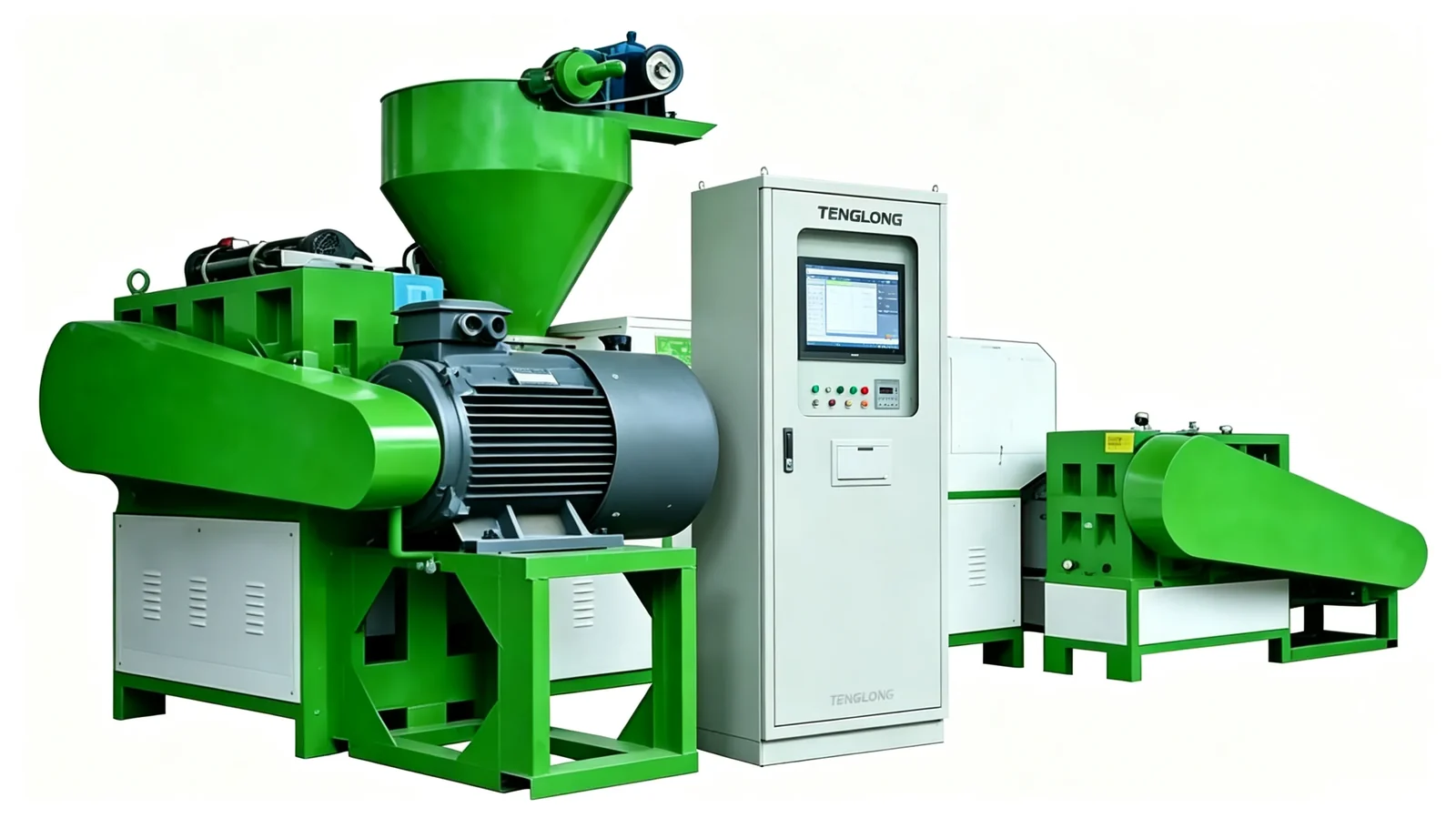
The order of the stages, and why it is not negotiable
A film recycling line that includes an agglomerator runs in a fixed order, and the order follows the material’s condition rather than convenience.
First the bale is opened and the loose dirt comes off. Second, labels and shrink sleeves are removed mechanically, before anything is cut small, because a sleeve that is still wrapped around a bottle is far easier to strip off the whole bottle than off a flake. Third, the bottles or film are crushed. Fourth, and only then, the material is washed and separated. Fifth, it is dewatered. Sixth, it is agglomerated. Seventh, it goes to the extruder.
Every one of those steps exists to make the next one work. Agglomerating before washing concentrates contamination instead of removing it. Agglomerating before dewatering means driving water out with friction heat, which is slower and costs more electricity than a dewatering step that costs almost nothing.
Sizing the buffer between stages
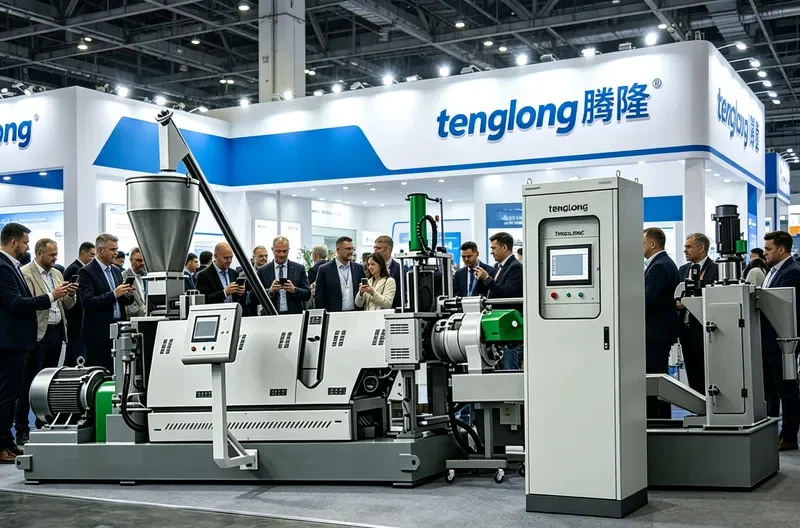
Agglomeration is a batch process and extrusion is a continuous one. That mismatch is what makes the layout interesting.
The buffer goes between them. A surge bin or accumulator ahead of the agglomerator absorbs the pulses from the washing line; a second buffer after it feeds the extruder at a steady rate. The two buffers together decouple the batch stages from the continuous stage, and that is what lets the line run without an operator constantly throttling the feed.
Sizing those buffers is a judgement about which stage you want to hold the line up when another stage stops. If the washing line is the constraint — usually it is, because washing is slower and wetter — then the buffer in front of the agglomerator should be the generous one. If you want the plant to survive an agglomerator knife change without stopping the wash section, the downstream buffer needs the volume.
On floor space, the published figures we work to are 8–12 m for a strand line, 5–7 m for a water ring line, 15–18 m for a two-stage line, and 32–58 m for a complete washing plus pelletizing plant. Add 1.5 m of maintenance access on the drive side and 2 m at the control cabinet. A line that leaves less than that is a line whose technicians work in crawl spaces.
Three sequencing errors that force a rebuild
The first error is putting the agglomerator before the washer. It is tempting because the agglomerator is the machine with the visible output, and the washer is a series of tanks. The consequence arrives later: contaminated chunks are much harder to clean than contaminated flake.
The second is feeding the extruder directly from the agglomerator discharge with no buffer. Every time a batch ends, the extruder runs dry for the length of the next cycle, and a screw that runs dry is a screw that scorches. This is the single most common cause of the yellow pellets and black specks that customers complain about.
The third is installing the control cabinets on the drive side of the line. It saves a few metres of cable and puts an operator between a hot machine and the panel, in a wet area, every time they need to read a screen.
What the layout has to leave room for
Three things are routinely missing from a layout drawn on paper. Maintenance access is the first: the drive side needs 1.5 m and the control cabinet needs 2 m, and both are non-negotiable if you intend to keep unplanned stops under 2%.
The second is a weighbridge or at least a platform scale at the agglomerator discharge. Without a way to measure output per batch, you cannot verify the machine is running at its rated rate, and every performance dispute with a supplier becomes an argument.
The third is waste handling. Agglomeration produces dust and rejected material, and that has to go somewhere. A dust cyclone with its own collection is part of the machine, but the space to empty it is not on most drawings.
Stage order in a film line with agglomeration
The order below is the order the material has to travel in, whatever the machine brand.
| Order | Stage | Purpose | Why it cannot move |
|---|---|---|---|
| 1 | Bale opener and pre-wash | Remove wire, sand and loose dirt | Abrasive contamination damages every downstream machine |
| 2 | Label remover | Strip sleeves and labels from whole bottles | Far easier to strip before crushing |
| 3 | Crusher | Reduce to 25–30 mm | Defines the size the washer works on |
| 4 | Wash and separate | Remove labels, glue, oil and light fraction | Cleaner and cheaper than removing contamination later |
| 5 | Dewater | Bring moisture below 2% | Drying by friction heat costs far more electricity |
| 6 | Agglomerate | Raise bulk density for stable feeding | Needs dense, dry, clean feed to chunk properly |
| 7 | Extrude and cut | Melt, filter, pelletise | Needs a steady, dense feed to hold pressure |
What buyers ask us before they order
Q1: Where should the agglomerator go relative to the washer?
After washing and dewatering, immediately before the extruder. Agglomerating before washing concentrates the contamination instead of removing it, and agglomerating wet material means driving off water with friction heat rather than with a mechanical dewatering step.
Q2: How much space does a film recycling line need?
A complete washing plus pelletizing plant is 32–58 m depending on capacity and configuration. A strand line alone needs 8–12 m, a water ring line 5–7 m, and a two-stage line 15–18 m. Add 1.5 m of maintenance access on the drive side and 2 m at the control cabinet.
Q3: Do I need a buffer between the agglomerator and the extruder?
Yes. Agglomeration is batch and extrusion is continuous. Without a buffer the screw runs dry between batches, and a dry screw scorches the melt — that is the usual origin of yellowed pellets and black specks that get blamed on the pelletizer rather than on the layout.
Q4: Can an existing line be retrofitted with an agglomerator?
It is a reasonable question and the answer depends on where the space comes from. The machine itself fits in a modest footprint; the difficulty is usually the buffer storage and the access clearances around it. If you send us the layout drawing and the hourly feed rate, we will tell you whether it fits before you commit.
Where this fits in the wider range: turnkey pelletizing solutions, applications by industry and contact for a layout review.
Read next, if the same model is going on your line: Plastic Agglomerator Machine: What It Does and Its Limits, How to Size a Plastic Agglomerator Machine for Film Scrap, Plastic Agglomerator Maintenance: Knife Clearance and Uptime and How to Test a Plastic Agglomerator Supplier Before You Pay.
About the author
Zhou Gong (周工) is a recycling machinery engineer at TENGLONG Plastic Machinery in Linyi, Shandong, where 30-plus staff work across 18,000 m² and 12 machine platforms covering 100 to 3,000 kg/h. The layout review I do free of charge is mostly about access: a line that cannot be unbolted at the side is a line that will be repaired badly at two in the morning. Every figure used here has been measured on a machine or taken from a dated published source, not from a brochure.
Send the material form, the contamination level and your target output to our engineering team and you get a model and a price range within one working day. A test run on 10–20 kg of your own material is free, and if the measured output misses the agreed figure by more than 5%, the deposit is refundable.