The TL-2S handles up to 8% surface moisture with standard venting because stage one removes water before filtration. Above that, a mechanical dewatering press is the recommendation: drying film with heat costs about three times more than squeezing the water out.
Take samples at the feed point across a full shift and design to the top of the observed range. Distinguish surface water, which a press removes, from absorbed moisture, which needs heat. PE and PP film mostly carry surface water, which is why the press works well.
Finding the moisture boundary
- Standard two-stage venting handles up to about 8% surface moisture.
- Above 8%, add a press upstream of the extruder.
- Squeezing uses roughly a third of the energy of evaporation.
- Sample across a shift and specify at the observed maximum.
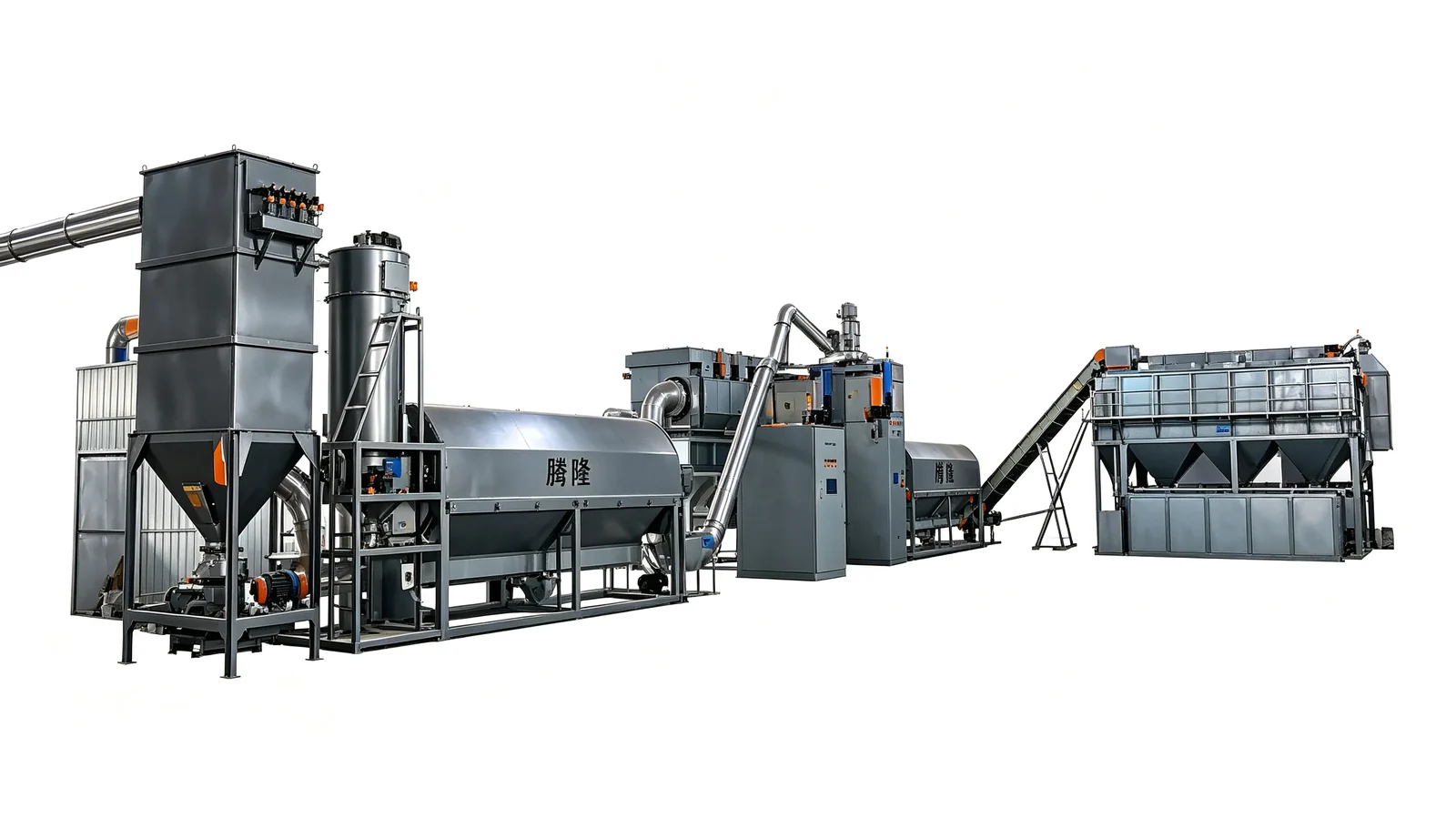
Eight percent, with a reason
The TL-2S handles up to 8% surface moisture with standard two-stage venting, because stage one vents before filtration. That is a generous limit compared with many extrusion lines and it reflects the order of operations: remove water before the material meets a fine screen.
Above 8%, the recommendation is a mechanical dewatering press upstream. The reason is simple and worth repeating: drying film with heat costs about three times more than squeezing the water out mechanically.
Post-consumer agricultural film often exceeds 8% after washing, especially when it has been baled outdoors. The moisture figure has to be measured on material leaving the washing stage, not on film as collected.
Why venting comes before filtration

Water in the melt turns to steam and disrupts the screen pack as well as the die. By venting in stage one, before the material passes through the 60 to 100 mesh changer, the line removes most of the water while the melt is still at modest pressure.
A single extruder has to vent and filter in the same pass, which is a compromise. The two-stage arrangement gives each job its own space, and that is why it tolerates wetter feedstock than a single screw of similar output.
Two-stage vacuum venting is offered as an option for heavily printed film. Ink volatiles behave like moisture in the vent, and removing them before filtration protects both the screen and the final pellet colour.
The press calculation
Compare the cost of a press with the value of the output and quality lost to excess moisture. At each percent above the venting limit, steam in the barrel reduces capacity and increases specific energy, and pellets can carry voids.
A screw press removes free water without changing phase, so its energy demand is much lower than evaporation. Our turnkey line uses a press followed by a three-stage hot-air dryer, with exhaust heat recovery cutting gas use by 25%.
The press also stabilises the feed. Flake or film with variable moisture gives variable output, and a press narrows that variation. On a line selling to a customer with tight delivery schedules, stability has a value beyond energy.
Measuring the real moisture
Take samples at the feed point over a full shift, not once. Film leaving a washing line can be wetter at the start of a run and drier at the end, and a single sample describes only one moment.
Distinguish surface water from water absorbed into the polymer. A press removes surface water effectively; absorbed moisture in materials such as PA needs thermal drying. PE and PP film mostly carry surface water, which is why a press works well here.
If the measured value sits close to 8%, test the material at the top of the observed range rather than the average. Designing to the average is how a line ends up with a moisture problem three weeks after commissioning.
Putting the limit in the specification
State the moisture at which the line is guaranteed, the point at which a press is required, and who supplies that press. A buyer who assumes the extruder can handle any wet film will dispute the performance test later.
Ask for a trial at the higher moisture level. Our factory test procedure records output, melt pressure and specific energy on the customer’s own material, which gives a defensible basis for the guarantee.
Our washing line equipment page describes the dewatering stages that precede a pelletizing line. Reading the two specifications together avoids the common error of sizing the extruder without sizing the drying stage.
Moisture and the response
Surface moisture has a boundary where squeezing beats heating. The table shows that boundary in operating terms.
| Surface moisture | Standard response | Why |
|---|---|---|
| Up to 8% | Two-stage venting | Stage one vents before filtration |
| Above 8% | Mechanical dewatering press | Squeezing costs about a third of heating |
| Heavily printed film | Two-stage venting option | Ink volatiles removed before screen |
| Absorbed moisture | Thermal drying | A press removes free water only |
| Variable moisture | Sample across a full shift | Design to the observed maximum |
Questions buyers ask about this machine
Q1: How wet can film be on a two-stage line?
Up to about 8% surface moisture with standard two-stage venting, because stage one vents before filtration. Above that, a mechanical dewatering press is recommended.
Q2: Why is a press cheaper than a dryer?
Drying film with heat costs roughly three times more than squeezing the same water out mechanically. A press removes free water without changing phase, and it also stabilises the feed.
Q3: Does venting remove ink from printed film?
It removes volatile components including ink carriers. Two-stage vacuum venting is offered as an option for heavily printed film, removing them before they reach the screen and the die.
Q4: When should I take moisture samples?
Across a full shift at the feed point. Material leaving a washing line varies through a run, and a single sample describes only one moment. Specify the line at the top of the observed range, not the average.
The pages that come up most often alongside this one: flakes pelletizing machine.
The companion write-ups for this machine family are: Two-Stage Die Pressure: Why Pellets Hold 0.2 mm, What a Cutter-Compactor Does: 60 to 300 kg/m3, Screen Life on Dirty Film: Four to Six Hours and When a Single Screw Beats a Two-Stage Line.
About the author
Zhou Gong (周工) is the recycling machinery engineer at TENGLONG Plastic Machinery in Linyi, Shandong — a plant of 18,000 m² with 30-plus staff, 12 platforms and 820-plus installations across 46 export markets. Design for the wettest load you expect. The average is a number that never arrives. Where a figure is quoted here it has been measured or published with a date attached; nothing in this article is an estimate.
The quickest way to a real answer is to send the feed form, the contamination level and the throughput you need. A model and a price range come back within one working day, the trial on 10–20 kg of your material is free, and a result that misses the agreed output by more than 5% leaves the deposit refundable.