Loose agricultural film has a bulk density around 60 kg/m3 and wraps around a screw throat rather than feeding it. The cutter-compactor on the TL-2S accepts whole film and woven bags, cutting and densifying them to more than 300 kg/m3 before they reach the screw.
A rotating cutter and a water spray do the work: the cutter reduces the film, the spray controls heat and helps fragments clump into pieces that fall cleanly. That makes a compact extruder possible without a separate crusher.
What densification changes
- Bulk density rises from about 60 to over 300 kg/m3.
- Whole film enters; no pre-crushing machine is needed.
- The water spray prevents material sticking to the chamber wall.
- A stable torque trace confirms the screw receives a steady feed.
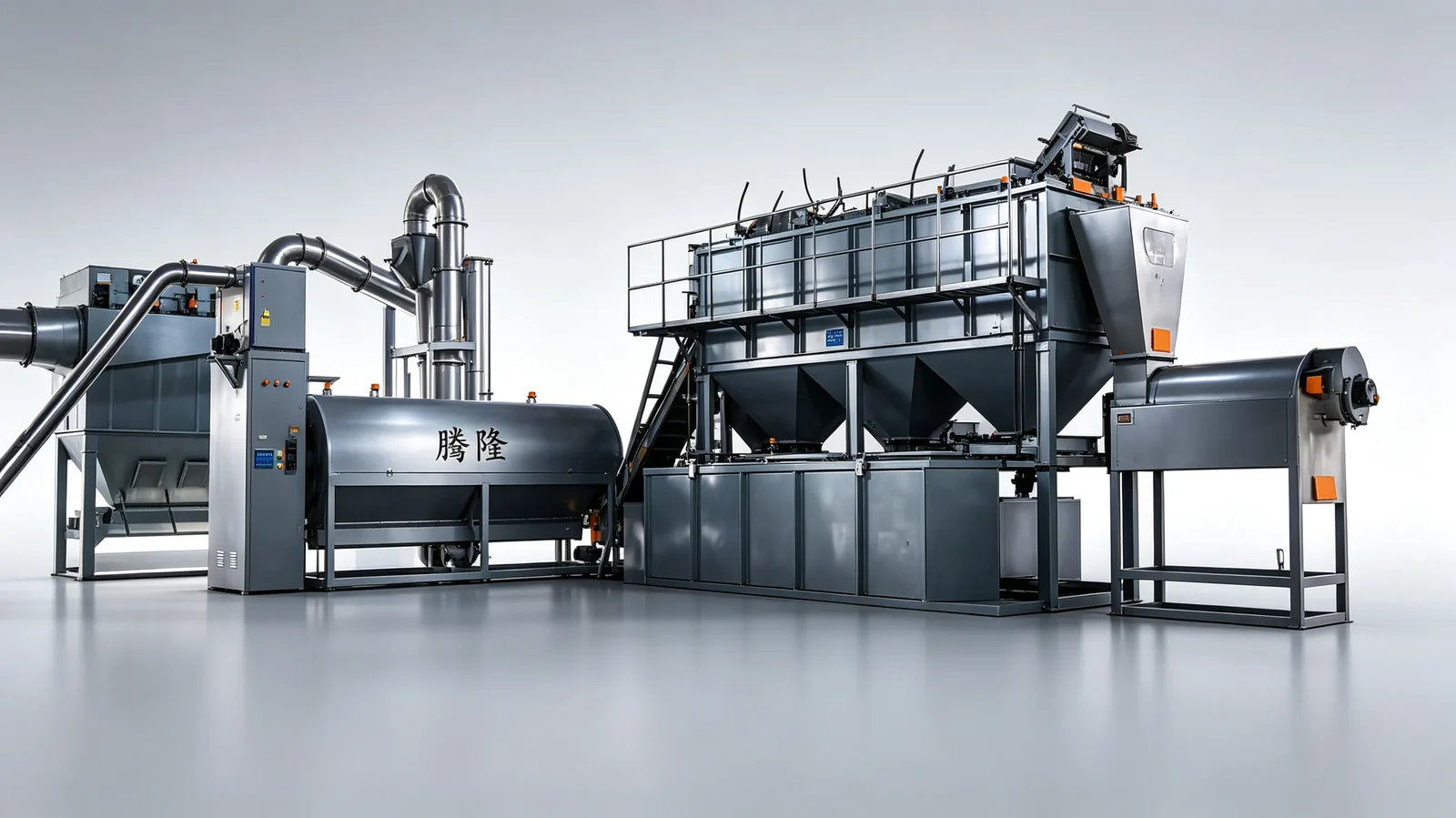
The feeding problem with film
Loose agricultural film has a bulk density around 60 kg/m3. A screw throat sized to accept that volume would have to be enormous to deliver useful throughput, and the film wraps around the screw rather than falling into the flights. Pre-crushing is one answer, but it adds a machine and a dust problem.
The cutter-compactor on stage one of the TL-2S accepts whole film and woven bags without pre-crushing. A rotating cutter and a water spray reduce the film to small pieces and densify it to more than 300 kg/m3 before it reaches the screw.
That change in density is what makes a compact extruder possible. The screw receives a dense, consistent feed instead of a bulky web, and the grooved-feed section can do its job.
What happens inside the compactor
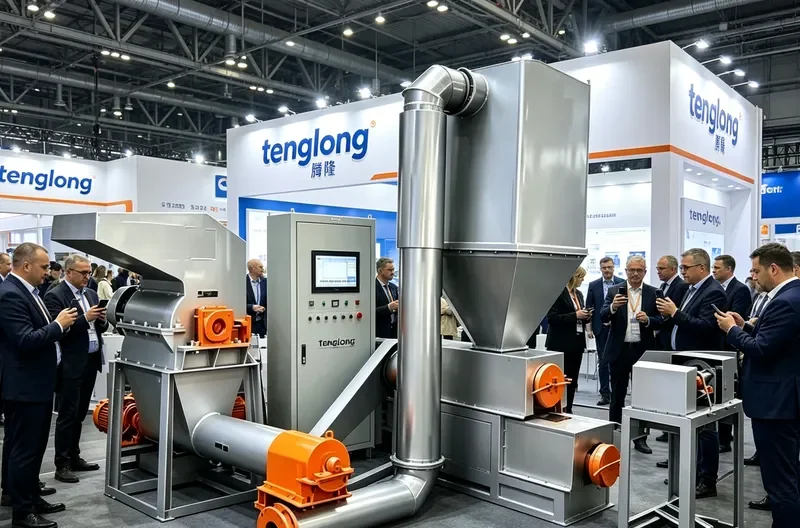
The film falls into a chamber with a rotating cutter and a stationary bed. The cutter reduces it to fragments while the water spray cools the cutting zone and helps the material agglomerate. Friction heats the fragments and they begin to soften and cling together.
The densified material drops into the feed throat under gravity. Because the compactor is directly coupled to the extruder, feed rate follows compactor speed and the two can be matched. That is more reliable than a separate crusher feeding a screw through a conveyor.
The heat generated in the compactor is useful up to a point. It pre-warms the film, reducing the work the first barrel zones have to do. Too much heat, from a dull cutter or insufficient water, makes the film form a skin that feeds unevenly.
Why the water spray matters
Cutting film generates heat quickly. Without the water spray, the fragments can reach a temperature where they stick to the chamber walls and form a ring, reducing the effective volume and eventually stopping the feed.
The spray also helps the fragments clump into pieces that fall cleanly into the screw. Fine film dust is difficult to feed; denser agglomerates flow and do not bridge at the throat.
The water added here is small compared with the moisture already on post-consumer film, and the first-stage vents remove it before filtration. An operator should not try to save water by reducing the spray, because the compactor will pay for it with an unstable feed.
Which materials suit the compactor
Greenhouse and silage film, PP woven bags and jumbo bags, LDPE shopping bags, mixed PE and PP agricultural waste, and stretch and shrink film are all listed applications for the TL-2S. All share the same problem: bulky, light, and difficult to feed by gravity.
Rigid flake does not need a compactor. Washed HDPE and PP flake already has useful bulk density, and a force-fed single screw handles it well. Putting flake through a compactor adds cost and wear without solving a problem.
Heavily printed film benefits from two-stage vacuum venting, offered as an option, because ink volatiles have to be removed before filtration. The compactor itself does not remove ink; it only prepares the feed.
Checking the densification
Watch the feed throat during a steady run. A uniform flow of softened fragments means the compactor is working. Large pieces falling intermittently mean the cutter is dull or the water spray is unbalanced.
Then check the screw torque trace. A stable trace means the screw is receiving a consistent density. A cycling trace means the compactor is delivering slugs rather than a steady stream, and the cutter speed should be reviewed.
Our factory test procedure runs the customer’s own film through the compactor, because film behaviour varies widely with grade and contamination. The test result should include the feed rate and the torque trace, not just the final output.
Film before and after the compactor
Film enters the compactor as a bulky web and leaves as a dense melt feed. The table records what changes across that step.
| Property | Loose film | After compactor |
|---|---|---|
| Bulk density | About 60 kg/m3 | More than 300 kg/m3 |
| Feed method | Bridges, wraps screw | Gravity feed to grooved screw |
| Preparation | Pre-crushing often needed | Whole film accepted |
| Temperature | Ambient | Pre-warmed by friction |
| Screw torque | Cyclic or starved | Stable |
Frequently asked questions
Q1: What does a cutter-compactor actually do?
It cuts loose film with a rotating cutter and a water spray, then densifies it from about 60 kg/m3 to over 300 kg/m3 before it reaches the screw. That lets a compact extruder accept whole film and woven bags without pre-crushing.
Q2: Why is the water spray necessary?
Cutting film generates heat. Without the spray, fragments stick to the chamber walls and form a ring that stops the feed. The spray also helps the fragments clump into pieces that fall cleanly into the screw throat.
Q3: Does the compactor need a separate crusher?
No. The TL-2S stage one accepts whole film and woven bags directly. Removing the separate crusher removes a machine, a conveyor and a dust source from the line.
Q4: Which feedstocks do not need a compactor?
Washed rigid flake such as HDPE bottle or PP crate regrind already has useful bulk density. A force-fed single screw such as the TL-FK handles it well, so a compactor would add cost without solving a feeding problem.
Further reading on this site: flakes pelletizing machine and plastic recycling equipment.
The rest of this series covers the same equipment from different angles: Two-Stage Die Pressure: Why Pellets Hold 0.2 mm, How Wet Can Film Be Before You Need a Press, Screen Life on Dirty Film: Four to Six Hours and When a Single Screw Beats a Two-Stage Line.
About the author
Zhou Gong (周工) builds recycling lines at TENGLONG Plastic Machinery, a factory in Linyi, Shandong, with 18,000 m² of floor area, 30-plus staff and 820-plus lines delivered to 46 export markets. Treat the water spray as a process setting. Saving water there costs you an unstable feed. The numbers in this article come from test runs and from dated published sources, not from a sales sheet.
If you want a recommendation rather than a catalogue, send the material form, the contamination level and the target output. We return a model and a price range within one working day, and the test run on 10–20 kg of your own material is free before the balance is paid.