Installed load on a TL-GPL is 280 kW at 500 kg/h, 520 kW at 1,500 kg/h and 900 kW at 3,000 kg/h, covering crushing through bagging. Plan the transformer at 1.25 times installed load so starting currents are covered.
The lines occupy 32 by 8, 45 by 10 and 58 by 12 metres with a 6 to 7 m ceiling. Those are machine envelopes; access, bale storage and finished-bag routes are additional. Supply is 380 to 440 V, 50 or 60 Hz three-phase.
Planning the site
- Transformer at 1.25 times installed load: roughly 350, 650 and 1,125 kVA.
- Ceiling height of 6 to 7 m is needed for line and access platforms.
- Washing and drying use the most energy, not the extruder.
- Have the power room ready before the 45 to 60 day build completes.
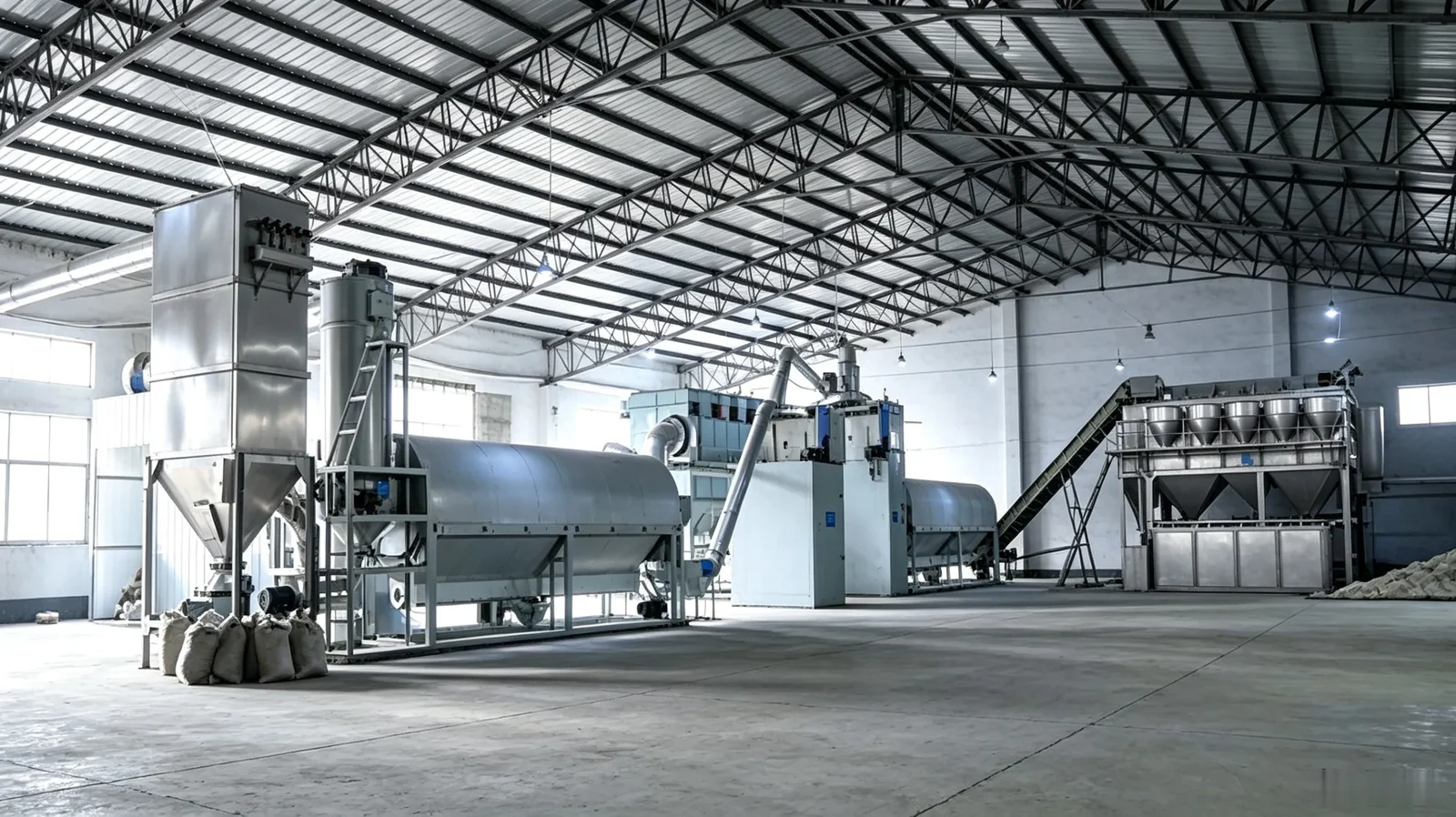
Installed load is not the transformer size
The TL-GPL draw is published as 280 kW installed at 500 kg/h, 520 kW at 1,500 kg/h and 900 kW at 3,000 kg/h. Those figures cover the complete line: crushing, washing, dewatering, drying, extrusion and bagging.
The transformer should be planned at 1.25 times installed load. That margin accommodates starting currents and the fact that stages do not all run at steady state at the same moment. A transformer sized exactly to installed load is a common and expensive error.
Power supply is 380 to 440 V, 50 or 60 Hz three-phase. A plant with a different local standard should state it at enquiry, because motors and drives are specified against the supply rather than adapted later.
Floor area and height
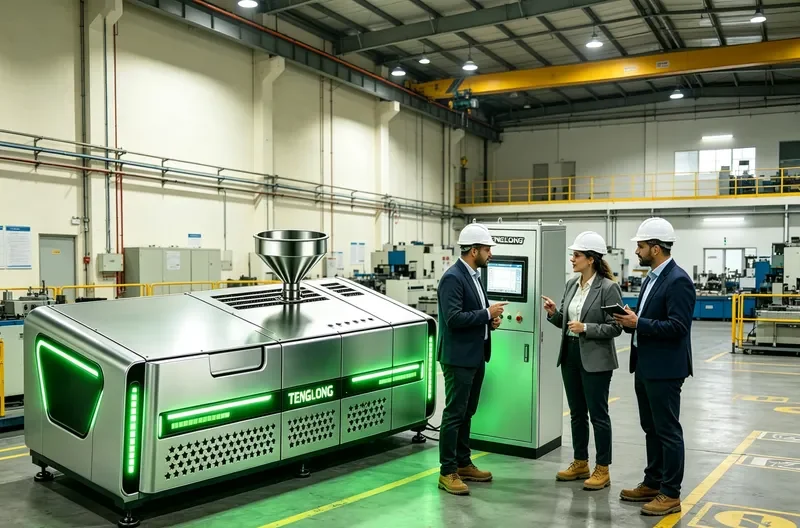
The TL-GPL-500 occupies 32 by 8 m, the TL-GPL-1500 45 by 10 m and the TL-GPL-3000 58 by 12 m. A ceiling of 6 to 7 m is needed for the line and its access platforms.
Those are line dimensions, not building dimensions. Access around the machines, space for bale storage and a route for finished bags all have to be added. A plan drawn to the machine envelope alone will be cramped on the first day of production.
The modular layout helps here. Stages are arranged so material flows in one direction, with buffer capacity between washing and extrusion. That buffer is what allows the washing stage to continue while the extruder is briefly stopped.
Where the power is spent
The washing and drying section is the largest consumer on a complete line, not the extruder. Heating the friction wash to 90 degrees C and running the three-stage dryer dominate the energy balance.
The dryer exhaust is recycled to cut gas consumption by 25%, which is the single largest efficiency measure in the design. A plant with cheap electricity but expensive gas will see the benefit differently from one with the reverse tariff structure.
The central MCC logs each stage separately, so the actual distribution can be measured after commissioning. That data is more useful than the published split because it reflects the real feedstock and the real operating pattern.
Planning the electrical installation
Install the transformer and distribution board before the line arrives. A complete line takes 45 to 60 days to build and can arrive before a civil contractor has finished the power room, which leaves machines standing on a factory floor.
The MCC supports per-stage start and stop with fault logging and remote diagnostics. That feature is useful only if the network connection is available, so include it in the site plan.
Earthing, cable routes and protection devices follow local code. Our documentation describes the supply requirements, but the installation itself should be designed by a qualified local electrician who knows the applicable standard.
Making the numbers usable
Multiply installed load by your operating hours and tariff to get a worst-case energy cost, then compare it with the metered figure from a factory trial. The gap between the two is where the process settings matter.
Include water treatment and material handling in the same calculation. They are separate from the line’s published load but form part of the site’s total demand.
Our contact page accepts floor drawings and supply details for a dimensional and power check. A drawing produces an answer that can be acted on; a nominal tonnage produces only a catalogue quotation.
Power and space by model
Installed load is only the starting number. The table gives the transformer, height and floor figures by model.
| Model | Installed power | Transformer at 1.25x | Footprint |
|---|---|---|---|
| TL-GPL-500 | 280 kW | About 350 kVA | 32 x 8 m |
| TL-GPL-1500 | 520 kW | About 650 kVA | 45 x 10 m |
| TL-GPL-3000 | 900 kW | About 1,125 kVA | 58 x 12 m |
| Supply | 380-440 V, 50/60 Hz | 3-phase | 6-7 m ceiling |
What buyers ask us before they order
Q1: How much power does a complete granules line need?
Installed load is 280 kW at 500 kg/h, 520 kW at 1,500 kg/h and 900 kW at 3,000 kg/h. Plan the transformer at 1.25 times installed load to cover starting currents.
Q2: How much floor space should I allow?
The lines occupy 32 by 8 m, 45 by 10 m and 58 by 12 m, with a 6 to 7 m ceiling. Those are machine envelopes; add access, bale storage and a route for finished bags.
Q3: Which stage uses the most energy?
Washing and drying, mainly heating the 90 degree friction wash and running the three-stage dryer. Exhaust heat recovery cuts gas consumption by 25%. The central MCC logs each stage so the real split can be measured.
Q4: What should be ready before the line arrives?
Transformer, distribution board, earthing, cable routes and a network connection for remote diagnostics. A complete line takes 45 to 60 days to build and can arrive before the power room is finished.
Where this fits in the wider range: plastic granules production line and auxiliary equipment.
Read next, if the same model is going on your line: What a Turnkey Granules Line Actually Includes, 90 C Friction Washing: What Each Stage Removes, Water Use in a Granules Line: 0.8 to 1.2 m3 per Tonne and A Granules Line That Grows from 500 to 3,000 kg/h.
About the author
Zhou Gong (周工) is the recycling machinery engineer at TENGLONG Plastic Machinery in Linyi, Shandong — a plant of 18,000 m² with 30-plus staff, 12 platforms and 820-plus installations across 46 export markets. A transformer sized exactly to installed load is the most common site error I see. Where a figure is quoted here it has been measured or published with a date attached; nothing in this article is an estimate.
The quickest way to a real answer is to send the feed form, the contamination level and the throughput you need. A model and a price range come back within one working day, the trial on 10–20 kg of your material is free, and a result that misses the agreed output by more than 5% leaves the deposit refundable.