The TL-FK handles up to 4% surface moisture without a separate dryer. A 3 m pre-heating section raises flake temperature gradually and two vacuum vents remove the water before the compression zone, which is worth 8 to 12% output on bottle flake.
Above that level a mechanical dewatering press pays back, because each 1% of water costs roughly 3% of capacity and squeezing water out uses far less energy than evaporating it. The key measurement is moisture at the feeder, not at the washing line.
Handling water in flake
- Two vents after a 3 m pre-heat handle about 4% surface moisture.
- Each 1% of water costs roughly 3% of capacity.
- Above 4%, a screw press recovers output faster than thermal drying.
- A blocked vent filter looks like wetter feedstock; check it first.

Wet flake makes the melt foam
Flake leaving a washing line carries surface water. Fed into a barrel, that water turns to steam at melting temperature and the melt foams, pressure fluctuates and the pellets come out with voids. The traditional answer is a separate thermal dryer, which consumes energy and floor space.
The TL-FK takes a different approach. A 3 m pre-heating section brings the flake up to temperature gradually, and two vacuum vents remove the volatiles before the material reaches the compression zone. On bottle flake the arrangement is worth 8 to 12% output.
The published handling limit is 4% surface moisture without a separate dryer. On cold-washed flake at that level, the venting is the difference between running and not running. Above it, the machine still runs but the output penalty grows.
What each percent of water costs
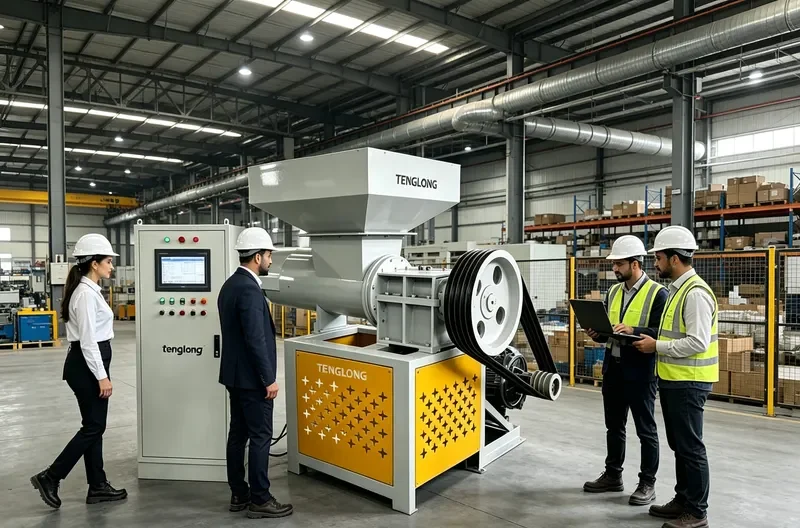
Each 1% of water costs roughly 3% of capacity. That figure explains why a dryer can pay for itself quickly on a wet feedstock: the energy used by a mechanical dewatering press is far less than the output lost to steam in the barrel.
The relationship is not linear at every level. At 1 or 2% the vents absorb the water with little effect. At 4% the system is working at its design limit. Above that, steam generation outpaces the vent capacity and the melt quality falls quickly.
Measure the moisture at the feeder, not at the washing line. Flake can pick up water in a conveyor or a storage silo, and a figure measured upstream does not describe what enters the screw.
The pre-heat and vent sequence
The 3 m feed section does two jobs. It raises the flake temperature so that surface water evaporates before compression, and it gives the first vacuum vent a region where vapor can be removed without pulling melt into the vacuum line.
The second vent catches what the first misses. Two vents rather than one allow a gradual pressure profile, which is safer with fine flake that can be carried away by a strong vacuum applied too early.
Operators should check the vacuum filters as part of the routine. A blocked filter reduces venting efficiency and produces the same foam symptom as a wetter feedstock. The fault looks like a material problem but is actually a maintenance problem.
When a press pays back
Above 4% surface moisture, add a mechanical dewatering press or a hot-air dryer. A screw press removes free water mechanically at a fraction of the energy cost of evaporation, and it is the correct first step for wet flake.
The payback calculation uses the 3% capacity rule. If a line loses 12% of output to 4% excess moisture, a press that recovers that output pays for itself in the value of the extra pellets, not merely in energy saved.
Our turnkey granules production line uses exactly this sequence: a screw press followed by a three-stage hot-air dryer, with exhaust heat recycled to cut gas consumption by 25%. The same logic applies at smaller scale to a standalone flake line.
Testing the boundary on your own flake
Send a sample with a known moisture content for a factory trial. The trial should report output, specific energy and pellet appearance at that moisture, because a single number cannot describe how the material behaves.
Ask for the result at two moisture levels if the feedstock varies by season. Flake from a washing line in a humid month behaves differently from the same flake in winter, and the configuration should cover the worst case.
The quality page on our site describes the factory test routine. A material trial is the only reliable way to decide whether the standard venting is enough or a press belongs upstream.
Surface moisture and the response
Surface water is the common flake feedstock problem. The table shows what the standard venting can absorb and where a press pays back.
| Moisture at feeder | What happens | Recommended response |
|---|---|---|
| 1-2% | Vents absorb water | Standard configuration |
| Around 4% | Vents at design limit | Standard TL-FK, monitor output |
| Above 4% | Foam and output loss | Add screw press or dryer |
| Each 1% of water | About 3% capacity loss | Use in payback calculation |
| Blocked vent filter | Same symptom as wetter feed | Clean filter first |
What buyers ask us before they order
Q1: Do I need a dryer before a flakes pelletizing machine?
Normally no. Two vacuum vents and a 3 m pre-heating section handle surface moisture up to about 4%. Above that, a mechanical dewatering press pays back through recovered output within a few months.
Q2: How much output does moisture cost?
About 3% of capacity for each 1% of water. That is why a press is usually cheaper than thermal drying: it removes free water mechanically instead of evaporating it in the barrel.
Q3: What do the two vacuum vents actually do?
The 3 m pre-heat section brings flake to temperature, then the first vent removes vapour before compression and the second catches what remains. Two vents give a gradual pressure profile that avoids carrying fine flake into the vacuum line.
Q4: Could a blocked vent look like wet flake?
Yes. A blocked vacuum filter reduces venting efficiency and produces foam and pressure fluctuation, the same symptoms as wetter feedstock. Check the filters before changing the drying configuration.
The rest of this series covers the same equipment from different angles: Why Flake Starves a Screw and How Force Feeding Fixes It, 80 or 100 Mesh? Size the Screen by Dirt Load, Where the Energy Goes in Flakes Pelletizing and 24/7 Flake Pelletizing: The Screen and Blade Rhythm.
About the author
Zhou Gong (周工) is the recycling machinery engineer at TENGLONG Plastic Machinery in Linyi, Shandong — a plant of 18,000 m² with 30-plus staff, 12 platforms and 820-plus installations across 46 export markets. Measure the moisture at the screw inlet. The number at the washing line has already changed by the time the flake arrives. Where a figure is quoted here it has been measured or published with a date attached; nothing in this article is an estimate.
The quickest way to a real answer is to send the feed form, the contamination level and the throughput you need. A model and a price range come back within one working day, the trial on 10–20 kg of your material is free, and a result that misses the agreed output by more than 5% leaves the deposit refundable.