Mesh is chosen against dirt load, not throughput. Bottle flake with labels and caps needs 100 mesh, while agricultural drum flake with sand needs 80 mesh and a larger area, because sand loads a pack faster than polymer residue.
A changer that blinds in twenty minutes makes a 1,000 kg/h line behave like a 600 kg/h one. The TL-FK uses a double-piston changer sized by dirt load, and an automatic back-flush option is offered for 120 mesh where fine filtration is needed continuously.
Choosing the pack
- Bottle flake normally takes 100 mesh; sandy drum flake takes 80 mesh and more area.
- A pack that blinds quickly reduces real output far below the nameplate.
- Record pressure at each change and watch the trend by flake source.
- An automatic back-flush changer suits 100 mesh and finer on continuous duty.

The wrong sizing question
Buyers commonly ask what mesh a flake line needs. The better question is how much dirt the screen has to catch per hour, because a changer that blinds in twenty minutes makes a 1,000 kg/h line behave like a 600 kg/h one. Mesh is a consequence of dirt load and particle size.
Bottle flake with labels and caps needs 100 mesh to hold back the fine contamination. Agricultural drum flake with sand needs 80 mesh and a larger screen area, because sand loads the pack faster than label fragments do. The same nominal output produces very different screen duty.
The TL-FK uses a double-piston changer sized by dirt load rather than by throughput. That distinction is the reason two lines with the same rated output can have different filtration packages.
Reading the flake source
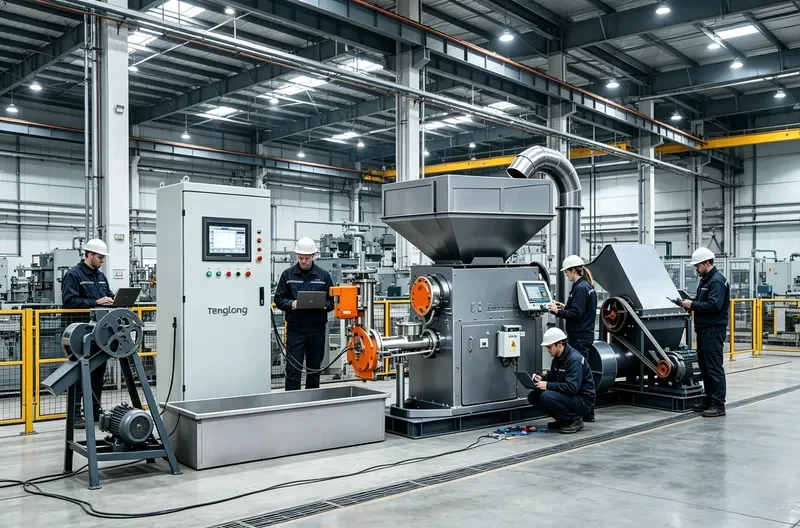
Start with where the flake came from. Washed bottle flake has label residue, cap fragments and adhesive. It is relatively consistent and 100 mesh is the standard choice on the TL-FK-150 and 165.
Agricultural drum flake carries sand and soil even after washing. Sand does not compress into the pack the way polymer residue does, so it builds a layer that blocks flow. An 80 mesh pack with more area handles it better, and the TL-FK-180 is specified at 80 mesh for this reason.
Post-consumer mixed flake is the least predictable. It needs a trial, because the dirt load depends on the collection stream. A supplier who quotes mesh over the phone without a flake sample is guessing.
What a blinding screen costs
As the pack loads, pressure rises and output falls. A line that starts at 1,000 kg/h and blinds in twenty minutes spends a large share of each hour below its rated output. The operator changes the screen, the pressure drops and the cycle begins again.
A larger screen area or a coarser pack extends the interval. The automatic back-flush changer, offered as an option for 120 mesh on the TL-FK, is another answer when fine filtration is required on a continuous duty cycle.
The cost is not only the lost output. Every screen change creates a short period of off-specification product and uses an operator’s time. On a 24/7 campaign those minutes multiply across every shift.
Matching the pack to the cutter
A screen that is too fine for the melt index raises pressure at the die, which affects the strand and therefore the cutter. On a flake line using water ring die-face cutting, high melt pressure changes pellet shape and raises fines.
A melt pump is offered as an option for plus or minus 0.4% pellet weight. It decouples die pressure from screen condition, which is useful when the pack loads significantly between changes. Without it, the pellet weight drifts as the screen fills.
The filter area rule used across the industry relates area to melt flow, material density and a filter factor. Our engineering team applies it alongside the measured dirt load from a material trial, because a formula alone cannot describe a contaminated waste stream.
Setting a screen-change interval
Run a trial with the intended pack and record pressure against time. The point where pressure reaches the machine’s change threshold is your interval. On bottle flake our published routine is a 20-minute screen change every 3 to 4 hours.
If the interval is shorter than two hours, increase the screen area or move one mesh coarser before accepting the schedule. A line that needs a screen change every twenty minutes is not a 1,000 kg/h line in practice.
Record the interval by flake source. After a few months the records show which suppliers deliver dirtier material, and that information is worth more in a purchase negotiation than a generic specification.
Mesh by flake source
Mesh is chosen against dirt load, not throughput. The table maps the flake source to the pack that survives it.
| Flake source | Contamination | Typical mesh | Note |
|---|---|---|---|
| Washed bottle flake | Labels, caps, adhesive | 100 mesh | Standard on MB-150/165 |
| Agricultural drum flake | Sand and soil | 80 mesh | Larger screen area |
| PP crate and container | Mixed residue | 80-100 mesh | Trial recommended |
| Fine filtration duty | High speck requirement | 120 mesh | Automatic back-flush option |
| Target interval | Bottle flake | 20 min every 3-4 h | Record pressure against time |
Frequently asked questions
Q1: Should I choose 80 or 100 mesh for flake?
Bottle flake with labels and caps normally needs 100 mesh. Agricultural drum flake with sand needs 80 mesh and a larger screen area, because sand loads the pack faster. Choose against the flake source, not the rated output.
Q2: Why does a screen changer blind so quickly?
Because it was sized by throughput instead of dirt load. A changer that blinds in twenty minutes makes a 1,000 kg/h line behave like a 600 kg/h one. Size the pack by the contamination arriving per hour.
Q3: When should I fit an automatic back-flush changer?
When fine filtration is required on continuous duty. The TL-FK offers it for 120 mesh. It is also worth considering if the measured screen-change interval is under two hours on the intended pack.
Q4: How do I set the screen-change interval?
Run a trial with the intended flake and pack, record pressure against time, and change at the machine’s threshold. Our published bottle-flake routine is a 20-minute change every 3 to 4 hours.
The pages that come up most often alongside this one: screen changer guidance and plastic recycling equipment.
The companion write-ups for this machine family are: Why Flake Starves a Screw and How Force Feeding Fixes It, Running 4% Moisture Flake Without a Separate Dryer, Where the Energy Goes in Flakes Pelletizing and 24/7 Flake Pelletizing: The Screen and Blade Rhythm.
About the author
Zhou Gong (周工) is a recycling machinery engineer at TENGLONG Plastic Machinery in Linyi, Shandong, where 30-plus staff work across 18,000 m² and 12 machine platforms covering 100 to 3,000 kg/h. Never size a screen from a tonnage figure alone. Show me the flake and I will size the pack. Every figure used here has been measured on a machine or taken from a dated published source, not from a brochure.
Send the material form, the contamination level and your target output to our engineering team and you get a model and a price range within one working day. A test run on 10–20 kg of your own material is free, and if the measured output misses the agreed figure by more than 5%, the deposit is refundable.