
Summary: This is a selection decision tree for the TL-TS twin screw granulator, written as a sequence of narrowing questions rather than a feature list, and it includes a legitimate exit. The first branch asks whether your product is a recipe or just a polymer: our own published threshold is to move to a twin screw above 15% filler, below 20 µm colour dispersion, or for engineering polymers that need strong devolatilization. From there the tree narrows on volatiles and moisture, on side feeding and liquid injection, on dosing tolerance and batch traceability, on output against the published bands of 300–450, 600–900 and 1,100–1,500 kg/h, on the site conditions, and finally on the published US$38,000–128,000 budget, with defined exits to single screw, masterbatch, strand and two-stage routes.
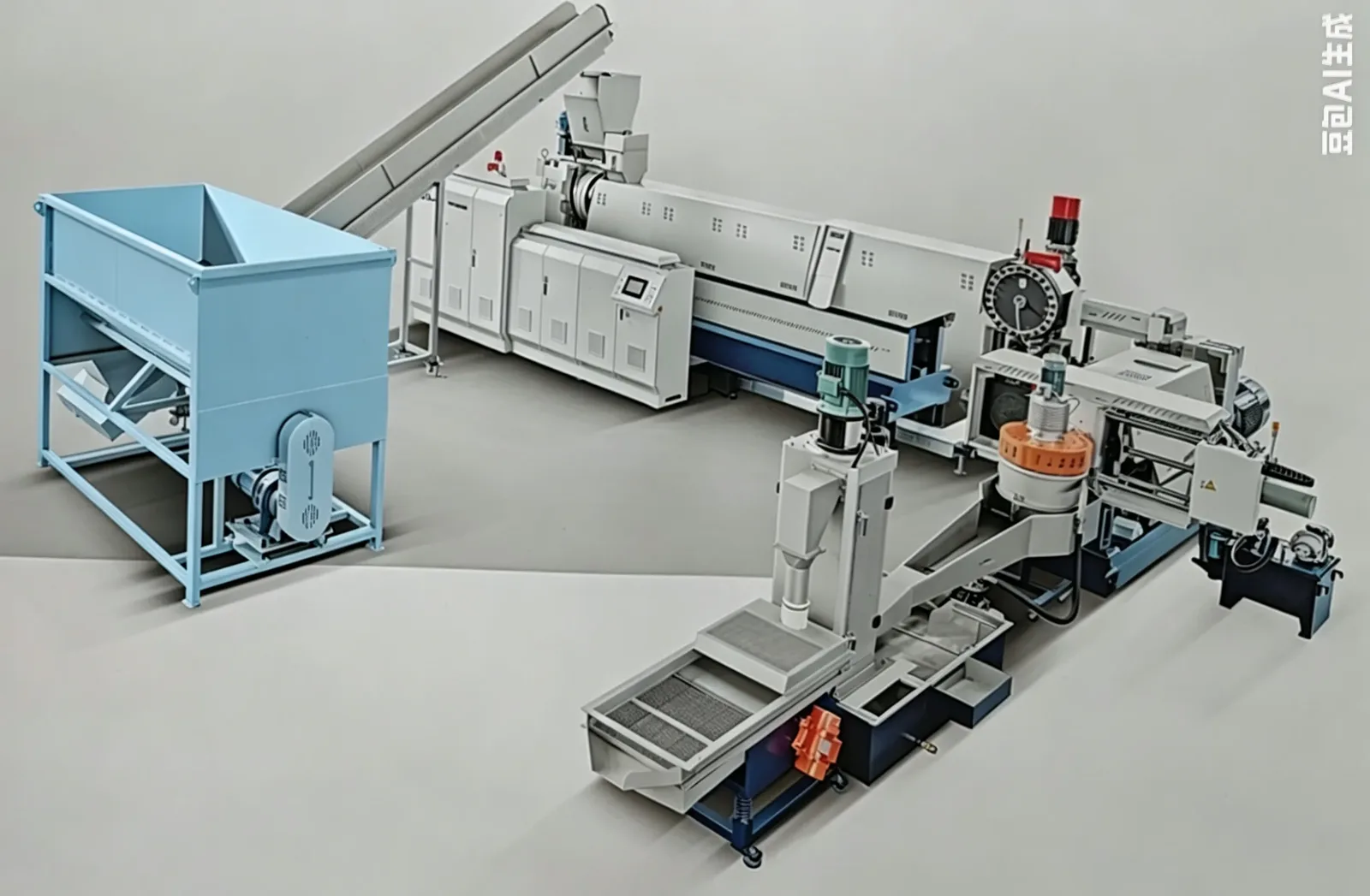
Branch one: is your product a recipe, or just a polymer?
Begin with the question that ends most enquiries early: are you compounding, or are you just melting and re-pelletizing? Our published threshold for moving from a single screw to a twin screw is specific: go twin when you add more than 15% filler, when you need colour dispersion below 20 µm, or when you run engineering polymers that need strong devolatilization. Below all three, a single screw is the right machine.
Let the exit be a real answer
If your stream is plain PP or PE regrind with no filler, no colour spec and no volatiles problem, then this tree ends at the first branch and points you to the TL-SJ single screw granulator. That is not a failure of the exercise: a single screw line is cheaper per kilogram, has one screw instead of an element set, and is the correct answer for a large part of the recycling market. The published comparison of the two screw types, with the numbers behind it, is on single screw versus twin screw granulation, and the machine this page describes is the TL-TS twin screw granulator itself.
If any one of the three thresholds applies, you are on the twin branch, and the remaining questions decide the configuration.
Branch two: do you have to remove volatiles or moisture?
Second question: does the recipe contain something that has to leave the melt as vapour? Recycled feedstock with a residual solvent or moisture problem, engineering polymers that need devolatilization, and filler that arrives damp all point at the same answer. The published machine has two vacuum vents and venting at zone 8, and the published answer to 5,000 ppm of volatiles is two-stage devolatilisation at high surface renewal.
How this changes the specification, not just the option list. If the answer is yes, the vent position and the devolatilisation stage become part of the screw layout, because the elements have to keep renewing surface inside the vented zone. That is a configuration decision made before the quotation, and it is why a formulation has to reach us before a specification can be written. If the answer is no, the budget you keep is better spent on dosing accuracy or on capacity, and a simpler line may serve.
Keep an eye on the interaction with branch three. A side feeder feeding damp filler into the melt creates a volatiles problem that a vent may not be sized to absorb, and the two branches have to be answered together rather than one after the other.
Branch three: does the recipe need side feeding or liquid injection?
Third question: does a component have to enter the melt at a specific point rather than with the base polymer? The published machine carries two side feeders for talc, glass fibre and CaCO3 and a liquid injection port for silane, oil or flame retardant. A compound that loads 70% calcium carbonate into PP, or 30% glass fibre into PA6, needs the filler to arrive in a partly molten carrier so it is wetted rather than dropped in as powder.
Side feeding is a capability, not a fitting
If the answer is yes, side feeding is mandatory and it changes the machine: the barrel has to be long enough to position the feeder after the melting zone but before the mixing zone, which is one of the reasons the published ratio is 40:1 with 44:1 optional. Loss-in-weight refill with a vacuum loader per component is the published way to keep those channels supplied.
If the answer is no and your recipe is a pigment concentrate rather than a bulk compound, the same mixing architecture is used for a different job: colour and additive masterbatch. In that case the tree may point at the TL-MB masterbatch granulator instead of at a compounding line, because the output, the pigment load and the downstream use are different from a bulk compound.
Branch four: how tight does the recipe have to be?
Fourth question: is your formulation a specification that a customer audits? The published metering is eight-channel gravimetric dosing with each channel within ±0.5%, recipe management and batch traceability, on a Siemens S7-1500 with a 10-inch HMI and OPC-UA readiness for MES integration.
Match the metering to the promise you make. If you sell compound against a written formulation, the traceability is worth as much as the accuracy, because a customer audit asks which batch was made from which recipe. If your product is a standard recycled grade sold on appearance, the metering requirement drops and the budget goes further down the tree instead.
Two related checks sit here. If the compound is sold into thin film, the dispersion target of below 20 µm becomes a contract term, and you should ask how that target is measured. And if a customer writes a pellet diameter onto the purchase order, the cutting route becomes a specification question rather than a preference.
Branch five: output, product count and the shape of the week
Fifth question: how many kilograms an hour, and how many hours a year? The published bands are TL-TS-65 at 300–450 kg/h, TL-TS-75 at 600–900 kg/h and TL-TS-95 at 1,100–1,500 kg/h, each on the LDPE film basis of 85% bulk density and 3% moisture. Note the gaps: roughly 450–600 kg/h and 900–1,100 kg/h are not covered, and a recipe landing in a gap needs either the larger frame with a slower screw or a confirmed band on your own material.
Product count decides the screw set strategy
The second half of this branch is how many products the line runs. A screw set change takes 4–6 hours, so one screw set per product family is normal practice, and a line running many short campaigns should budget for that time. Annual hours matter as much: capital recovery per tonne rises sharply below roughly 5,000 hours, so below that the tree should point at a smaller model rather than a bigger one.
The published specific energy of 0.22–0.35 kWh/kg is the input for the energy term in any cost model you build, and it is confirmed on the factory test. If you are building that model, the structure is set out in what a plastic granulator costs.
Branch six: the site, the budget and where the tree exits
Final question in the tree: is the published budget range inside your envelope? The indicative price is US$38,000–128,000 FOB Qingdao for the base configuration, with a lead time of 35–45 days, a minimum order of one set and an 18-month warranty from commissioning. If that is inside your envelope, the tree has an answer.
Know which branch sent you away. Where the tree exits, be precise about which branch failed, because each exit has a different alternative. If the product is a plain polymer, compare the single screw. If the throughput is high and the recipe is simple, compare the two-stage route. If the product is a flake or film stream rather than a compound, the upstream equipment matters more than the compounding step. Whole-platform comparisons, including the strand, water ring and two-stage routes, are in all 12 platforms compared in one table, and every machine in the range is factory tested the same way, on how every line is factory tested.
The last question is contractual rather than technical. Is the number you are paying for written down against your own feed, or only against an LDPE film basis? Ask for the four-hour run on your material, with output, melt pressure, melt temperature and kWh logged every minute, and have those confirmed values pasted onto the quotation rather than left in the brochure. That is how every machine in the range is sold, from 820-plus lines shipped to 46 export markets.
| Checkpoint | If YES | If NO | Published figure that settles it |
|---|---|---|---|
| Do you compound rather than simply re-pelletize? | Continue on the twin screw branch | Exit to a single screw line; the extra capability is not sold | Move above 15% filler, below 20 µm dispersion, or into engineering polymers needing devolatilization |
| Must moisture or volatiles be removed from the melt? | Specify vent position and devolatilisation stage | Keep the budget for dosing accuracy or capacity | Two vacuum vents, venting at zone 8; two-stage devolatilisation for 5,000 ppm |
| Does a component have to enter the melt at a set point? | Specify two side feeders and the liquid injection port | Simplify the layout; consider the masterbatch route instead | 70% calcium carbonate and 30% glass fibre need side feeding |
| Is the formulation customer-auditable? | Specify eight-channel gravimetric dosing with batch traceability | Drop the metering requirement and move down the budget | Eight channels at ±0.5% per channel; S7-1500 with OPC-UA |
| Is your output inside a published band of 300–450, 600–900 or 1,100–1,500 kg/h? | Select the matching model, noting the gaps between bands | Confirm the band on your material or plan the larger frame with a slower screw | Model bands on the LDPE basis of 85% bulk density and 3% moisture |
| Will the plant run well above 5,000 hours a year? | Size for the target rate; capital recovery per tonne stays low | Compare a smaller model first; fixed cost per tonne rises as tonnes fall | Screw set change takes 4–6 hours; colour change about 40 minutes |
| Can the site take 13.5 × 2.8 × 3.0 m, 14.5 t and 380–440 V three-phase? | Proceed to commercial terms | Re-plan the layout, slab loading and crane access before quoting | US$38,000–128,000 FOB Qingdao, 35–45 days lead time, 18-month warranty |
Frequently asked questions
Q1: Is a twin screw granulator overkill for a plain regrind stream?
If you are melting and re-pelletizing without compounding, it is. Our published threshold for moving to a twin screw is above 15% filler, below 20 µm colour dispersion, or for engineering polymers that need strong devolatilization. Below all three, a single screw is cheaper per kilogram, has one screw instead of an element set to maintain, and is the correct answer rather than a compromise.
Q2: Which TL-TS model should I choose for around 1,000 kg/h of output?
No model covers that figure: the published bands are 300–450, 600–900 and 1,100–1,500 kg/h, so 1,000 kg/h falls in the gap between the 75 mm and 95 mm machines. The answer is either the larger frame with a slower screw or a band confirmed on your own material during the four-hour factory test, on the LDPE basis of 85% bulk density and 3% moisture.
Q3: Do I need the vacuum vents fitted if my material is already dry?
Not if it is genuinely dry and free of volatiles, and the tree should then spend the budget on dosing accuracy or capacity instead. But check the filler rather than the base polymer: moisture in the filler enters with the recipe, and the published machine handles that with two vacuum vents and venting at zone 8. Highly volatile streams need two-stage devolatilisation, a specification decision.
Q4: How much does the changeover time really matter in the selection?
More than buyers expect. A colour change takes about 40 minutes on a co-rotating twin screw because there are no dead corners to clear, but a screw set change takes 4–6 hours, because the element layout is part of the recipe. One screw set per product family is normal practice, and short campaigns should carry that downtime in the production plan.
Q5: What does the site have to provide for a twin screw granulator?
Three-phase power at 380–440 V, 50/60 Hz, floor area for the machine plus the service access it needs, and capacity for the drying and conveying equipment downstream. The largest model occupies 13.5 × 2.8 × 3.0 m and weighs 14.5 t, so slab loading and crane access have to be checked before the layout is frozen. The lead time is 35–45 days with an 18-month warranty.
Engineer’s note
Most quotations I write start with the material and end at the machine, not the other way round. A client with PE regrind and no filler does not need a compounding line, and saying so early costs less than a bad purchase later. Our factory began as a screw and barrel workshop in 2016, so we know that the screw decides whether the machine holds output.
Engineering note: the numbers on this page are our own published reference ranges for the machine family, not a specification guarantee for any individual unit. Final output, specific energy and pellet quality are set by the incoming material, its moisture and contamination level, and the screen pack fitted. We write the confirmed figures onto the quotation after a factory test run on your own material.
Who wrote this
Zhou Gong (周工) is a senior plastic machinery engineer at TENGLONG Plastic Machinery in Linyi, Shandong. The factory was registered as Linyi Hedong District Tenglong Plastic Machinery Factory on 7 June 2016 and grew out of a screw and barrel workshop, so his work is rooted in the parts that decide whether a granulator holds output: screw geometry, nitriding case depth, barrel alignment and melt filtration. He prepares the technical specification for customer quotations, reviews the four-hour factory test data before shipment, and runs commissioning support on site. Screws are nitrided in-house to a 0.5–0.7 mm case at HV 900–1000 and straightened to 0.03 mm runout over the full length; barrel, screw, gearbox and frame are aligned to 0.05 mm before the test run.
Figures quoted here are engineering reference ranges published on our own product pages, not guaranteed values for any specific machine. Real output, specific energy and pellet quality depend on the incoming material, its moisture and contamination level, and the screen pack fitted. Final values are written after a factory test run on the customer’s own material, and the PLC-logged test report ships with the machine. For a quotation that reflects your material, send the feed form, contamination level and target output and a configuration comes back within one working day.
Run the tree with us: send your formulation, filler load, target output and site limits to the quotation request form and we will return the model, the options and the published figures that apply to your case within one working day.