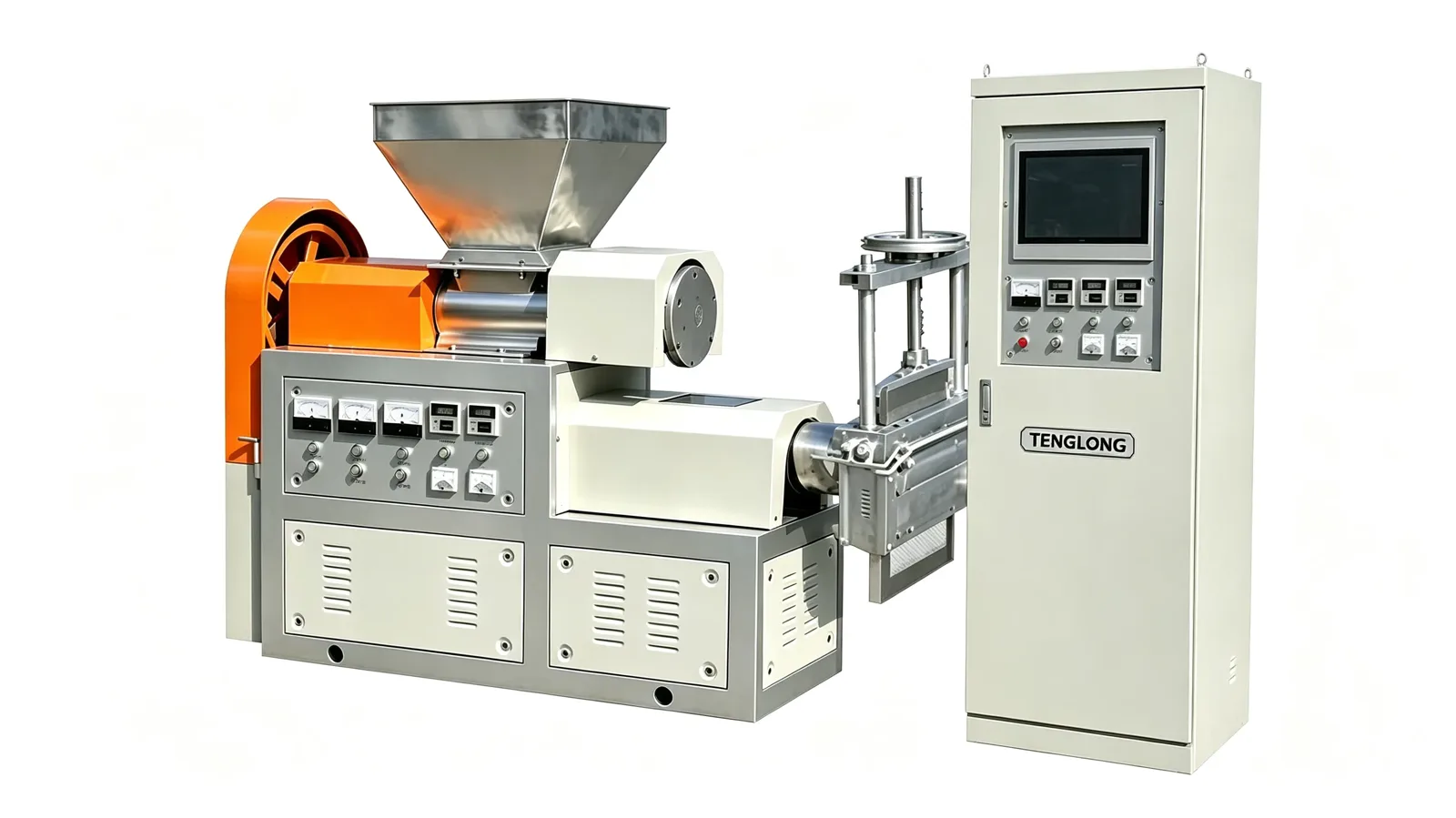
Summary: A water ring pelletizer specification sheet is easy to read and easy to misread. Output, pellet diameter, motor power, cooling flow and footprint are all published, but each number only becomes meaningful once you know the condition behind it. This guide walks the TL-WR sheet line by line: what the 100 to 1,000 kg/h output figure assumes, why pellet size follows die hole diameter rather than the model name, what the closed-loop cooling circuit does and does not tell you, and where a published number is a boundary condition rather than a promise. Each line is paired with the practical check that confirms it on your own material, so quotations can be compared on equal terms before a configuration is fixed. The TL-WR family covers 100 to 1,000 kg/h in three models.
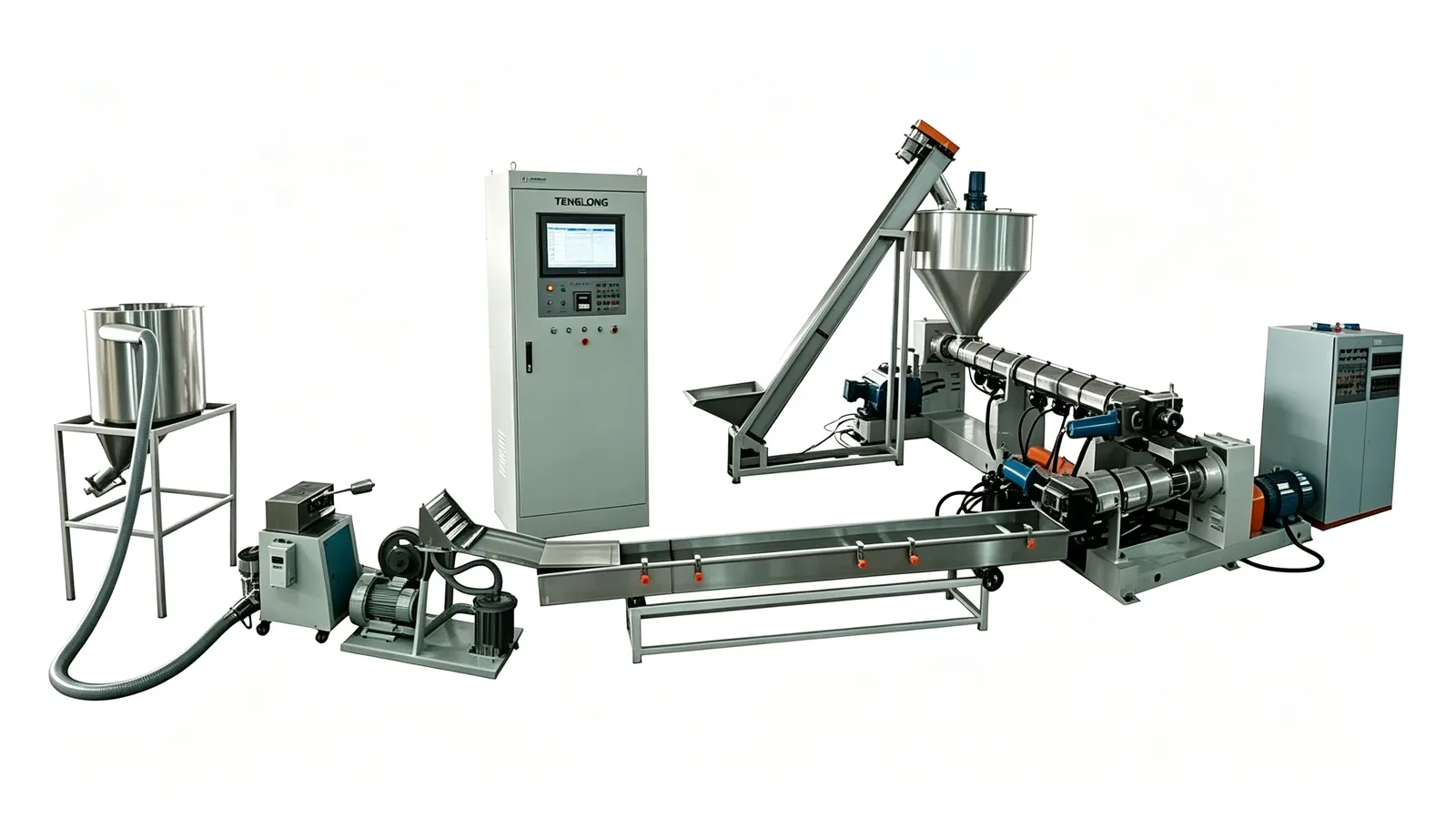
Start with the output number and read its footnote
The headline on the TL-WR water ring pelletizer page is output: 100 to 1,000 kg/h, split across three models. TL-WR-100 runs at 100 to 250 kg/h, TL-WR-200 at 300 to 550 kg/h and TL-WR-300 at 700 to 1,000 kg/h. Underneath it sits the line that decides how much of that number applies to you. Output figures refer to LDPE film at 85% bulk density with 3% moisture, and actual output depends on feedstock, flake size and filtration.
What the output figure assumes
Three conditions hide in that footnote, and all three move the result. A bulk density of 85% describes a light, consistent feed; a filled compound or a dusty regrind stream arrives at a different apparent density and will not melt the same way. Moisture of 3% is already on the high side for a die face, because the last of that water turns to steam inside the pellet. Flake size and filtration decide whether melt reaches the die face continuously or in pulses, and that is why output fluctuates through a shift on an otherwise identical machine.
- Ask what the quoted rate assumes — the material, its bulk density, its moisture, and the screen pack fitted.
- Ask for the confirmed figure — on our machines the final output is written onto the quotation after the 4-hour factory test run on the customer’s own material, logged by the PLC every minute.
- Do not treat the gap as a fixed offset — output is set by melt delivery at the die, so a feed with weaker melt quality gives a proportionally lower rate, not a number shaved down by a constant.
One more reading habit pays off immediately. The screw diameter field on the sheet is empty, because the TL-WR is a pelletizing head, not an extruder. It takes melt from any extruder, yours or ours. That single point reshapes the whole quotation, because the screw, gearbox, drive motor and barrel of the upstream extruder sit in a different part of the supply chain with different lead times and different spares. Before you build a comparison, see where the platform sits against the others in the 12-platform comparison.
Pellet size is a die decision, not a catalogue decision
Published pellet size is 2 to 4 mm, with 1.5 mm available on a fine die. That 1.5 mm figure is not a free upgrade. The product sheet states it needs a 2,000 rpm cutter, that output drops roughly 30%, and that the fines load on the screen rises with it. Below 1.2 mm the sheet itself points elsewhere, to underwater pelletizing as the more reliable route.
- 2 to 4 mm — the standard range on all three models, produced by a hard-chrome die plate with 1.5 to 4 mm holes and a replaceable insert option.
- 1.5 mm — fine die plate plus a 2,000 rpm cutter; budget for the 30% output loss and the heavier screen load, and ask for the quick-change die plate option if die changes are frequent.
- Under 1.2 mm — outside the water ring’s envelope; the TL-UW underwater pelletizer is the platform to quote instead.
Pellet shape matters as much as pellet diameter. Water ring cutting produces round pellets, which flow well and bridge less in a hopper, the natural choice for injection moulding and rotomoulding. If your downstream process doses by volume ratio, the cubic pellets from a strand line are what you want, and the water ring versus strand versus underwater comparison sets out the geometry difference in more detail than any single spec line can.
One decoding point is easy to miss: pellet diameter and filtration are one line of the specification, not two. A die bored to 2.0 mm still delivers a broad size band if the filtration in front of it is wrong, and the screen is what actually holds the diameter. Read the two together, and use the published vocabulary rather than two people using the same word for different things.
Power, cooling and the electrical supply
The power line is published twice in two forms, and both matter. The main motor is listed as a pair — cutter 4 to 15 kW plus water pump 3 to 7.5 kW — because the two machines do entirely different work. The cutter motor sets the shear rate at the die face, and therefore the pellet shape. The pump motor sets how fast the water ring travels, and therefore how quickly a cut pellet is pulled away and quenched. Both run on variable frequency drives, and the cutter is interlocked with extruder melt pressure so that it stops if pressure drops.
The cooling line reads 8 to 15 m³/h in a closed loop at 20 to 45 °C. Three engineering readings sit inside it.
- Closed loop, 40 mesh filter — water is filtered and returned rather than discharged, with roughly 0.3 m³ of make-up per hour on a 10 m³/h ring.
- 20 to 45 °C is a working band, not a set point — above 45 °C pellets begin to stick together, so in a hot climate the plant, not the machine, decides whether the band holds.
- 20 to 80 °C with a controller — the listed water temperature controller option widens the band for sites without chilled water or with high summer ambient.
Electrically the supply is 380 V, 50 Hz, three phase. Upstream of that, drives are ABB ACS380 or Danfoss FC51 units and the control is a Siemens S7-1200 or S7-1500 PLC with a 7 to 10 inch HMI — which is also where the per-minute test log comes from. How that is verified before shipment is described in how every line is factory tested.
Footprint, weight and the comparison that matters
Skid dimensions run 2.2 × 1.4 × 1.6 m at 1.1 t for the TL-WR-100 and 3.0 × 1.8 × 2.0 m at 2.3 t for the TL-WR-300, and the vertical die-face layout is what delivers the published claim of roughly 40% less floor space than a strand bath. The comparison holds on length too: a strand line needs 8 to 12 m of running length plus a water bath, air knives and an operator watching for strand breaks, where the water ring folds cooling, conveying and drying into one unit.
Retrofit floor space is not the same as skid space
If the machine will be fed by an extruder you already own, the sheet states the conditions plainly: the extruder must hold 60 to 100 bar at the die, there must be 2.6 m of free floor after the screen changer, and we need the screw diameter, the output and the existing die flange drawing to match the adapter. Those three inputs decide feasibility more reliably than the footprint line does.
The commercial lines are short and worth reading literally: lead time 20 to 25 days, warranty 18 months with 3-year spare-parts availability, MOQ one set, and an indicative FOB Qingdao price band of US$18,500 to 52,000 for the base configuration, excluding freight, installation and local duties. Incoterms available are FOB Qingdao, CIF and DAP.
The lines that are promises rather than specifications
Every specification sheet contains a few entries that describe a performance promise rather than a fixed quantity. Knowing which is which saves arguments later.
- Output — conditional on material, flake size and filtration, confirmed only after the 4-hour test run on your own material.
- Pellet size and moisture — the 2 to 4 mm range and the at-or-below 0.3% figure after the dewatering screen hold when the machine is set for your formulation, not across every formulation.
- Indicative price — a band for the base configuration; the firm price follows the material test.
- Lead time, warranty, MOQ — firm, and worth quoting straight into a project schedule.
A short worked example shows why the distinction matters. A buyer quoting on the 1,000 kg/h figure for a dusty ABS regrind stream, at 1.5 mm pellets, on a 20 t month, with no chiller in the plant, ends up with three lines of the sheet working against each other: the melt rate that actually arrives at the die, the 30% output loss the fine die imposes, and a cooling loop that cannot hold below 45 °C in August. Read as one engineered system instead of six separate numbers, the gap closes. Send the material, the contamination level and the target output, and a configuration comes back with the figures written on it.
| Published TL-WR line | What it controls on the line | What it does not tell you | Check before you order |
|---|---|---|---|
| Output 100 to 1,000 kg/h across TL-WR-100, -200 and -300 | Melt throughput the die plate can deliver without the water ring overloading | That the figure is for LDPE film at 85% bulk density with 3% moisture | Ask for your material’s confirmed rate after the 4-hour factory test run |
| Pellet size 2 to 4 mm, 1.5 mm on a fine die | Die hole diameter and, below 2 mm, cutter speed at the die face | Whether 1.5 mm is economic at your throughput and screen load | Confirm 1.5 mm needs a 2,000 rpm cutter and loses roughly 30% output |
| Cooling 8 to 15 m³/h in a closed loop at 20 to 45 °C | Heat removed from each pellet inside the ring | That 45 °C is a sticking threshold rather than a recommended set point | Confirm the plant can hold the loop below 45 °C in the hottest week |
| Cutter 4 to 15 kW and water pump 3 to 7.5 kW | Shear rate at the die and travel speed of the water ring | The total connected load on your incoming supply | Sum cutter and pump at 380 V, 50 Hz three phase before sizing the panel |
| Footprint 2.2 × 1.4 × 1.6 m to 3.0 × 1.8 × 2.0 m, 1.1 to 2.3 t | Skid space, crane access and floor loading | The 2.6 m of free floor a retrofit needs behind an existing screen changer | Measure the run-up from your screen changer, not only the skid |
| Lead time 20 to 25 days and 18 months warranty | When the line can be commissioned and how long support is contractual | Any performance guarantee on your specific material | Ask that the PLC-logged test report ships with the machine |
Frequently asked questions
Q1: What output should I expect from a water ring pelletizer on my own material?
Published output is 100 to 1,000 kg/h across three models, measured on LDPE film at 85% bulk density with 3% moisture. On your material the confirmed figure comes from the 4-hour factory test run, where output, melt pressure, melt temperature and kWh are logged every minute. Send the polymer, the contamination level and the target output, and the rate for your material is written onto the quotation rather than estimated.
Q2: Can a water ring pelletizer produce pellets smaller than 2 mm?
Yes, down to 1.5 mm with a fine die plate and a 2,000 rpm cutter, but the published penalty is roughly 30% lower output and a heavier fines load on the screen. Below 1.2 mm the product sheet directs the enquiry to underwater pelletizing, where the die sits inside a pressurised water chamber. The economics of the fine die usually matter more than the diameter itself.
Q3: How much cooling water does a water ring pelletizer consume per hour?
Circulation is 8 to 15 m³/h in a closed loop filtered through a 40 mesh screen, and roughly 0.3 m³ of make-up per hour on a 10 m³/h ring. There is no continuous discharge, so water is a temperature question rather than a volume question: the band is 20 to 45 °C, and above 45 °C pellets stick together. Plant cooling capacity decides whether that band holds.
Q4: What electrical supply and connected load does the TL-WR pelletizer need?
The published supply is 380 V, 50 Hz, three phase, with the cutter and the water pump on variable frequency drives and the cutter interlocked to the extruder melt pressure. Drives are ABB ACS380 or Danfoss FC51 and the control is a Siemens S7-1200 or S7-1500 PLC. Connected load is 4 to 15 kW for the cutter plus 3 to 7.5 kW for the pump.
Q5: Can I retrofit a water ring pelletizer onto my existing extruder?
Usually yes, and the published conditions are specific: the extruder must hold 60 to 100 bar at the die and there must be 2.6 m of free floor after the screen changer. We need three things to match the adapter — the screw diameter, the output and the existing die flange drawing. Retrofitting keeps the extruder you already own and often shortens the schedule against ordering a complete new line.
Engineer’s note
When a customer sends a specification sheet, the first thing I read is not the output line but the footnote under it. LDPE film at 85% bulk density and 3% moisture tells me the sheet was measured on clean, dry, light material, and how far the real number can move. Screw geometry is where that shift begins: our nitrided case of 0.5 to 0.7 mm at HV 900 to 1000 and 0.03 mm runout keep melt delivery steady at the die face.
Engineering note: the numbers on this page are our own published reference ranges for the machine family, not a specification guarantee for any individual unit. Final output, specific energy and pellet quality are set by the incoming material, its moisture and contamination level, and the screen pack fitted. We write the confirmed figures onto the quotation after a factory test run on your own material.
Who wrote this
Zhou Gong (周工) is a senior plastic machinery engineer at TENGLONG Plastic Machinery in Linyi, Shandong. The factory was registered as Linyi Hedong District Tenglong Plastic Machinery Factory on 7 June 2016 and grew out of a screw and barrel workshop, so his work is rooted in the parts that decide whether a granulator holds output: screw geometry, nitriding case depth, barrel alignment and melt filtration. He prepares the technical specification for customer quotations, reviews the four-hour factory test data before shipment, and runs commissioning support on site. Screws are nitrided in-house to a 0.5–0.7 mm case at HV 900–1000 and straightened to 0.03 mm runout over the full length; barrel, screw, gearbox and frame are aligned to 0.05 mm before the test run.
Figures quoted here are engineering reference ranges published on our own product pages, not guaranteed values for any specific machine. Real output, specific energy and pellet quality depend on the incoming material, its moisture and contamination level, and the screen pack fitted. Final values are written after a factory test run on the customer’s own material, and the PLC-logged test report ships with the machine. For a quotation that reflects your material, send the feed form, contamination level and target output and a configuration comes back within one working day.
Send the polymer, the contamination level and the target output, and we will return a TL-WR configuration with the figures written on your material, not on film. Request the quotation and the 4-hour test protocol — a reply comes back within one working day.