A strand break is a symptom with a location, and the location tells you which setting moved. A break at the die face points to a die 10 to 15 degrees C too cold or a screen pack that is too fine. A break at the first guide roll points to bath water below 18 degrees C.
Work in a fixed order and change one thing at a time: channel, location, die temperature, screen, bath, then take-up ratio. A pneumatic detector stops the feed within half a second of a break, which protects the bath but also hides the evidence unless the panel is read.
From symptom to cause
- A break at the die face usually means the die is 10 to 15 degrees C too low.
- One repeated break points to a partly blocked die hole, not a process setting.
- Breaks at the first guide roll come from water below 18 degrees C.
- Change one setting at a time and run ten minutes before judging the result.
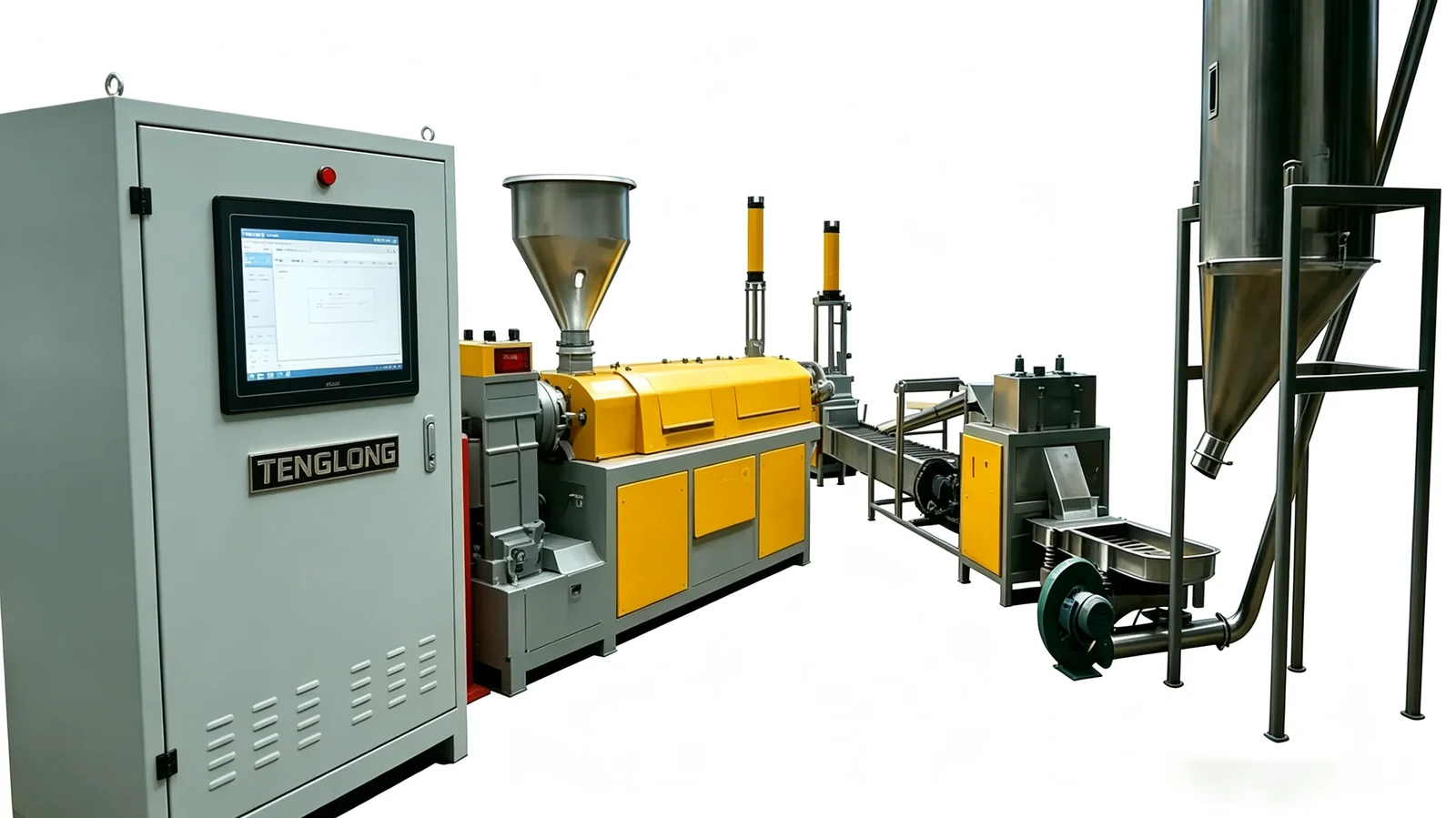
Start with where the break happens
A strand break is never just a strand break. The location tells you which setting moved. A break right at the die face points to melt temperature or screen pressure. A break at the first guide roll points to bath temperature. A break further down, near the cutter, points to draw ratio or a worn guide.
Train the operator to call the location before calling for help. On a line with eight to twenty-four strands, one strand failing repeatedly in the same position usually means a blocked die hole rather than a general process fault. A hole that is partly blocked delivers less melt, and the thinner strand cannot take the same pull as its neighbours.
The pneumatic strand-break detector stops the feed within half a second of a break. That protects the bath from flooding, but it also hides the evidence if nobody looks at the panel. The detector logs which strand failed, so the first diagnostic question is always which channel tripped.
Temperature and screen pressure at the die

The most common cause of a break at the die is a die temperature 10 to 15 degrees C too low. The melt leaves the holes under higher pressure and is drawn faster than it can stretch, so it snaps close to the face. Raise the die temperature first, because that is cheap and reversible.
The second cause is a screen pack that is too fine for the melt index. A fine pack pushes pressure up and the same thing happens: the strand is extruded under stress and cannot tolerate the take-up draw. Check the mesh against the melt flow rate of the actual material, not the nominal grade on the sack.
The third cause is a die that has not been cleaned after a colour or material change. A carbonised speck at one hole distorts the strand and breaks it every few minutes. Cleaning the die plate is a scheduled job, not a fault repair, and it belongs in the same routine as the knife check.
Draw ratio and take-up speed
The feed rolls pull the strands into the cutter at a speed set relative to the extruder output. Increase the pull and the strand gets thinner and stronger up to a point, then it necks and breaks. That point is the draw ratio limit, and it moves with melt temperature and with polymer.
The cutter uses a fixed bed knife and a twelve-blade rotor at 200 to 600 rpm. Pellet length comes from the ratio between feed-roll speed and cutter speed, so an operator chasing pellet size by changing roll speed can accidentally push the strand past its draw limit. The correct move is to adjust the cutter side of the ratio, not the pull.
A practical test is to stop the cutter and watch the bare strands for thirty seconds. If they hold a steady diameter, the extruder and bath are sound and the problem is in the take-up. If they sag or break without the cutter running, the fault is upstream. That one test separates half the possible causes.
What the detector protects
When a strand breaks and the feed keeps running, melt pours into the bath and sticks to the guide rolls. Cleaning a flooded bath is a job measured in hours, and the material is usually lost. The strand-break detector was fitted to remove that cost, and it stops the feed within half a second.
A detector that trips too often gets bypassed, which defeats its purpose. If the nuisance trips are frequent, the cause is usually a guide roll with a burr, a strand that is too thin for the sensor, or water on the lens. Clean the sensor and check the strand diameter before blaming the electronics.
The detector should also be part of the handover test. Break a strand deliberately during commissioning and time the stop. A half-second stop is a specification; an untested detector is a hope. Our quality page describes the factory test routine that precedes every shipment.
A diagnostic sequence that holds
Work in a fixed order so two operators reach the same answer. First, identify the channel that tripped. Second, look at the break location. Third, check die temperature against the setpoint and raise it by 10 degrees if it is low. Fourth, check the screen mesh and pressure. Fifth, check bath temperature and guide rolls. Sixth, review the feed-roll ratio.
Change one thing at a time and run for ten minutes before judging the result. A line that has two faults — a cold die and a fine screen — will not respond cleanly to either fix alone, and changing both at once destroys the evidence about which one mattered.
Record the outcome on a simple sheet kept by the machine. After a few weeks the sheet shows a pattern: the same grade, the same screen change interval, the same break. That pattern is worth more to the next operator than any manual, and it is the basis of a maintenance schedule built on what the line actually does.
Break location to likely cause
A strand break is a symptom with a short list of causes. The table maps what you see at the die to the setting that actually moved.
| Where the strand breaks | Likely cause | First action |
|---|---|---|
| At the die face | Die 10-15 C too low | Raise die temperature |
| At the die face, one hole | Partly blocked die hole | Clean the die plate |
| First guide roll | Bath below 18 C | Raise bath into 20-35 C |
| Near the cutter | Draw ratio too high | Adjust cutter side of ratio |
| Repeatedly, all strands | Screen pack too fine | Check mesh against melt index |
Common questions, with short answers
Q1: What temperature should the die run at?
Set it to the grade supplier’s recommendation, then confirm on the line. A die running 10 to 15 degrees C cold is the most common cause of breaks at the face. Raise the die temperature first, before changing the screen pack or the take-up speed.
Q2: Can a screen pack cause strand breaks?
Yes. A pack that is too fine for the melt index raises pressure and extrudes the strand under stress, so it snaps at the die. Check the mesh against the actual melt flow rate of the material you are running, not the nominal grade.
Q3: How fast does the strand-break detector respond?
The pneumatic detector stops the feed within half a second. That prevents melt from flooding the bath and sticking to the guide rolls. Test it deliberately during commissioning and check it whenever nuisance trips become frequent.
Q4: Why does only one strand keep breaking?
A single strand failing at the same die hole usually means that hole is partly blocked or has a carbonised speck. Clean the die plate. If the position moves between strands, look instead at bath temperature or take-up speed.
The pages that come up most often alongside this one: melt filtration and screen changers and granulator types.
The companion write-ups for this machine family are: Why Cubic Pellets Still Win in Injection Feeding, Strand Bath Length and Water Temperature Explained, Strand Cutter Maintenance: Knife Clearance and Blades and Strand Pelletizing Line: How Much Floor Space to Plan.
About the author
Zhou Gong (周工) is the recycling machinery engineer at TENGLONG Plastic Machinery in Linyi, Shandong — a plant of 18,000 m² with 30-plus staff, 12 platforms and 820-plus installations across 46 export markets. The operator who calls the break location before calling for help usually fixes the line in half the time. Where a figure is quoted here it has been measured or published with a date attached; nothing in this article is an estimate.
The quickest way to a real answer is to send the feed form, the contamination level and the throughput you need. A model and a price range come back within one working day, the trial on 10–20 kg of your material is free, and a result that misses the agreed output by more than 5% leaves the deposit refundable.