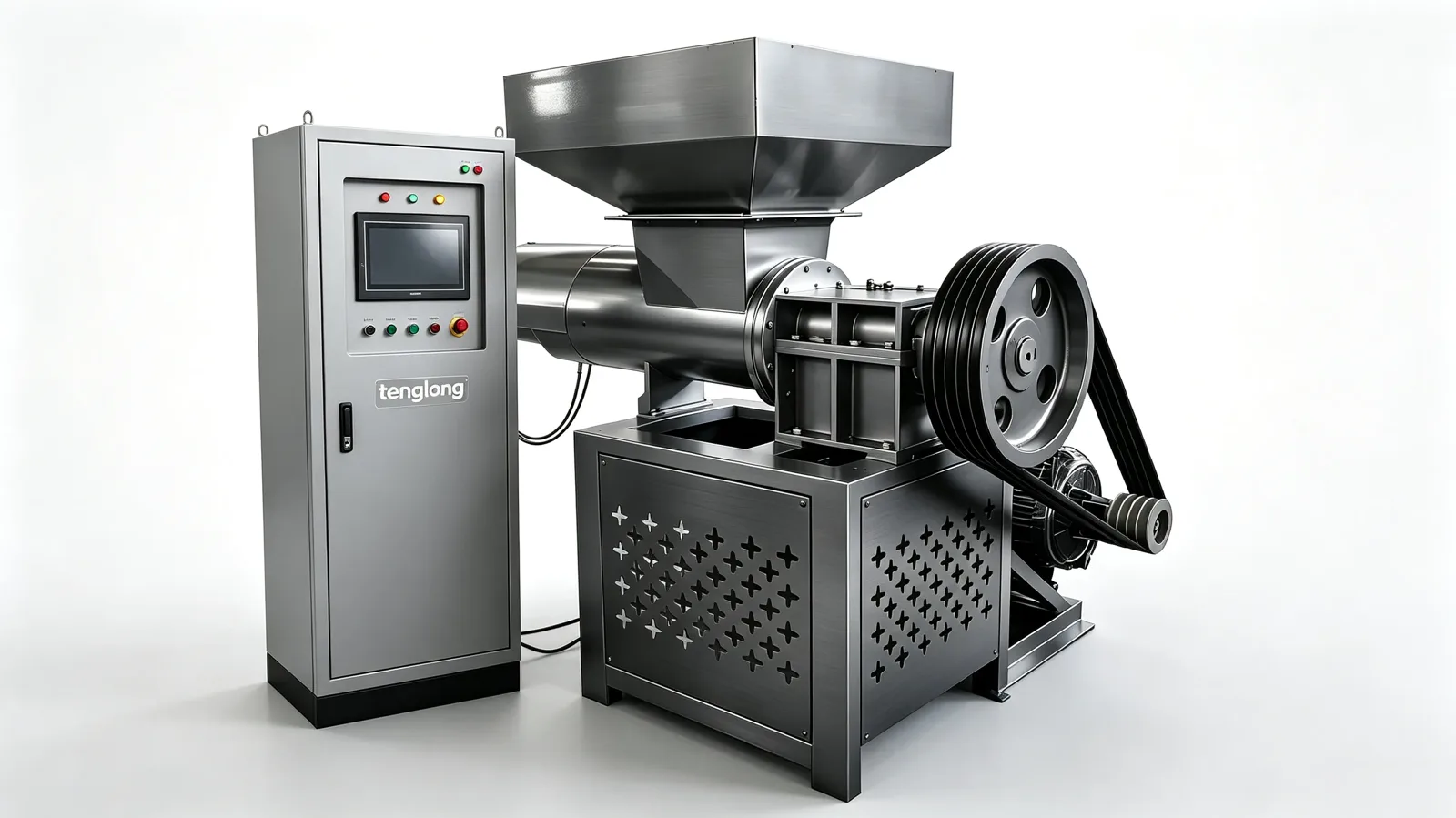
Summary: A plastic pellet mill specification sheet has six lines that decide whether the machine fits your workshop, and only one of them is output. The TL-PM family covers 100 to 500 kg/h in three models on 37 to 90 kW, but the published rate assumes LDPE film at 85% bulk density and 3% moisture, so the number that matters is the one confirmed on your own regrind. This guide reads each line the way a buyer should: what the figure measures, which mechanism moves it, and the check that settles it before a deposit is paid. It covers screw diameter against L/D, the division that exposes an unrealistic output claim, die hole size against knife count, the difference between skid length and working envelope, and the supply limits that decide where the machine can be installed.

The output line is a test condition, not a machine property
The TL-PM plastic pellet mill page publishes 100 to 500 kg/h across three models: TL-PM-80 at 100 to 150 kg/h on an 80 mm screw, TL-PM-100 at 200 to 300 kg/h on 100 mm, and TL-PM-120 at 400 to 500 kg/h on 120 mm. Read the brackets rather than the headline. There is no model between 150 and 200 kg/h, and none between 300 and 400, so a workshop needing 180 kg/h must run an 80 flat out or a 100 at 60% of its band. That is an energy decision before it is a price decision.
Three conditions hide in the footnote
Under the table sits one sentence: output figures refer to LDPE film at 85% bulk density with 3% moisture. Each condition is a lever. Bulk density matters because the feed section of a single screw conveys volume, not mass, so a ground flake at 60% bulk density puts about 70% of the mass into the same flights as a working approximation, and the rate falls with it. Moisture matters because water leaving the melt as steam at the die face disturbs the cut. Flake size and filtration matter because a pulsing feed delivers a pulsing melt, and that delivers a varying pellet.
The practical consequence is that quotations at the same nominal output are not comparable until both state their reference material. Ask which polymer, which bulk density, which moisture and which screen pack the figure came from; if the answer is clean dry film, you are reading a best case. Consistent flake size from the upstream crushers and shredders is worth more to the mill than an extra 10 kW.
Output is set at the die face by how much melt arrives, so the sheet figure is a delivery rate, not a capacity you can push towards by feeding harder.
Screw diameter against L/D decides what the machine will tolerate
Screw diameter is published as 80, 100 or 120 mm and L/D as 26:1 to 30:1. Multiply the two and you get flighted length: about 2.1 m on the small machine and 3.6 m on the large. That length, not the kW rating, tells you how much mixing the polymer sees before the die.
A compact mill is short by design, and a short screw buys footprint at the cost of two things. First, dispersive mixing: a 26:1 screw will not break up agglomerates or distribute a filler as evenly as a longer one, so a single-polymer regrind runs clean and a mixed stream does not. Second, venting: there is no atmospheric vent in this frame, so moisture leaves through the feed throat or not at all.
What diameter does to shear
A smaller screw turns faster to deliver the same mass, and screw speed is shear rate. At equal output an 80 mm screw runs at higher rpm than a 120 mm, so it puts more shear heat into each kilogram and narrows the window on heat-sensitive material. That is why ABS and PS regrind behave differently on a PM-80 than LDPE does, and why 180 to 240 °C is four zones you tune rather than one number you set. Where the platform runs out of tolerance, all 12 platforms compared in one table shows which of the twelve models picks up.
For a buyer the check is one request: send a sample of the actual feed and ask for the zone profile and screw speed used in the factory test. A supplier without that record has not run your material.
Motor power is the arithmetic check on an output claim
The three models carry 37, 55 and 90 kW. Divide power by output and you get a figure you can compare across quotations without knowing anything else about the machine. At the published rates the main motor alone works out at 0.25 to 0.37 kWh/kg on the PM-80, 0.18 to 0.28 on the PM-100 and 0.18 to 0.23 on the PM-120.
Set that against the published specific energy of 0.35 to 0.50 kWh/kg for the unit as a whole. The balance, in the order of 0.10 to 0.25 kWh/kg depending on model, is heater bands, blower, water pump and drive losses. That gap is not waste to be designed away; it is what it costs to run a die-face cutter and a dewatering blower at all. Plan the electricity bill on the higher figure, not the motor rating.
The division that catches an inflated quote
Heating and melting polyethylene takes roughly 0.15 to 0.17 kWh/kg of energy before any machine loss, being the enthalpy of melting plus the sensible heat from ambient to melt temperature. If a quotation claims 500 kg/h from a 45 kW main motor, the implied figure is 0.09 kWh/kg, which sits below that floor. Either the material is not what you assume, or the rate was not measured the way yours will be. Run the division on every quote you receive; it takes ten seconds and it is difficult to argue with.
The same numbers size the supply, which is the line most often read last and should be read second. Connected load is the main motor plus heaters, blower and pump, so a 90 kW machine needs a feed sized well above 90 kW.
Die hole size and knife count are one decision, not two
Pellet size is published as 2.5 to 4 mm on a bolt-on 200 mm die plate. Open area scales with hole count multiplied by the square of hole diameter. Halve the diameter and each hole passes a quarter of the area, so a 2.5 mm die needs roughly 2.5 times the hole count of a 4 mm die to hold the same open area. That is why fine dies are ordered with denser drilling, and why the plate rather than the knife is the expensive part of a size change.
Two consequences follow. A fine die runs at higher head pressure and lower rate on the same screw, because the same pumping capacity pushes melt through less area. And the cut gets harder: at 2.5 mm the window between a clean cut and a tail narrows, so knife clearance becomes a production variable.
What to order, and what to keep on the shelf
Order the die for the pellet your customer buys, not the pellet in the photograph. Small-tonnage injection moulding wants 3 to 4 mm because it flows and bridges less in a small hopper; a compounder blending down wants 2.5 to 3 mm for faster dispersion. Extra plates in 2.5, 3 and 4 mm are a listed option and cost far less than a week of off-spec production. Knives, heater bands and seals are standard sizes, which matters when the machine is far from a distributor. The the pellets and feedstock glossary fixes the vocabulary if a quotation uses another word for the same part.
Read the pellet size line with the filtration line, because they act as one system. A die bored to 2.5 mm still delivers a broad size band if a torn 40 mesh screen is passing oversize lumps through it.
Footprint is the skid; the working envelope is the room
The three frames measure 2.8 × 1.2 × 1.5 m, 3.4 × 1.4 × 1.7 m and 4.0 × 1.6 × 1.9 m, weighing 1.2, 1.9 and 2.7 t. The three metre description belongs to the small and middle models; the 120 is four metres before anything is added to it.
Add the working envelope and the number roughly doubles. You need feed access at the hopper; takeaway space for bags or an octabin; about a metre at the die head to swing the cutter and pull the 200 mm plate; and clear access to the panel for a thermal check. In a room six metres deep, a four metre skid leaves two metres, which is one person and no pallet truck. A conveyor and loader can remove the feed-side person, but it adds its own metre.
The floor loading nobody checks
2.7 t on four feet is about 675 kg per foot on a contact patch of a few square centimetres, and the dynamic load when the die blocks is higher again. On a ground-bearing slab that is nothing. On a mezzanine, a first-floor unit or a wooden deck it is a structural question to settle before the machine arrives. The frame carries wheels and lifting eyes, so the unit can be moved between workshops, but it cannot be moved onto a floor that will not take the point load.
The electrical line is where the compact machine differs most
All three models are 380 V, 50 Hz, three phase, with a 220 V single-phase option on the PM-80 only. That option is real but narrow: the motor is limited to 22 kW and output drops to about 80 kg/h.
The current arithmetic
For three phase, amperes equals kW × 1000 divided by (1.732 × volts × power factor). A 90 kW motor at 380 V and 0.88 power factor draws about 155 A at full load, so with heaters, blower and pump on the same feed, plan a 200 A supply. For the single-phase option the 1.732 disappears: 22 kW at 220 V and 0.85 power factor is about 118 A on one phase. Most small workshops sit on a 60 to 100 A service, so the single-phase route usually means a service upgrade rather than a different plug.
One feature is worth more than it looks on a sheet. These units start through a VFD with thermal overload protection rather than a direct-on-line contactor, so starting current is limited and the machine tolerates a weak grid or a generator. If your site runs on a diesel set, ask for the generator kVA alongside the machine rating and confirm the drive is configured for it. Where the supply is the binding constraint, that is a siting decision, and how to choose a plastic granulator sets it beside the other selection criteria.
Read the supply line second, right after output. It is the one line that can stop an otherwise correct purchase.
| Published line | What it measures | How it moves on your material | Check before ordering |
|---|---|---|---|
| Output 100-500 kg/h across PM-80, PM-100, PM-120 | Melt the die plate can pass without overloading the cutter | Measured on LDPE film at 85% bulk density and 3% moisture; drops with lower bulk density | Ask for the confirmed rate on your regrind after the 4-hour factory test |
| Screw 80 / 100 / 120 mm, L/D 26:1-30:1 | Flighted length, therefore mixing and devolatilising | Shorter screws tolerate single-polymer feed, not mixed or wet feed | Ask for the zone profile and screw speed used on your sample |
| Main motor 37-90 kW, specific energy 0.35-0.50 kWh/kg | Connected mechanical power against unit consumption | Part load raises kWh/kg because heaters and blower draw a near-fixed 16 kW | Divide kW by kg/h and compare with 0.15-0.17 kWh/kg melting energy |
| Pellet 2.5-4 mm on a 200 mm bolt-on die | Hole diameter and open area at the die face | A 2.5 mm die needs about 2.5x the hole count for the same open area | Specify the die for your customer’s pellet, and price a second plate |
| Footprint 2.8-4.0 m, weight 1.2-2.7 t | Skid length, not the space the machine needs to run | Add feed access, bagging space and 1 m at the die head | Measure the room, then check floor point load at about 675 kg per foot |
| 380 V 3-phase, 220 V single-phase on PM-80 only | Supply the drive and heaters expect | Single phase caps the motor at 22 kW and output at about 80 kg/h | Confirm service amps: about 118 A single phase, 200 A for the 90 kW model |
Frequently asked questions
Q1: What output can I expect from a plastic pellet mill on my own regrind?
Published output is 100 to 500 kg/h across three models, measured on LDPE film at 85% bulk density with 3% moisture. On your material the confirmed figure comes from the 4-hour factory test run, where output, melt pressure, melt temperature and kWh are logged every minute. Send the polymer, the bulk density and the contamination level, and the rate is written onto the quotation for your material.
Q2: Can a plastic pellet mill run on single-phase 220 V power?
Only the TL-PM-80 with the single-phase option, and output drops to about 80 kg/h because the motor is limited to 22 kW. That motor still draws roughly 118 A on one phase, so most workshops need a service upgrade first. For 100 kg/h and above, three-phase 380 V is required on every model in the range.
Q3: Why are the three TL-PM models spaced so far apart in output?
The bands are 100-150, 200-300 and 400-500 kg/h, so there is no model at 180 or at 350 kg/h. The gaps are deliberate: each step roughly doubles screw diameter area, and a machine sized between them would run neither at full load. If you need 180 kg/h, choose the PM-100 and accept part load, or the PM-80 and accept running it at its ceiling.
Q4: How do I check whether a quoted output is realistic?
Divide the main motor rating by the quoted rate. Melting polyethylene needs about 0.15-0.17 kWh/kg before any loss, so a claim of 500 kg/h on a 45 kW motor implies 0.09 kWh/kg, below the physical floor. On the TL-PM range the division gives 0.18-0.37 kWh/kg on the main motor, with the unit total at 0.35-0.50 kWh/kg.
Q5: Which die hole size should I order with the machine?
Match the die to the pellet your customer buys. Small-tonnage injection moulding usually wants 3-4 mm; blending or compounding wants 2.5-3 mm for faster dispersion. A 2.5 mm die needs about 2.5 times the hole count of a 4 mm plate for equal open area, so it runs slower and at higher head pressure. Extra plates are a listed option.
Engineer’s note
When a customer sends a sheet, I read the footnote before the output line. “LDPE film at 85% bulk density, 3% moisture” tells me the figure came from light, clean, dry material, and how far the real number can travel. Screw geometry is where that travel begins: a nitrided 0.5 to 0.7 mm case at HV 900 to 1000, straightened to 0.03 mm runout, keeps melt arriving at the die in a steady stream rather than in surges.
Engineering note: the numbers on this page are our own published reference ranges for the machine family, not a specification guarantee for any individual unit. Final output, specific energy and pellet quality are set by the incoming material, its moisture and contamination level, and the screen pack fitted. We write the confirmed figures onto the quotation after a factory test run on your own material.
Who wrote this
Zhou Gong (周工) is a senior plastic machinery engineer at TENGLONG Plastic Machinery in Linyi, Shandong. The factory was registered as Linyi Hedong District Tenglong Plastic Machinery Factory on 7 June 2016 and grew out of a screw and barrel workshop, so his work is rooted in the parts that decide whether a granulator holds output: screw geometry, nitriding case depth, barrel alignment and melt filtration. He prepares the technical specification for customer quotations, reviews the four-hour factory test data before shipment, and runs commissioning support on site. Screws are nitrided in-house to a 0.5–0.7 mm case at HV 900–1000 and straightened to 0.03 mm runout over the full length; barrel, screw, gearbox and frame are aligned to 0.05 mm before the test run.
Figures quoted here are engineering reference ranges published on our own product pages, not guaranteed values for any specific machine. Real output, specific energy and pellet quality depend on the incoming material, its moisture and contamination level, and the screen pack fitted. Final values are written after a factory test run on the customer’s own material, and the PLC-logged test report ships with the machine. For a quotation that reflects your material, send the feed form, contamination level and target output and a configuration comes back within one working day.
Send the polymer, the bulk density and the target output, and we will return a TL-PM configuration with the figures written on your material rather than on film. Request the quotation and the 4-hour test protocol; a reply comes back within one working day.