
Summary: This is a selection decision tree for the TL-UW underwater pelletizer, built as a sequence of questions rather than a feature list. It starts with the polymer, because PET, PA, PBAT/PLA, masterbatch and filled compounds each send you down a different branch, and it asks next whether you need spherical pellets at 1.2–3 mm with a ±0.15 mm tolerance. From there the tree narrows on throughput against the published model bands of 300–500, 700–1,100 and 1,400–2,000 kg/h, on the site conditions — footprint from 3.4 × 1.9 × 2.2 m up to 4.6 × 2.3 × 2.6 m, weight to 5.4 t, 380–440 V three-phase supply and a closed-loop water circuit — and finally on the budget of US$62,000–160,000, with a defined exit to the water ring, strand or pellet mill alternatives.
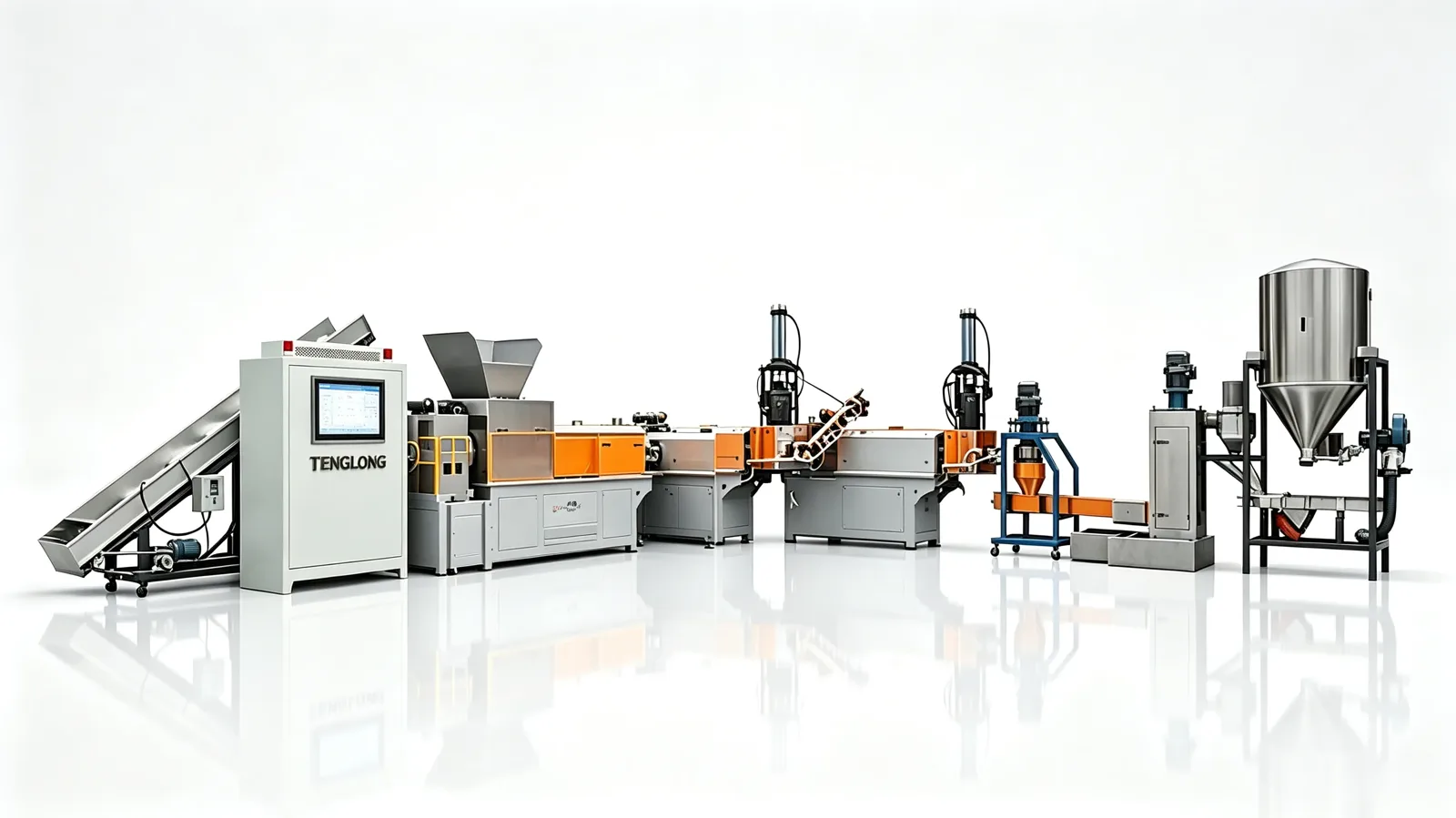
Start with the polymer, not with the machine
Begin here: does your polymer quench cleanly in hot water? If yes, the underwater route is open. If the polymer is a simple PE or PP regrind stream with no shape requirement, an underwater chamber is buying capability you will not use, and the tree should send you to a cheaper platform. The background on picking by material sits in granulator types compared, and the published feedstock list for this machine is on the TL-UW underwater pelletizer product page.
Each published feedstock sends you down a different branch
The published feedstock list for the TL-UW is PET, PA, PBAT/PLA, masterbatch and filled compounds. Each one arrives with a different reason for being here. PET recycles need a hot loop at 70–85 °C and careful intrinsic viscosity control, covered in PET intrinsic viscosity loss. PA takes on water within seconds. Masterbatch and colour concentrates need the tight pellet size that a die-face cut gives. Glass-fibre reinforced compounds need a cut that does not break fibres, and the enclosed path helps.
If your material is food-contact or medical grade, stay on the branch: the stainless steel water circuit and the fully enclosed path are published options for exactly this case, and the TL-PET food-contact pelletizing line is the same logic at line scale.
Branch two: do you need spherical pellets, and how tight?
Ask the next question: is pellet shape or size part of your specification? If the answer is no and your downstream use is blending or injection, the tree continues but the budget can move down. If the answer is yes, the published figures constrain you: 1.2–3 mm pellets with a ±0.15 mm tolerance, cut from 60 to 400 die holes.
Where the published limits sit
Now the hard limits. If your customer specifies below 1.2 mm or above 3 mm, this is the wrong machine — die holes and cutter speed cannot be pushed there. If the size has to hold to a tight tolerance under contract, ask about the melt pump: without one, pellet size drifts 0.1–0.2 mm as screen condition changes, which is the same order as the tolerance itself, and with one, pressure holds within ±0.3%.
Also fix the downstream requirement, because it changes the option list. Optical-grade pellets point to the published screen changer with 100–200 mesh. Metal detection in the pneumatic conveying line matters for regrind streams. A water-cooled or cryogenic die plate is the answer for heat-sensitive grades. Write these down before you compare quotes, otherwise three quotations will differ for reasons you never stated.
Branch three: throughput and the shape of your week
Next question: how many kilograms an hour, and how many hours a year? The published model bands are 300–500 kg/h for TL-UW-300, 700–1,100 kg/h for TL-UW-600 and 1,400–2,000 kg/h for TL-UW-1000, each on the LDPE film basis of 85% bulk density and 3% moisture. Note the gaps between the bands; if your real output falls in one of them, plan for the larger chamber with a smaller screw or confirm the band on your own material.
Match the model band to your real output, not your peak
The second half of the question matters as much as the first. A line running one shift has a very different cost per tonne from the same line running three, because depreciation is spread over fewer tonnes. If your annual hours are well below 5,000, the tree should point you at a smaller model and at more flexible scheduling, not at a bigger machine.
Third question in this branch: how many products? The published 20-minute die change makes short runs practical, so multiple grades on one line are not the disqualifier they would be on a slower changeover. Add the screen changer option if the grades differ in contamination level rather than in colour alone.
Branch four: what the building has to give
The site question is usually the one that decides the project: can the building take the footprint, the weight, the power and the water circuit? The published footprints run from 3.4 × 1.9 × 2.2 m at 2.8 t to 4.6 × 2.3 × 2.6 m at 5.4 t, supply is 380–440 V, 50/60 Hz, three-phase, and the process water circulates at 18–35 m³/h with make-up under 0.5 m³/h.
Three checks usually catch people out. Slab loading for up to 5.4 t plus the extrusion package. Crane access and floor space for pulling the water chamber during a die change, because the 20-minute change only stays 20 minutes if the machine can be opened. And the drain, plus somewhere to put the blowdown that carries polymer fines out of the loop.
Ask whether you want the whole plant or just the pelletizing step. If the line has to be integrated with feeding, drying of the flake and bagging, the boundary conditions change and the turnkey pelletizing solutions page shows how those scopes are usually assembled.
Branch five: budget, and where this tree exits
The final branch is the budget. The published indicative range is US$62,000–160,000 FOB Qingdao for the base configuration, lead time 30–40 days, warranty 18 months, minimum order one set. If that is inside your envelope, the tree has an answer.
Compare like with like before you decide
Where it exits, be precise about which branch failed. If the polymer does not need a pressurised quench, compare the TL-WR water ring pelletizer for die-face cutting at a lower entry price, or the strand pelletizing line for a simpler cut. If throughput is small and shape is not critical, a pellet mill on one 3 m skid may carry the load. The published comparison of the wet and dry cutting routes is in water ring versus strand versus underwater.
One last test before you sign: does the specification you are buying exist on paper for your material? Ask for the four-hour factory test on your own material, with output, melt pressure, melt temperature and kWh logged every minute, and ask that the confirmed figures be written onto the quotation. Every other machine in the range, from 820-plus lines shipped to 46 export markets, is sold the same way.
| Decision point | If YES | If NO |
|---|---|---|
| Does the polymer quench cleanly in hot water (PET, PA, PBAT/PLA, masterbatch, filled compounds)? | Continue on the underwater branch | Exit to a water ring or strand route; underwater cost is not justified |
| Do you need spherical pellets in the 1.2–3 mm range with ±0.15 mm tolerance? | Size the model; specify die holes from 60 to 400 | A die-face or pellet mill route is enough; keep the budget for capacity |
| Is 1.2–3 mm at ±0.15 mm written into a customer specification? | Specify the melt pump to hold pressure within ±0.3% | Standard configuration is acceptable |
| Is your output inside a published band: 300–500, 700–1,100 or 1,400–2,000 kg/h? | Select the matching model, checking the gaps between bands | Confirm the band on your material or plan the larger chamber with a smaller screw |
| Will the plant run well above 5,000 hours a year? | Size for the target rate; capital recovery per tonne stays low | Compare a smaller model first; fixed cost per tonne rises as tonnes fall |
| Can the site take the footprint, up to 5.4 t, 380–440 V three-phase and the water circuit? | Proceed to commercial terms | Re-plan the layout, the drain and crane access before quoting |
| Is the published US$62,000–160,000 FOB Qingdao range inside your budget? | Ask for a configuration and a four-hour material test | Compare the water ring, strand line or pellet mill routes on the same basis |
Frequently asked questions
Q1: Is an underwater pelletizer overkill for a simple regrind stream?
If the polymer cools cleanly and you do not need spherical pellets, it is. Underwater pelletizing earns its cost with 1.2–3 mm spherical pellets, dust below 0.2%, sealed handling and below 0.1% moisture, on PET, PA, PBAT/PLA, masterbatch and filled compounds. For PE or PP regrind where shape does not matter, a water ring or strand line is usually the cheaper answer and worth pricing side by side.
Q2: Which TL-UW model should I choose for around 1,000 kg/h of output?
TL-UW-600 is published at 700–1,100 kg/h, so 1,000 kg/h sits inside its band, while TL-UW-1000 covers 1,400–2,000 kg/h. Use the published output for LDPE film at 85% bulk density with 3% moisture as the starting point, then confirm it with a four-hour factory test run on your own material before you size the line or the building around it.
Q3: Do I need the optional melt pump on an underwater pelletizer?
Not strictly, but it changes cut stability. Without a pump, die pressure follows screen condition and pellet size drifts 0.1–0.2 mm, which is the same order as the published ±0.15 mm tolerance. With a pump, pressure holds within ±0.3% and screen changes stop disturbing the cut, which matters when pellet size is a customer-specified value.
Q4: What does the building need to provide for an underwater pelletizer?
Power at 380–440 V, 50/60 Hz, three-phase, a water connection sized for the circulating flow, a drain, and floor area for the machine plus access for the die change. The largest model occupies 4.6 × 2.3 × 2.6 m and weighs 5.4 t, so check slab loading and crane access before the layout is frozen.
Q5: How long does delivery take and what does the order require?
The published lead time is 30–40 days with a minimum order of one set, and the warranty is 18 months from commissioning with three years of spare-parts availability. Payment terms are 30% T/T deposit and 70% before shipment, with an L/C at sight available above US$50,000. Every machine runs 24 hours no-load and four hours on your own material before shipment.
Engineer’s note
Most quotations I write start with the material and end at the machine, not the other way round. A client with PE regrind and no size specification does not need a pressurised chamber; a client with optical-grade PET does, and the difference shows up in the quote. My job on the specification side is to make sure the screw, the nitrided case of 0.5–0.7 mm at HV 900–1000, the 0.03 mm runout and the 0.05 mm alignment are in place first.
Engineering note: the numbers on this page are our own published reference ranges for the machine family, not a specification guarantee for any individual unit. Final output, specific energy and pellet quality are set by the incoming material, its moisture and contamination level, and the screen pack fitted. We write the confirmed figures onto the quotation after a factory test run on your own material.
Who wrote this
Zhou Gong (周工) is a senior plastic machinery engineer at TENGLONG Plastic Machinery in Linyi, Shandong. The factory was registered as Linyi Hedong District Tenglong Plastic Machinery Factory on 7 June 2016 and grew out of a screw and barrel workshop, so his work is rooted in the parts that decide whether a granulator holds output: screw geometry, nitriding case depth, barrel alignment and melt filtration. He prepares the technical specification for customer quotations, reviews the four-hour factory test data before shipment, and runs commissioning support on site. Screws are nitrided in-house to a 0.5–0.7 mm case at HV 900–1000 and straightened to 0.03 mm runout over the full length; barrel, screw, gearbox and frame are aligned to 0.05 mm before the test run.
Figures quoted here are engineering reference ranges published on our own product pages, not guaranteed values for any specific machine. Real output, specific energy and pellet quality depend on the incoming material, its moisture and contamination level, and the screen pack fitted. Final values are written after a factory test run on the customer’s own material, and the PLC-logged test report ships with the machine. For a quotation that reflects your material, send the feed form, contamination level and target output and a configuration comes back within one working day.
Run the tree with us: send your polymer, target pellet size, output and site limits to the quotation request form and we will return the model, the options and the published figures that apply to your case within one working day.