Summary of Frequent Questions about Vertical Mixer Selection, Material, Capacity and Usage
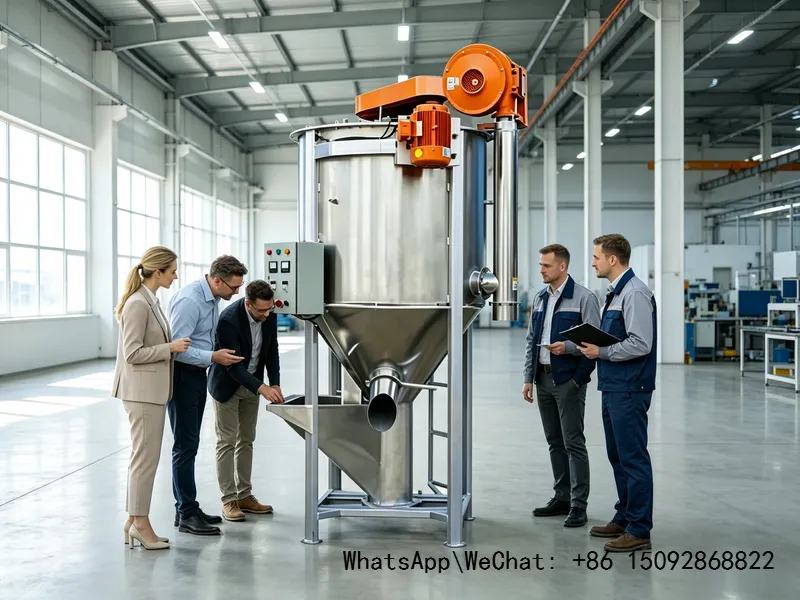
As a universal core mixing auxiliary machine in the plastic processing industry, the vertical mixer is widely used in various plastic production lines such as injection molding, pelletizing, and extrusion due to its uniform mixing, wide adaptability, customizable design, and low failure rate. Combined with a large number of customer application feedback and practical operation experience, we systematically summarize and professionally answer frequent questions to help enterprises select equipment scientifically, use it standardly, and achieve stable and efficient production.
Q1: What are the core advantages of vertical mixers compared with traditional mixing equipment?
Professional Answer: The core advantages are reflected in mixing effect and practicality. First, better mixing effect: the vertical mixer adopts spiral up-and-down circulating vortex mixing without dead angles or stratification. The mixing uniformity of new/recycled materials and color masterbatch is far higher than that of traditional plane mixing equipment, fundamentally solving finished product chromatic aberration problems. Second, stronger practicality: it supports dual material options of stainless steel and A3 iron to adapt to different material working conditions, as well as non-standard customization with full 1T-5T gradient capacity coverage. It features stable operation, low failure rate, and simple maintenance, suitable for long-term industrial mass production.
Q2: How to accurately select equipment models according to different production capacities?
Professional Answer: Select models according to the weight of materials mixed in a single batch: TL-1T for materials within 1000kg; TL-2T for about 2000kg materials; TL-3T for 3000kg mass production demands; TL-5T large-capacity model is preferred for 5000kg large-batch material mixing and large-scale production lines. The power and size of all models are accurately matched with corresponding working conditions to ensure mixing efficiency and stability.
Q3: How to choose between stainless steel and A3 iron materials? Are there differences in later maintenance?
Professional Answer: Stainless steel vertical mixer is preferred for mixing high-precision, light-color, food-grade, and high-cleanliness plastic raw materials, featuring rust prevention, pollution avoidance, no residue, and simple maintenance. A3 iron material is suitable for ordinary dark-color recycled plastics and general industrial plastics with higher cost performance and good wear resistance. Both materials require extremely simple later maintenance, only regular cleaning of barrel residual materials and inspection of motor operation status, without complex maintenance procedures.
Q4: Does the equipment support customized sizes and special configurations?
Professional Answer: Full-range non-standard customization is supported. We can customize equipment height, diameter, power configuration, discharging mode and other parameters according to customers’ workshop space, material characteristics, special capacity, and process requirements, fully adapting to personalized production demands of enterprises.
Call to Action
If you have personalized questions aboutvertical mixer selection matching, material selection, production line docking, non-standard customization, and accurate quotation, feel free to contact us for free one-on-one professional technical consultation!
WhatsApp/WeChat: +86 15092868822 | Email: [email protected]