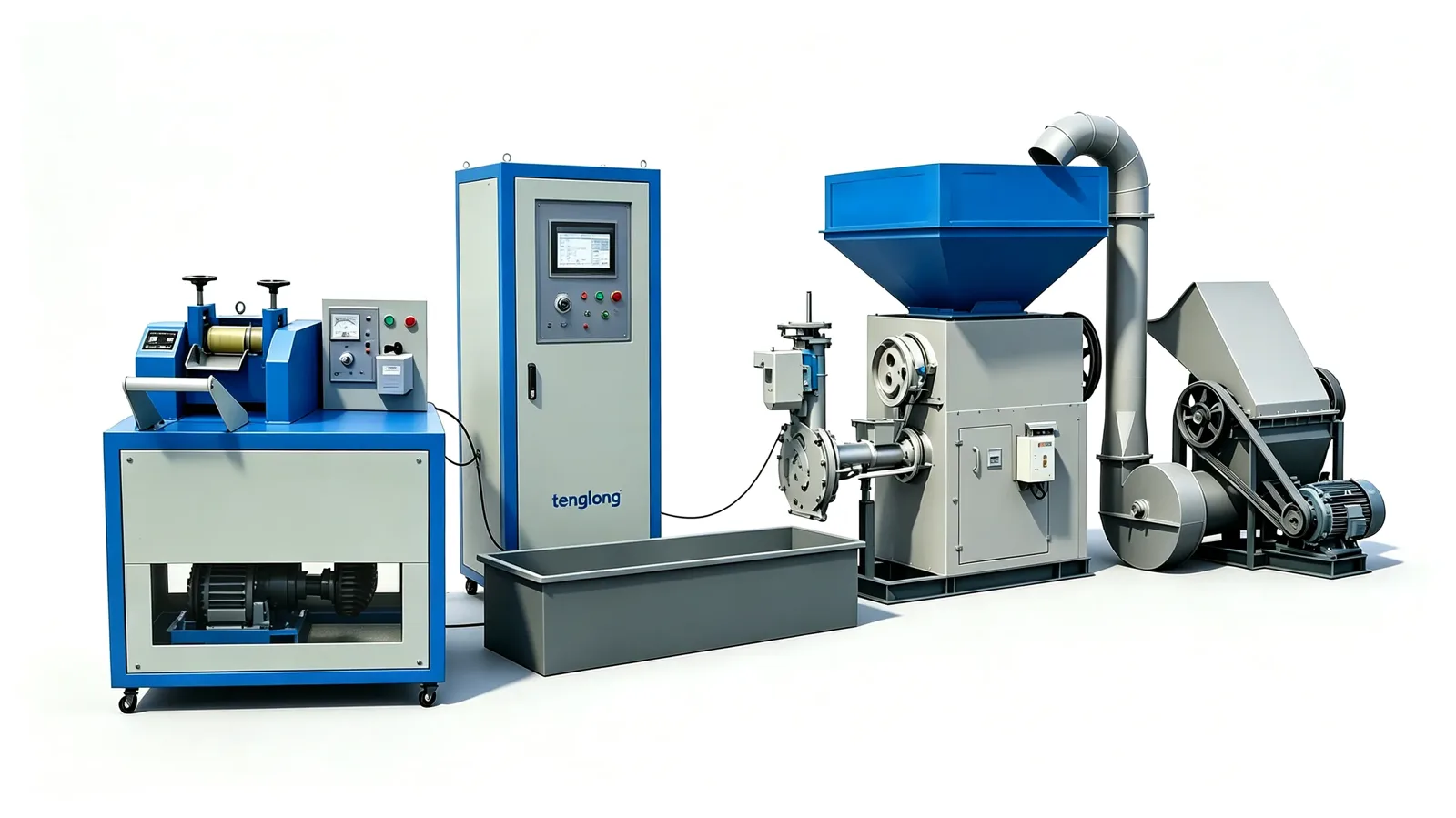
Summary: A single screw granulator specification sheet is short because the machine is simple: one screw, one barrel, one screen changer, one strand bath. Short sheets are easy to skim and easy to misread. This guide decodes the published TL-SJ data in the order the questions arrive: which screw diameter to choose, what the 30:1 L/D ratio does and does not promise, why compression ratio and screw speed are the two figures the sheet never prints, how to compare 55 to 160 kW of drive power as watts per kilogram of output, what six PID zones at ±1 °C are actually holding, and how 40 to 80 mesh filtration and a 30 mm feed limit decide whether the line runs at all. Each figure is paired with the check that confirms it on your own material, so two quotations can be compared on equal terms before a configuration is fixed. The TL-SJ family covers 150 to 700 kg/h in four models.

The sheet prints output three times and a basis note twice
The published TL-SJ page has three layers: a headline band, a model table, and a technical-data block that repeats several figures. Output appears in all three, and the basis note appears twice — output figures refer to LDPE film at 85% bulk density with 3% moisture, and actual output depends on feedstock, flake size and filtration. Two readings of one number is a warning: the headline is the range the family covers, the table is what one screw delivers, and the footnote tells you what either number means.
Read the sheet as six questions. Which diameter, which L/D, what compression, what drive, what heat, what filtration. Four of the six are printed as numbers. Two are not, and those two decide whether your polymer melts correctly on the screw you buy. The full data sits on the TL-SJ single screw granulator page, and the platform sits inside the 12-platform comparison table.
Screw diameter is the first decision, because everything scales from it
Four models, four diameters, and four output bands that do not touch. The gaps are the point: no model covers 200 to 220 kg/h, 300 to 350 kg/h or 450 to 550 kg/h, because the band belongs to a screw size, not a continuous range.
- TL-SJ-90 — 150 to 200 kg/h, 90 mm screw, 30:1 L/D, 55 kW, 6.8 × 1.5 × 2.0 m, 2.6 t.
- TL-SJ-100 — 220 to 300 kg/h, 100 mm screw, 30:1 L/D, 75 kW, 7.4 × 1.6 × 2.1 m, 3.1 t.
- TL-SJ-120 — 350 to 450 kg/h, 120 mm screw, 30:1 L/D, 110 kW, 8.2 × 1.8 × 2.2 m, 4.2 t.
- TL-SJ-150 — 550 to 700 kg/h, 150 mm screw, 30:1 L/D, 160 kW, 9.6 × 2.0 × 2.4 m, 5.8 t.
Every model shares the same 30:1 L/D, with 28:1 to 33:1 offered as an option. That is the sheet’s way of saying the ratio is a family setting, not a per-material recommendation. When a requirement lands in a gap — 320 kg/h, say — the answer is the next screw up running below its band. Footprint and weight scale with the same sequence, so crane access and floor loading are decided alongside throughput.
Reading the gaps as information
The gaps are not a missing product line. Each band is the output envelope of one extrusion package, so the band edge is where the melt delivery of that screw runs out, not where the catalogue was cut off. Running at the band edge means running with no margin for a feed heavier than the reference material.
Compression ratio and screw speed: the two figures the sheet does not print
L/D ratio is barrel length divided by screw diameter. It is a length statement, and it does not tell you how hard the material is squeezed on the way. That is the job of the compression ratio — feed channel depth over melt channel depth — and it decides whether PP, ABS and PS melt correctly on the same screw. The TL-SJ sheet prints 30:1 with 28:1 to 33:1 optional and no compression ratio at all.
Screw speed is treated the same way. The sheet publishes cutter speed — a 12-blade cutter at 300 to 900 rpm — but not a fixed screw rpm figure, because on a single screw the screw speed follows feed rate and melt temperature rather than a set point. Ask for it as a range, with the control mode stated.
The four items to put in writing
- Feed channel depth and melt channel depth per zone — the compression ratio in millimetres, not as a ratio alone.
- Screw speed range and how it is set — fixed rpm, follow-feed, or load-limited, plus the drive mode on the ABB inverter.
- Vent positions along the 30:1 barrel — three venting stages are published, and a 28:1 L/D option has fewer lengths to give away.
- Which polymer the profile was cut for — PP and PE sit about 10 to 15 °C apart in melt temperature, and ABS and PS need tighter control than either.
Read drive power as watts per kilogram, not as kilowatts
The main motor is published as 55 to 160 kW, IE3. That range is only comparable across models if you divide it by the output each screw delivers. Divide the rating by the mid-point of the model band and you get installed drive power per kilogram of throughput: 314 W per kg/h on the TL-SJ-90, 288 on the TL-SJ-100, 275 on the TL-SJ-120 and 256 on the TL-SJ-150. The line falls because the drive and the heaters do not scale in step with the screw.
These are nameplate numbers against published output, not a measurement. The measured figure on the same page is the specific energy of 0.28 to 0.42 kWh/kg, and it moves with the polymer, the moisture and the screen pack. Behind the motor sits a hardened helical gearbox with a 1.8 service factor — the figure that matters when the feed mixes film, lumps and rigid regrind, because a single screw on an inconsistent stream sees torque peaks a light gearbox would not survive.
The electrical side is worth reading as part of the specification, not a footnote: 380 V, 50 Hz, three phase; ABB inverter; Siemens S7-1200 PLC with a 7-inch HMI; recipe storage per material and one-touch start; a guarded belt drive; CE-interlocked covers; and an emergency stop at three positions. The recipe storage turns a grade change into a selection on the HMI.
What the numbers do not settle
Installed power is not consumption. Whether the machine draws 55 kW or 48 kW at the barrel depends on the feed and the screen, and the only honest answer is the meter on the 4-hour factory test run.
Six PID zones, one melt window, and the drying question underneath it
Heating is published as PID barrel control in six zones at ±1 °C, with melt-pressure and melt-temperature alarms, and the process description puts the polymer at 190 to 240 °C across those zones. Two things in that sentence get collapsed into one. The ±1 °C is control resolution — how tightly a zone holds its set point — not a melt tolerance. The 190 to 240 °C band is the working window for these polyolefins, and the set points inside it are set per material, not printed.
Ventilation is the reason the machine runs film that still carries moisture. The barrel carries three venting stages, and the process description names two vacuum vents whose job is to pull moisture and ink volatiles out before they reach the melt. That is why washed film at 3% surface moisture is quoted without a pre-drying step for most polyolefins.
Set points do not transfer between polymers. LDPE runs about 10 to 15 °C cooler than PP, ABS and PS sit between the two and need tighter control, and PET needs dehumidified drying and crystallisation that a single screw line is not configured to deliver. The logic by polymer is set out on granulator selection by material.
Why the alarms matter more than the zone count
Six zones tell you how finely the barrel can be held. The two alarms tell you a change is being noticed: rising pressure with a stable temperature is a filtration problem, and stable pressure with a drifting temperature is a barrel or feed problem. Two alarms separate two fault families that look identical from the chute.
Filtration and feeding decide whether the line runs at all
Melt is filtered through a hydraulic double-piston screen changer with 40 to 80 mesh packs, and one cavity works while the other is exchanged, so a screen change does not interrupt output. The mesh number is a decision about your dirt rather than the machine: a coarse pack passes more and runs longer between changes, a fine pack holds back paper, sand and unmelted specks and blocks sooner. Screen life is the clock that sets the output you actually get, which is why the how every line is factory tested protocol logs the pack alongside output and pressure on every run.
Feeding carries two published conditions that are easy to under-read. Feed must be smaller than 30 mm and free of sand, metal and paper, and material enters through a force feeder or a gravity hopper with a metal detector protecting the screw. Those two sentences decide whether the line feeds continuously or starves, and they point upstream: size reduction and washing are separate machines, covered in the crusher and shredder range and washing line equipment.
Which leaves the two numbers that were not printed. Compression ratio and screw speed appear nowhere on the sheet, and they decide whether your polymer melts cleanly on a 30:1 barrel. Ask for them in millimetres and in rpm, and you will be comparing two configurations instead of two brochures.
| Published TL-SJ line | What it fixes on the line | What it leaves open | The check that closes the gap |
|---|---|---|---|
| Output 150 to 700 kg/h across four models | Throughput per screw size and the model ladder | That it is quoted on LDPE film at 85% bulk density with 3% moisture | Ask for your material’s rate after the 4-hour factory test run |
| Screw diameter 90 / 100 / 120 / 150 mm, L/D 30:1 | Barrel length available for feeding, venting and melting | The compression ratio behind the length, and the screw speed range | Request feed depth, melt depth, vent positions and the rpm range in writing |
| Main motor 55 to 160 kW, IE3 | Installed drive power and the electrical supply at 380 V three phase | Actual draw at your material and your tariff | Compare 314 / 288 / 275 / 256 W per kg/h across the four models |
| Six PID zones at ±1 °C, melt window 190 to 240 °C | How tightly each barrel zone holds its set point | The set points for your polymer, and the drying requirement | LDPE runs 10 to 15 °C cooler than PP; confirm set points on the test run |
| Hydraulic double-piston screen changer, 40 to 80 mesh | How dirty the feed can be before the melt has to stop | How long a pack lasts on your contamination level | Read what the extracted pack collected; the double-piston design keeps output running |
| Feed smaller than 30 mm, force feeder or gravity hopper, metal detector | Whether the screw can be fed continuously at all | Whether the upstream size reduction and washing are already in place | Confirm flake size and contamination level before the model is fixed |
Frequently asked questions
Q1: What does the 30:1 L/D ratio mean on a single screw granulator, and must I specify it?
L/D is barrel length divided by screw diameter. It tells you how much polymer path and how many venting stages the machine has, and the sheet publishes it as 30:1 standard, 28:1 to 33:1 optional. It does not tell you the compression ratio, which decides whether the polymer melts correctly. Ask for feed depth, melt depth and vent positions in writing.
Q2: How do I choose between the TL-SJ-90, -100, -120 and -150 models?
Pick by the output band your material needs, because the published bands do not overlap: 150 to 200 kg/h on the 90 mm screw, then 220 to 300, 350 to 450 and 550 to 700 kg/h. If your requirement sits in a gap, take the next screw up and run it below its band. Motor power runs from 55 to 160 kW across the four.
Q3: Why does the same single screw granulator quote a different output for different plastics?
The published band is measured on LDPE film at 85% bulk density with 3% moisture, and the page states that actual output depends on feedstock, flake size and filtration. Density sets how much solid the screw swallows per turn, so HDPE bottle flake runs 15 to 20% higher than the reference band while high-ink film runs about 10% lower, because a finer screen pack is needed.
Q4: What is the difference between L/D ratio and compression ratio on a granulator screw?
L/D measures length: how much barrel the polymer travels through. Compression ratio measures squeeze: feed channel depth divided by melt channel depth, and it decides how the polymer melts and whether shear is too aggressive for the grade. The TL-SJ page publishes 30:1 L/D with 28:1 to 33:1 optional but prints no compression ratio, so request the channel depths in millimetres.
Q5: Which screen pack mesh should a single screw granulator run on washed film and on rigid regrind?
Filtration is published as a hydraulic double-piston screen changer with 40 to 80 mesh packs, and the mesh is a decision about contamination rather than about the machine. Rigid regrind with paper and label fragments needs the coarser pack, while washed film with ink carries finer particles and blocks the tight pack sooner. Because one cavity works while the other is exchanged, a screen change does not interrupt output.
Engineer’s note
The first figure I ask for on any single screw enquiry is not the output but the compression ratio, because L/D only tells me the length of the barrel. Our screws are 38CrMoAlA, nitrided in-house to a 0.5–0.7 mm case at HV 900–1000 and straightened to 0.03 mm runout over the full length. The case is what survives the feed; the channel profile is what melts the polymer. Only one of the two is visible on a data sheet.
Engineering note: the numbers on this page are our own published reference ranges for the machine family, not a specification guarantee for any individual unit. Final output, specific energy and pellet quality are set by the incoming material, its moisture and contamination level, and the screen pack fitted. We write the confirmed figures onto the quotation after a factory test run on your own material.
Who wrote this
Zhou Gong (周工) is a senior plastic machinery engineer at TENGLONG Plastic Machinery in Linyi, Shandong. The factory was registered as Linyi Hedong District Tenglong Plastic Machinery Factory on 7 June 2016 and grew out of a screw and barrel workshop, so his work is rooted in the parts that decide whether a granulator holds output: screw geometry, nitriding case depth, barrel alignment and melt filtration. He prepares the technical specification for customer quotations, reviews the four-hour factory test data before shipment, and runs commissioning support on site. Screws are nitrided in-house to a 0.5–0.7 mm case at HV 900–1000 and straightened to 0.03 mm runout over the full length; barrel, screw, gearbox and frame are aligned to 0.05 mm before the test run.
Figures quoted here are engineering reference ranges published on our own product pages, not guaranteed values for any specific machine. Real output, specific energy and pellet quality depend on the incoming material, its moisture and contamination level, and the screen pack fitted. Final values are written after a factory test run on the customer’s own material, and the PLC-logged test report ships with the machine. For a quotation that reflects your material, send the feed form, contamination level and target output and a configuration comes back within one working day.
Send the polymer, the flake size, the contamination level and the target output, and we will return a TL-SJ configuration with the compression ratio, vent positions and screw speed range written on it. Request the specification and the 4-hour test protocol — a reply comes back within one working day.