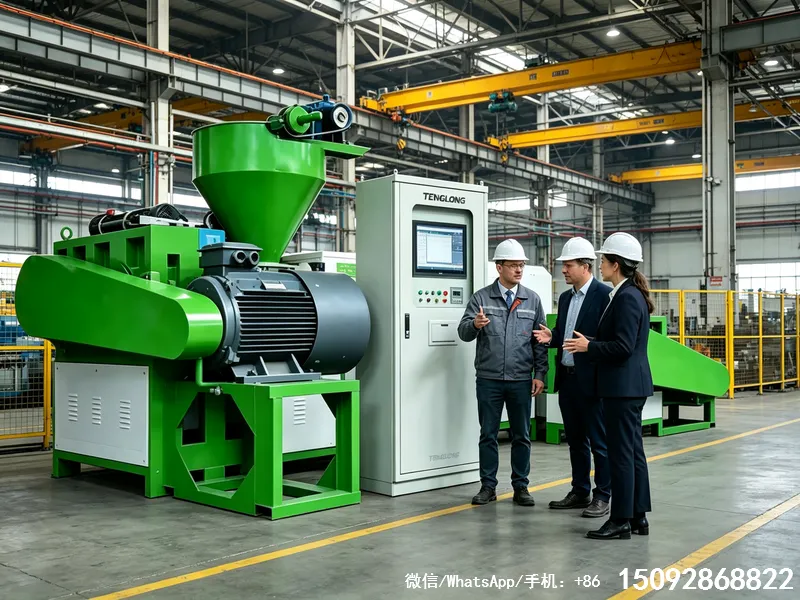
Short answer: Plastic recycling machine prices in 2026 range from about US$6,800 for a compact 100–500 kg/h pellet mill to US$120,000 for a 500–2,000 kg/h PET pelletizing line. Total installed cost adds freight, utilities, water treatment and commissioning, and payback is driven by feedstock-to-pellet margin and uptime.
Buyers routinely compare ex-works machine prices and then discover that the installed project costs 30 to 60 percent more. This article separates equipment price from total cost of ownership, publishes a transparent price range by machine class, and shows a worked payback calculation you can recompute using your own local material prices.
All price points below are published indicative 2026 starting prices from TENGLONG Plastic Machinery, a Linyi-based manufacturer founded in 2016 with CE marking and ISO 9001:2015 certification. Starting prices describe a base configuration; filtration, drying, automation and voltage options change the final figure.
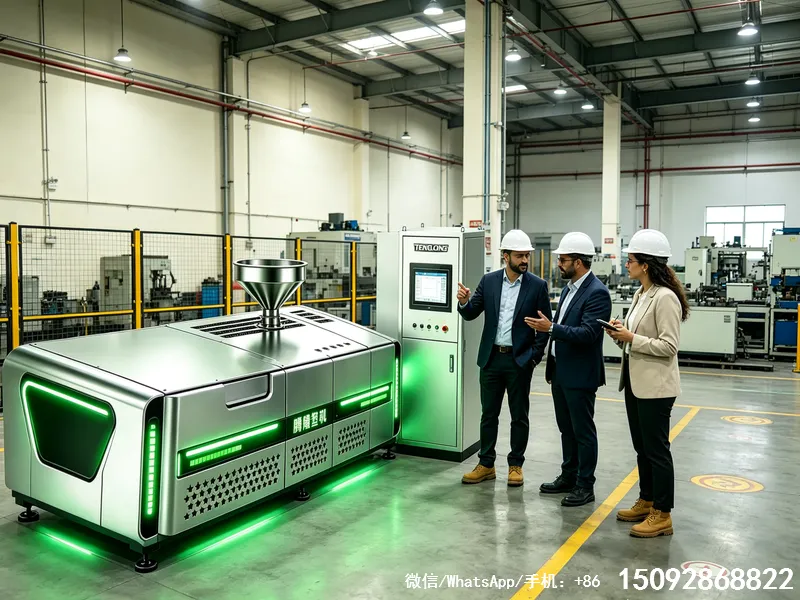
How much does a plastic recycling machine cost in 2026?
Entry-level equipment starts near US$6,800, mainstream single-screw granulators near US$12,500, and complete PET or turnkey lines near US$85,000 to US$120,000. Price scales primarily with throughput, filtration fineness, drying capability and automation, not with brand alone.
| Platform | Rated output | Key specification | Starting price (USD) |
|---|---|---|---|
| Plastic pellet mill TL-PM | 100–500 kg/h | 37–90 kW, 3 m skid | 6,800 |
| Single screw granulator TL-SJ | 150–700 kg/h | 90–150 mm nitrided screw | 12,500 |
| Strand pelletizing line TL-ST | 150–800 kg/h | 4–6 m bath, 12-blade cutter | 16,800 |
| Water ring pelletizer TL-WR | 100–1,000 kg/h | 2–4 mm pellets | 18,500 |
| Masterbatch granulator TL-MB | 20–500 kg/h | 20–60% pigment loading | 26,000 |
| Flakes pelletizing machine TL-FK | 300–1,000 kg/h | 0.26–0.36 kWh/kg, 80–100 mesh | 28,000 |
| Twin screw granulator TL-TS | 300–1,500 kg/h | 40:1 L/D, gravimetric dosing | 38,000 |
| Film granulating line TL-FL | 200–800 kg/h | Cutter compactor, 80 mesh | 42,000 |
| Two stage line TL-2S | 300–1,200 kg/h | 60–100 mesh, stable die pressure | 46,000 |
| Underwater pelletizer TL-UW | 300–2,000 kg/h | Below 0.1% moisture | 62,000 |
| Turnkey line TL-GPL | 500–3,000 kg/h | Crushing, washing, drying, bagging | 85,000 |
| PET pelletizing line TL-PET | 500–2,000 kg/h | 50 ppm drying, IV loss below 0.03 dl/g | 120,000 |
These figures are published starting prices, not quotations. For a machine-by-machine capacity comparison see the 12-model comparison, and for the full equipment taxonomy see plastic recycling equipment.
What costs are usually excluded from an equipment quote?
Freight, import duty, site electrical work, water treatment, civil works, installation travel, spare parts kits and operator training are commonly excluded. Request a total installed cost line by line before comparing two suppliers, because the cheaper machine often carries the larger installation scope gap.
| Cost layer | What it covers | How to control it |
|---|---|---|
| Logistics and import | Sea freight, containerisation, insurance, duty, local haulage | Ask for a delivered-duty-paid alternative quote |
| Site utilities | Three-phase supply, cabling, switchgear, process water, drainage, compressed air | Get the connected-load and utility drawing before civil work |
| Effluent treatment | Wash-water recirculation, settling, sludge handling, discharge compliance | Request a water balance with the line layout |
| Installation and commissioning | Engineer travel, alignment, dry and wet tests, trial runs | Define acceptance criteria and day rates in the contract |
| Consumables and spares | Knives, screens, heater bands, seals, filter mesh | Request a priced recommended spare parts list |
How do you calculate total cost of ownership per kilogram?
Divide the sum of annualised capital, electricity, labour, consumables, water and maintenance by annual saleable pellet output. The dominant variable is usually electricity, followed by labour and screen or knife consumption. Under-utilisation raises cost per kilogram because fixed loads are spread over fewer tonnes.
A published benchmark is 0.26–0.36 kWh/kg for a flakes pelletizing machine. Washing and thermal drying add to that figure. Always measure your own line with a sub-meter over a full steady-state shift rather than using a catalogue number for financial modelling.
Worked example: 500 kg/h line, illustrative only
| Assumption | Value |
|---|---|
| Rated output / actual average | 500 kg/h / 400 kg/h at 80% utilisation |
| Operating schedule | 20 h/day × 300 days = 6,000 h/year |
| Annual saleable pellets | 2,400 t |
| Equipment investment (installed) | US$60,000 (example, not a quote) |
| Specific energy | 0.32 kWh/kg at US$0.10/kWh |
| Annual electricity | 768,000 kWh = US$76,800 |
| Feedstock, washing losses and consumables | Enter local cost per tonne and yield loss |
| Gross margin per tonne (pellet price minus feedstock and conversion cost, excluding equipment) | Enter your local spread |
| Simple payback | Investment ÷ (annual margin per tonne × 2,400 t) |
This table deliberately leaves the margin blank: pellet and waste prices vary widely by region and by polymer, and a fabricated number would be misleading. The calculation method is the deliverable. If your local gross margin is US$80 per tonne, annual gross margin is US$192,000 and simple payback on this example is roughly 3.8 months; if it is US$30 per tonne, payback is about 10 months. Verify the spread with signed offtake and supply agreements.
When does a more expensive machine pay for itself?
It pays for itself when it removes a real constraint: contamination tolerance, drying, uptime or pellet quality. A two-stage line costs more than a single-screw granulator, but it stabilises die pressure on heavily contaminated waste. A water-ring pelletizer saves about 40 percent floor space over strand cutting, which matters where floor area is expensive. A PET line with dehumidified drying to 50 ppm is the only route to food-contact or fibre-grade output.
Conversely, paying for capability you cannot use destroys returns. Clean, single-polymer in-house scrap processed on a single-screw granulator can match the pellet quality of a far more expensive compounding line. Match the machine to the material, not to the catalogue ceiling.
Key takeaways
- 2026 published starting prices span US$6,800 to US$120,000 across 12 machine platforms.
- Total installed cost, not ex-works price, is the correct comparison basis.
- Electricity at 0.26–0.36 kWh/kg is usually the largest variable operating cost.
- Under-utilisation raises cost per kilogram because fixed loads remain constant.
- Payback depends on the verified feedstock-to-pellet margin and real uptime, not on nameplate capacity.
Want a costed configuration? Request an itemised quotation including utilities and commissioning scope via the contact page, or review the turnkey pelletizing solutions scope before budgeting.
Frequently Asked Questions
How much does a plastic recycling machine cost in 2026?
Entry-level plastic recycling machines start around US$6,800 for a 100-500 kg/h pellet mill. Single-screw granulators start near US$12,500, two-stage lines near US$46,000, and a 500-2,000 kg/h PET pelletizing line starts near US$120,000. Final quotes depend on capacity, filtration and drying requirements.
What costs are usually excluded from an equipment quote?
Common exclusions are freight and import duty, site electrical work, water treatment, installation and commissioning travel, spare parts kits, operator training and civil works. Buyers should request a total installed cost, not only an ex-works machine price, before comparing supplier quotations.
What is a realistic payback period for a recycling line?
Payback depends on the spread between waste feedstock cost and pellet selling price, plus uptime. With 20 hours per day, 300 operating days, a 500 kg/h line and a conservative margin, many projects model 12 to 30 months. Always validate the margin with local material prices before committing.
Does a higher machine price always mean better output quality?
Not always. Price rises mainly with throughput, filtration fineness, drying capability and automation. A two-stage line costs more because it handles heavily contaminated feedstock. If your material is clean in-house scrap, a simpler single-screw machine can produce equivalent pellets at far lower cost.
Related reading
- What Is a Plastic Recycling Machine? A 2026 System Guide
- Film Recycling Process Upgrade: Film Squeeze Material Granulation Production Line Solves Pain Points of High Labor Demand and Low Capacity
- Core Cost Reduction Solution for Sheet Production:PVC Hard Trim Recycling Machine Realizes 100% Edge Trim Circular Utilization