3-Stage Granulation Becomes Mainstream | 250 Type Plastic Woven Bag Granulator Solves Low-Quality & Low-Yield Pain Points of Woven Bag Recycling
In the PP woven bag recycling industry, old single and double-stage plastic woven bag granulator can no longer meet the current mass production demands for high quality, high output and low loss. Waste woven bags are inherently light, loose, and mixed with a large amount of sediment, dust and moisture after recycling, making recycling far more difficult than ordinary plastic materials. Traditional equipment features single plasticization layer and insufficient filtration accuracy, commonly causing particle looseness, yellowing, excessive impurities and serious color difference in production. Frequent shutdown screen changes lead to production gaps and waste accumulation. Ordinary screws have poor wear resistance, prone to carbon deposition and scratching when processing impure materials for a long time, resulting in high operation and maintenance costs. Most factories fall into a dilemma: high output with low quality, or high quality with low output. Equipped with the industry-leading 3-stage extrusion process, the 250 type plastic woven bag granulator targets and solves the core pain points of woven bag recycling, becoming the preferred equipment for large-scale recycling plants to improve quality and increase profits.
Many recycling practitioners hold a misunderstanding that woven bag granulation is simple and ordinary double-stage equipment is sufficient for production. In fact, woven bag materials are light, impurity-rich and easy to oxidize and yellow, putting forward extremely high requirements for equipment plasticization layering, temperature control accuracy, filtration capacity and wear resistance. Double-stage equipment can only complete one filtration and two plasticization processes at most, failing to fully refine materials and remove fine impurities, resulting in unstable finished particle quality that can only be sold at low prices in low-end markets. In contrast, the 250 type plastic woven bag granulator adopts a three-stage collaborative operation with clear responsibilities and progressive optimization, comprehensively improving material compaction, impurity filtration and fine plasticization extrusion, serving as a customized model adapted to the characteristics of woven bag materials.
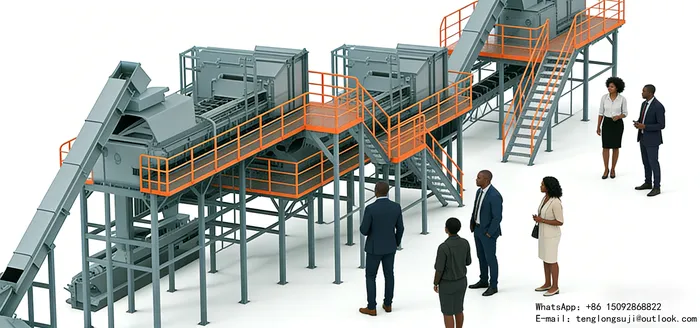
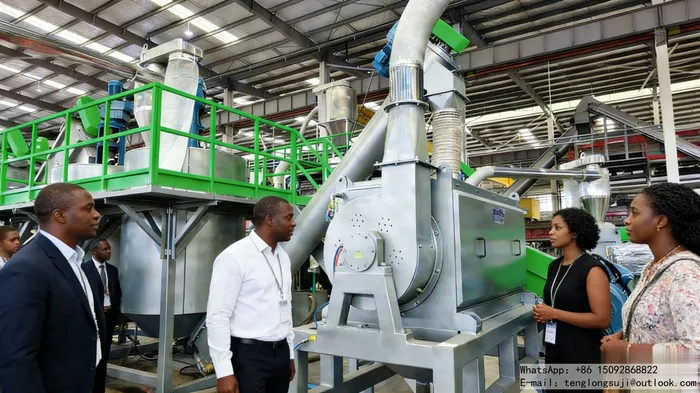
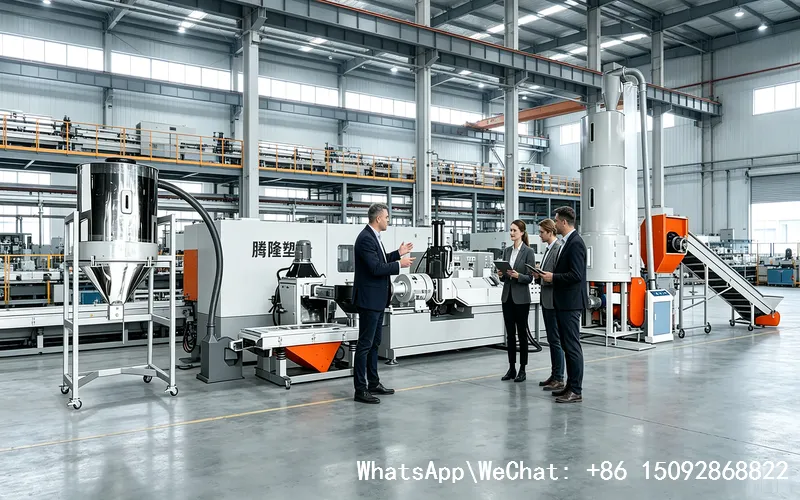
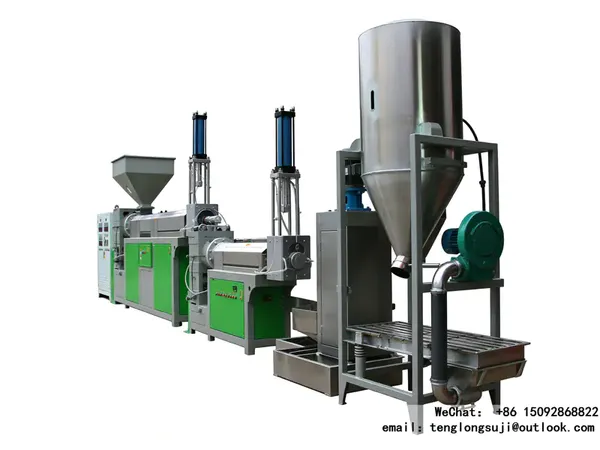
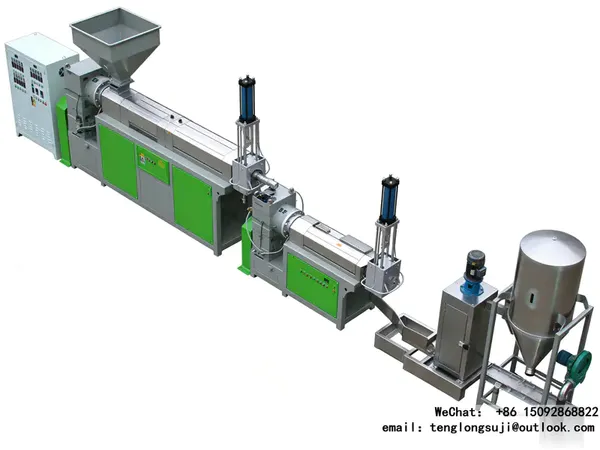
In material pretreatment and primary refining, the equipment relies on a forced feeder and 250-type high-yield main host to solve difficult feeding and shallow plasticization problems of woven bags. Thickened enlarged feeding teeth eliminate slipping and bridging. The 22KW high-power feeding system delivers uniform material supply, matching the 4.2m extended wear-resistant screw and 110KW sufficient power to fully compact, melt and roughly refine loose woven bag materials, completing preliminary material homogenization and greatly reducing the fine plasticization pressure of subsequent processes. Four sets of 80KW electromagnetic heaters of the main host realize uniform and energy-efficient zoned temperature rise, accurately controlling PP melting temperature to avoid high-temperature oxidative yellowing and low-temperature incomplete melting, ensuring pure material base color from the source.
In the core purification and stable production stage, the 210-type secondary unit undertakes key impurity filtration and non-stop production stabilization. The 315-type high-torque reducer operates stably, and the 4.2m high-frequency wear-resistant screw performs secondary material mixing and refinement. Matched with a large 400×400mm hydraulic non-stop screen changing head and 4KW hydraulic pump station for continuous pressure supply, it realizes automatic alternating screen replacement without shutdown or strand breakage, completely solving the production loss problem of traditional shutdown screen changes and greatly improving the effective operating rate. The large-size screen accurately intercepts fine sediment, dust and burnt impurities carried by woven bags, significantly improving melt purity — the core reason why 3-stage equipment delivers far better particle quality than double-stage models.
In the fine plasticization forming stage, the 180-type tertiary unit completes final pressure stabilization, homogenization and precise strand extrusion. The 250-type silent reducer ensures accurate transmission, and special heating rings provide precise temperature compensation for fine plasticization and pressure stabilization of purified materials, making particles denser, more transparent and uniform. The rear complete automatic post-processing line includes a 5-meter extended gradient cooling water tank, 0.55KW vibrating drying machine for thorough water removal, 220-type variable-frequency precision granulator, stainless steel vibrating sieve for graded impurity removal and closed dust-drying storage bin, strictly controlling every procedure to ensure dry, clean and uniform finished particle batches.
The whole machine adopts differentiated zoned heating design: high-efficiency electromagnetic heating for the main host and precise temperature compensation for secondary and tertiary units, adapting to the stepped melting characteristics of PP woven bags with remarkable energy-saving effects. All-stage screws and barrels are strengthened by high-frequency quenching, and the feeding port is reinforced with wear-resistant alloys, resisting impure material wear, carbon deposition and high temperature with extremely low failure rate in long-term mass production. Actual test data shows that upgrading to the 250 type 3-stage plastic woven bag granulator line greatly increases factory particle yield rate and output, comprehensively reduces waste loss, power consumption and operation & maintenance costs, completely getting rid of low-end price involution.
FAQ
plastic woven bag granulatorQ1: Does the 3-stage 250 type have better energy-saving effects than double-stage equipment?
A: Yes. The equipment adopts graded differentiated heating: the main host high-power electromagnetic heating features high thermal conversion rate and fast temperature rise, while secondary and tertiary units provide precise temperature compensation without invalid energy consumption, saving more than 30% energy compared with traditional unified whole-machine heating. Meanwhile, the 3-stage process achieves higher plasticization efficiency and lower defective rate, comprehensively reducing comprehensive energy consumption and material loss.
Q2: Is this equipment suitable for mass production of wet-dry mixed waste woven bags?
A: Fully suitable. The front-end forced compaction and melting structure can handle humid loose materials, 3-stage filtration and purification removes moisture and impurities, and the rear dedicated water drying and dust removal system completely solves moisture adhesion problems. There is no need for thorough material drying in advance, simplifying production procedures and supporting continuous mass production of wet-dry impure materials.
Call to Action
To learn detailed output data, energy-saving parameters and exclusive PP woven bag debugging process of the plastic woven bag granulator, feel free to consult for free at any time!
WhatsApp/WeChat: +86 15092868822 | Email: [email protected]