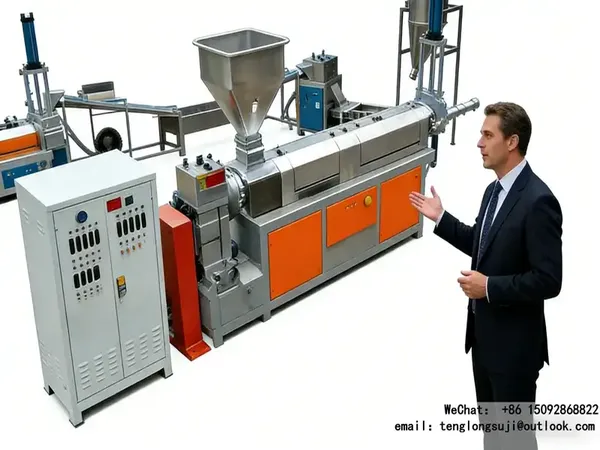
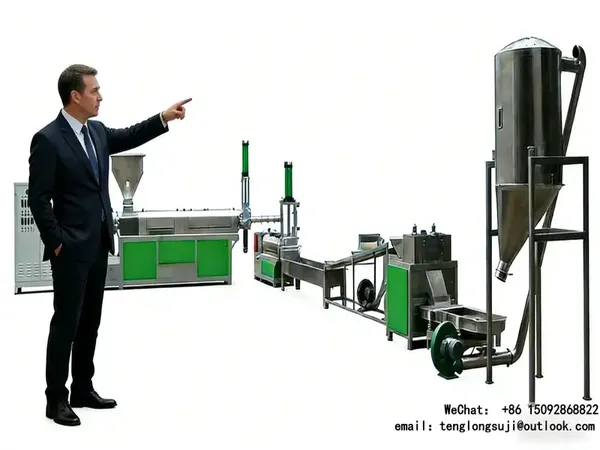
Strand Pelletizing of Plastic Granulator: The Most Practical Way to Turn Waste Plastic into Pellets

People in the plastic recycling industry all know that there are several ways to turn waste materials into pellets. Methods like water ring cutting and underwater cutting sound quite advanced.
But if you visit recycling factories in Southeast Asia or small and medium-sized factories in Europe and America, the most commonly used method is still strand pelletizing.
Why? It’s practical, easy to use, and affordable.
Today, we’ll talk about this strand pelletizing. No empty talk—we’ll just cover how it works, its advantages, and who it’s suitable for.
- What Exactly is Strand Pelletizing?
To put it simply, it’s four steps:
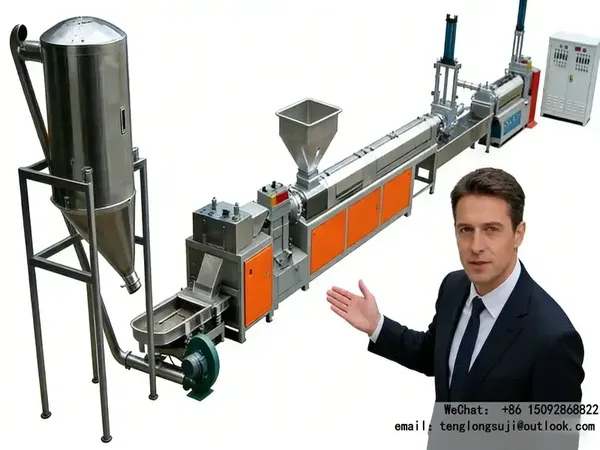
Step 1: Melt the plastic into a paste.
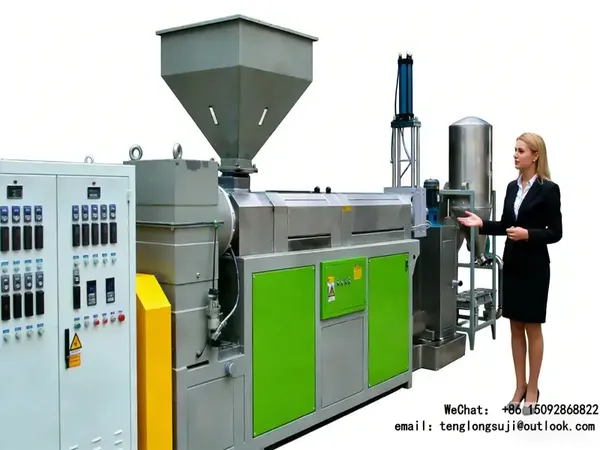
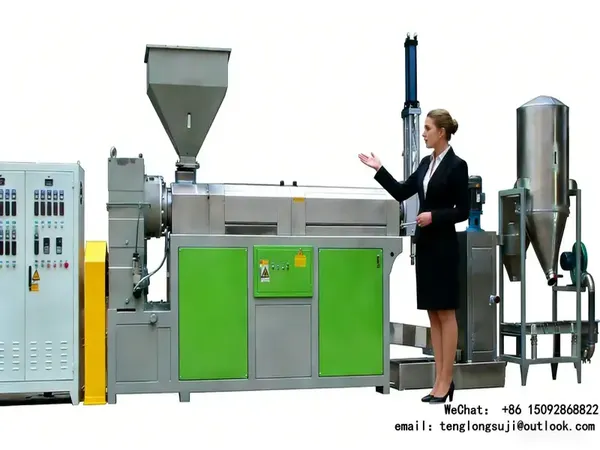
Waste plastic is fed into the plastic granulator, where the screw pushes it forward and the heating coil heats it, gradually melting it into a thick paste.
Step 2: Extrude into “noodles”.
This paste is extruded through a die head, forming continuous hot “noodles” that are soft and pliable.
Step 3: Cool the “noodles”.
The hot plastic noodles are quickly cooled and hardened—either by passing through water or blowing air—until they can be pinched by hand.
Step 4: Cut into pellets.
The hardened noodles are cut into small sections by a high-speed cutter. They are then sieved to remove irregular pellets and fine powder, leaving the finished plastic pellets.
It’s that simple.
- What Advantages Does It Have Compared to Other Processes?
There are other processes on the market, such as water ring cutting and underwater cutting, which sound more high-end. But strand pelletizing has several practical advantages:
First, the equipment is affordable.
It doesn’t require complex circulating water systems or high-pressure water pumps. A regular plastic granulator is enough to get the job done.
Second, it’s easy to repair.
If it breaks down, you can fix it yourself. No need to hire professional technicians—saves time and trouble.
Third, quick material change.
You can process PP today and PE tomorrow—just change the strands and adjust the temperature. Unlike other processes, changing materials doesn’t take half a day of hassle.
Fourth, it’s visible.
You can see the strands coming out of the die head at a glance—whether they’re thick, thin, or broken. If there’s a problem, you can adjust immediately, no need to wait until the pellets are cut to find out.
That’s why small factories in Southeast Asia prefer strand pelletizing—fewer people, tight budgets, and a need for durability.
III. The Complete Process of Strand Pelletizing: Every Step Matters
3.1 Plasticizing and Extrusion
Waste plastic is fed into the plastic granulator, where the screw pushes it forward and the temperature is gradually increased.
Key point: The die head temperature must be accurate. If the temperature is too low, the strands won’t come out; if it’s too high, the strands will be soft and break easily when touched.
How to judge if the temperature is right? If the strands come out shiny, bubble-free, and continuous, it’s correct.
3.2 Cooling and Shaping
The hot noodles must be cooled and solidified quickly.
Water cooling—the most common method—is suitable for most general-purpose plastics. Air cooling is used for heat-sensitive materials like PVC to avoid moisture residue affecting pellet performance.
Note: For water cooling, the water must be clean and the temperature stable. If the water is too hot, the strands won’t cool thoroughly and will remain soft; if there are too many impurities in the water, they will stick to the strands and cause black spots.
3.3 Traction and Stretching
After cooling, the strands are pulled forward by a traction device.
Key point: The traction speed must match the extrusion speed. Pulling too fast will make the strands too thin; pulling too slow will cause the strands to pile up on the ground.
How to adjust? Check the strand diameter. Uniform thickness means the speed is correct. If the strands are thick in one section and thin in another, the traction speed is unstable or the extrusion pressure is fluctuating.
3.4 Pelletizing and Sieving
The cooled strands are cut into standard pellets by a high-speed cutter. They are then passed through a vibrating sieve to remove irregular pellets and fine powder, resulting in qualified recycled plastic pellets.
How to judge if the cutting is good? Check the pellets. Uniformly sized pellets are acceptable; those that are uneven or have “tails” are not.
- What Materials Can Strand Pelletizing Process?
This is the biggest advantage of strand pelletizing—it’s not picky about materials.
It can process various general-purpose and engineering plastics:
PP (woven bags, ton bags)
PE (films, bottles)
PS (daily necessities, packaging)
ABS (electrical casings)
It can process both new raw materials and waste recycled materials:
Plastic bottles
Woven bags
Films
Factory scrap
A plastic granulator with strand pelletizing can handle almost all common waste plastics. No need to buy multiple machines.
- Europe & America vs. Southeast Asia: Different Configurations
Even though it’s the same strand pelletizing, the equipment configurations differ for different regions.
European and American markets:
High requirements.
Precise temperature control (within ±1℃)
Low energy consumption to save electricity
CE certification required
Stable pellet quality, compatible with new materials
Therefore, plastic granulators sold to Europe and America are equipped with high-precision temperature control systems and energy-saving designs, meeting CE and ISO 14021 environmental labeling standards to comply with strict local environmental requirements.
Southeast Asian markets:
Practical requirements.
Durable and reliable, not prone to breakdowns
Simple operation, easy for anyone to use
Easy-to-buy accessories, can be replaced by oneself
Affordable price
Therefore, machines sold to Southeast Asia have simplified structures, improved stability, and lower energy consumption, suitable for small-scale production. The operation process is also simplified to match the technical level of local operators.
Before buying a machine, figure out who you’re selling the pellets to. If selling to Europe and America, don’t skimp on configuration. If selling locally, a basic configuration is enough.

- Common Problems with Strand Pelletizing
Problem 1: Strands won’t come out
Symptom: Intermittent or no discharge from the die head.
Cause: Temperature is too low (causing blockage) or impurities in the die head.
Solution: Increase the temperature or shut down to clean the die head.
Problem 2: Bubbles on the strands
Symptom: Small holes on the strand surface, and air bubbles inside the pellets when cut open.
Cause: Raw materials are too wet, or the temperature is too high (causing material decomposition).
Solution: Dry the raw materials or lower the temperature.
Problem 3: Uneven strand thickness
Symptom: Strands are thick in some sections and thin in others.
Cause: Unstable traction speed or fluctuating extrusion pressure.
Solution: Check the traction machine and ensure the screw speed is stable.
Problem 4: Pellets with “tails”
Symptom: Pellets have a small tip on one end after cutting.
Cause: Dull cutter or insufficiently cooled strands.
Solution: Sharpen the cutter or lengthen the cooling water tank.
VII. Daily Maintenance: Just 3 Things
Maintaining a plastic granulator for strand pelletizing is not complicated—remember these three things:
- Clean the die head before each shutdown.
If not cleaned, it will be more severely blocked the next time you start the machine.
- Check the cooling water.
Replace the water if there are too many impurities—otherwise, they will stick to the strands and cause black spots on the pellets.
- Sharpen the cutter.
Dull cutters cause pellets to have “tails”. Sharpen them as soon as you notice they’re not working well—don’t wait.
VIII. Who is Strand Pelletizing Suitable For?
To be honest, strand pelletizing is not suitable for all occasions.
Suitable for:
Small and medium-sized recycling factories
Those with changing material types (processing different plastics every day)
Operators with average technical skills
Limited budget
Not suitable for:
Large factories with daily output of tens of tons (inefficient)
Those producing high-end materials with strict requirements (strand pelletizing is prone to contamination)
Areas with high labor costs (strand pelletizing requires on-site monitoring)
The choice of process depends on your scale, materials, and budget. Don’t follow the trend blindly.
We’ve been in this industry for 20 years and have sold thousands of plastic granulators. Strand pelletizing is the oldest and most practical process.
If you’re not sure if strand pelletizing is suitable for you—
Add our WeChat to tell us what materials you process and your output.
WhatsApp / WeChat: +86 15092868822
We’ll help you determine the most suitable process or send you a configuration list for strand pelletizing.