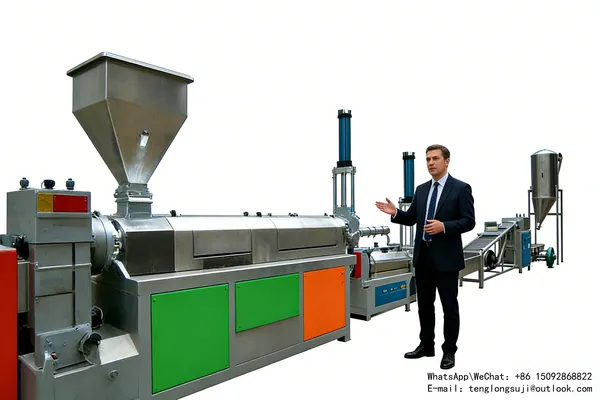
The Head and Die of plastic pelletizing machine: They Determine the Appearance and Qualification of Granules
Almost all bosses engaged in plastic recycling have encountered such a frustrating situation:
The plastic pelletizing machine was running smoothly, but the produced granules suddenly “failed” — some had a small tail, some were pointed at both ends, some had a rough surface, and what was worse, no material came out at all, with the head pressure soaring to an alarming level, directly affecting the production progress.
Where exactly is the problem? The answer is clear: it’s the head and die.
Many bosses focus all their attention on the screw, motor and reducer when buying a plastic pelletizing machine, but glance over the head and die, or even don’t ask a single question. However, experienced machine repairmen all know a truth: the appearance and qualification of granules are entirely determined by the head and die.
Today, we won’t talk nonsense. We will explain the head and die of the plastic pelletizing machine thoroughly in down-to-earth language to help everyone avoid pitfalls in production.
What Do the Head and Die Do? Simply Put, Two Sentences
After the material is fully melted in the barrel, it is pushed forward by the screw. At this time, two key components are needed for “shaping” — neither can be missing:
Head: Responsible for “smoothing” the spirally advancing melt, converting it into uniform linear flow, and stabilizing the pressure at the same time to lay a good foundation for subsequent shaping;
Die: Responsible for extruding the stabilized melt into fixed strips, and the number of circles, thickness and shape of the granules are all determined by it.
To put it simply: the head is a “feeding channel” to ensure the stable transportation of the melt; the die is a “shaping mold” to determine the final appearance of the granules. If the two do not cooperate well, no matter how high-quality the raw materials are or how good the screw is, it is impossible to produce good granules.
For a reliable plastic pelletizing machine, the head and die must be of high quality. Even if the screw is good and the temperature control is accurate, if the final shaping step is not in place, all previous efforts will be in vain.
Two Common Types of Heads: Easy to Choose at a Glance
The head of the plastic pelletizing machine is mainly divided according to the angle between the melt flow direction and the screw center line. There are two common types, which are suitable for different production scenarios:
2.1 Bevel Head (120° Angle)
This is the most commonly used and mature type of head, which is suitable for almost all conventional plastic pelletizing machines. After the melt comes out of the screw, it turns a 120° corner into the die without severe steering.
Features:
- Mature and stable structure, wide application range, suitable for PP, PE, ABS and other materials;
- Uniform pressure distribution, not easy to have melt retention and carbonization, and the granule appearance is more stable;
- Simple maintenance, easy to buy accessories, low later maintenance cost, suitable for most small and medium-sized recycling plants.
2.2 Right-Angle Head (90° Angle)
After the melt comes out of the screw, it turns 90° directly into the die, with more severe steering and a relatively compact structure.
Features:
- Compact structure, small space occupation, suitable for workshops with limited installation space;
- Suitable for some special models, mostly used in customized plastic pelletizing machines;
- Higher requirements for installation accuracy, and special attention should be paid to the melt flow at the steering position during later maintenance.
How to choose? It’s enough to look at the overall layout of the plastic pelletizing machine: for conventional production with sufficient space, the bevel head is completely sufficient; if the space is tight and customized models are needed, then consider the right-angle head.
Two Key Internal Parts of the Head: Neither Can Be Missing
Many bosses don’t know what to look at when opening the head. In fact, the focus is on two parts — the splitter sleeve and the pressure equalizing ring, which directly affect the granule quality.
3.1 Splitter Sleeve
When the melt comes out of the screw, the flow speed is uneven — some places are fast and some are slow, which is easy to form “dead corners”. If the material accumulates in the dead corners for a long time, it will carbonize and turn black, and mix into the granules to form black spots.
The core function of the splitter sleeve is to “cut” the uneven melt and then “recombine” it, completely eliminating the flow dead corners, making the melt evenly distributed, and avoiding material retention and carbonization.
3.2 Pressure Equalizing Ring
If the melt pressure is uneven, the produced granules will be thick in one section and thin in another, or even hollow and burrs. The function of the pressure equalizing ring is to “smooth” the melt pressure, allowing the melt to flow out evenly from the head and ensuring the uniform thickness of the granules.
How to judge if the pressure equalizing ring is broken? It’s very simple: if the granule surface is not smooth, has wrinkles, or there is a small hole or hollow in the middle of the granule, it is likely that the pressure equalizing ring is worn or failed, and it can be solved by timely inspection and replacement.
Die: Determines the Appearance of Granules, Key to These 3 Points
The die is the “last pass” of the plastic pelletizing machine. The melt is extruded and shaped here, and the thickness, shape and smoothness of the granules are all determined by the die.
The die is mainly composed of three parts: core, die sleeve and core seat, none of which can be missing:
- Core: Located in the middle of the die, determining the inner diameter of the granules;
- Die sleeve: Wrapped outside the core, forming an annular gap with the core, which is the channel for melt extrusion;
- Core seat: Fixes the position of the core to prevent core deviation.
Here is a core standard: for a good plastic pelletizing machine, the concentricity error between the core and the die sleeve should be controlled within a very small range, which cannot be detected by a caliper. Only when the concentricity meets the standard can the extruded granules be round and uniform, without the situation of being big at one end and small at the other.
How to judge if the concentricity is good? Just look at the granules: if the granules are round and uniform, the concentricity is okay; if the granules are elliptical, big at one end and small at the other, the core is deviated, and it can be corrected by adjusting the screws of the core seat.
Europe & America vs. Southeast Asia: Great Differences in Head and Die Configuration
When the plastic pelletizing machine is sold to different regions, the configuration of the head and die must be adjusted accordingly to adapt to the local production needs, and it cannot be generalized.
5.1 European and American Markets: Precision First, Pursuing High Efficiency and Low Consumption
The European and American markets have extremely high requirements for the precision of recycled granules, and the corresponding head and die configurations are more exquisite, focusing on “high precision, low loss and automation”:
- Adopting high-precision processing technology, the granule size deviation is controlled within ±0.01mm, meeting the export demand of high-end recycled materials;
- Equipped with automatic centering device, which can automatically correct the core deviation and reduce manual intervention;
- With built-in pressure feedback system, it can monitor the head pressure in real time, avoid material blockage and excessive pressure, and ensure continuous and stable production.
Suitable for: Enterprises engaged in high-end recycled granules and exporting to European and American markets, which pursue granule quality and production efficiency and are willing to invest in high-precision configurations.
5.2 Southeast Asian Markets: Cost-Effectiveness First, Durable and Easy to Repair
Small and medium-sized recycling plants in Southeast Asia pay more attention to the cost-effectiveness and ease of maintenance of the plastic pelletizing machine, and the head and die configurations are mainly “practical and durable”:
- Adopting ordinary alloy steel material with moderate cost, meeting the needs of conventional plastic recycling;
- The screen changing adopts automatic spiral design, which can be operated by ordinary workers without professional technology, and the later maintenance is convenient;
- Simplified structure, easy to purchase accessories, low maintenance cost, suitable for granulating conventional waste plastics such as woven bags and agricultural films.
Suitable for: Small and medium-sized recycling plants, focusing on conventional recycled materials, pursuing high cost-effectiveness and paying attention to the ease of maintenance of equipment.
Four Most Common Faults: You Can Judge and Solve Them Yourself
When there is a problem with the head and die, there is no need to rush to find a maintenance master. Remember these 4 common faults, and you can judge the cause and handle them quickly by yourself without delaying production.
Fault 1: Die Orifice Blockage
Performance: The reading of the head pressure gauge soars, the material output becomes thin, intermittent, or even no material comes out at all;
Cause: The die orifice is blocked by impurities, or the die heating temperature is insufficient, causing the melt to cool and solidify at the die orifice;
Solution:
- First, check the die heating temperature to confirm whether it reaches the set value. If not, increase the temperature and wait for the temperature to stabilize;
- After the temperature is normal, stop the machine to clean the impurities at the die orifice, and completely dig out the blocked material to avoid damaging the die by forced extrusion.
Note: When the die orifice is blocked, it is strictly forbidden to start the machine for forced extrusion, otherwise the head pressure will be too high, damaging the core, die sleeve, and even affecting the overall performance of the plastic pelletizing machine.
Fault 2: Black Spots on Granules
Performance: There are small black spots or pieces on the granule surface, which affect the granule appearance and cannot be sold in severe cases;
Cause: There is material retention inside the head, which carbonizes at high temperature for a long time and mixes into the new melt;
Solution:
- After stopping the machine and cooling down, open the head and thoroughly clean the internal dead corners, focusing on cleaning the carbon deposits around the splitter sleeve;
- Subsequent prevention: Stop feeding 5-10 minutes in advance before stopping the machine, and let the screw extrude all the melt in the head to avoid material retention.
Prevention: Empty the melt before each shutdown, and do not leave the material in the head overnight.
Fault 3: Uneven Granule Thickness
Performance: In the same batch of granules, some are thick and some are thin, with obvious size deviation, which does not meet the production requirements;
Cause: Deviation in concentricity between the core and the die sleeve, or wear and failure of the pressure equalizing ring;
Solution:
- Remove the die, check the core position with a caliper, adjust the screws of the core seat, and correct the core to the center;
- Check whether the pressure equalizing ring is worn or deformed, and replace it in time if it is damaged.
Fault 4: Granules with Burrs or Tails
Performance: The granule surface is not smooth, has burrs, or has a small tail after extrusion, which affects the granule appearance;
Cause: Failure of the pressure equalizing ring, unstable melt pressure; or burrs on the edge of the die orifice that are not polished smooth;
Solution:
- Check the pressure equalizing ring, and replace it if it is worn or deformed;
- Polish the edge of the die orifice with fine sandpaper to remove burrs and ensure the die orifice is smooth and flawless.
Daily Maintenance: 3 Things to Extend the Service Life of Head and Die
The service life of the head and die depends entirely on daily maintenance. Spending 10 minutes doing these 3 things at ordinary times can greatly reduce faults, extend the service life, and save a lot of maintenance costs.
- Thoroughly clean before each shutdown
Method: Stop feeding 5-10 minutes before stopping the machine, let the screw continue to run, and extrude all the melt in the head and die to avoid material retention and carbonization;
Purpose: Eliminate material residue, reduce carbon deposits, and avoid black spots and blockage during the next startup.
- Check the head pressure once a month
Method: Record the head pressure value during normal production. If the pressure is found to be more than 30% higher than the normal value, stop the machine immediately for inspection to check for die orifice blockage, filter blockage and other problems;
Note: Continuous high pressure will damage the head seal and core, so do not force operation.
- Disassemble and inspect once a quarter
Method: After stopping the machine and cooling down, disassemble the head and die, and check 3 key points:
- Splitter sleeve: Whether there is carbon deposit or blockage;
- Pressure equalizing ring: Whether there is wear or deformation;
- Core and die sleeve: Whether there are scratches and wear, and whether the concentricity meets the standard.
Note: Handle with care during disassembly and assembly to avoid damaging the threads; before assembly, apply high-temperature anti-seize agent on the threads to prevent high-temperature adhesion.
Summary: When Choosing a plastic pelletizing machine, Remember These 3 Sentences About the Head and Die
If you are purchasing a plastic pelletizing machine, remember these 3 sentences about the head and die to avoid detours and pitfalls:
- The splitter sleeve and pressure equalizing ring inside the head are indispensable, which directly affect the granule quality;
- The concentricity of the core and die sleeve is the key to the uniform thickness of the granules, which must meet the standard;
- Regular cleaning and maintenance are more important than buying expensive heads and dies. No matter how good the accessories are, they will be damaged if not maintained.
We have been deeply engaged in the plastic recycling machinery industry for 20 years, and have delivered thousands of plastic pelletizing machines. The head and die of each machine are separately designed and configured according to the customer’s granule specifications and target market to adapt to different needs.
If you are not sure whether there is a problem with your head and die, or want to know the configuration differences at different prices —
You can add WeChat, send a photo of your granule sample and specification requirements, and we will help you judge the problem of the head and die, and also send you a “Head and Die Selection Comparison Table” to help you choose the right configuration.
WhatsApp / WeChat: +86 15092868822
We will help you judge whether the head and die meet the standard, and also recommend a suitable configuration plan according to your needs.