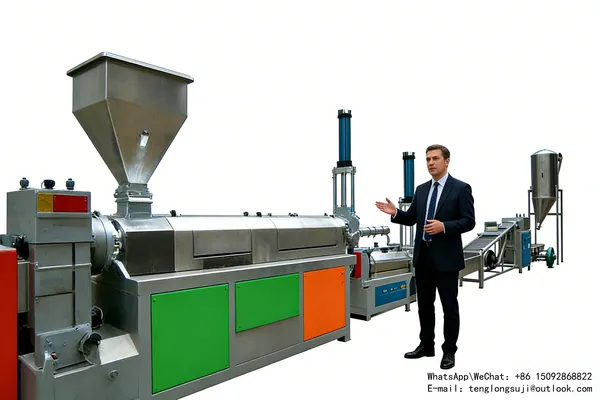
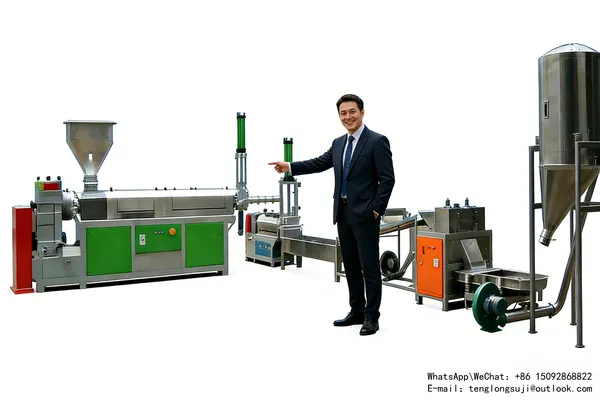
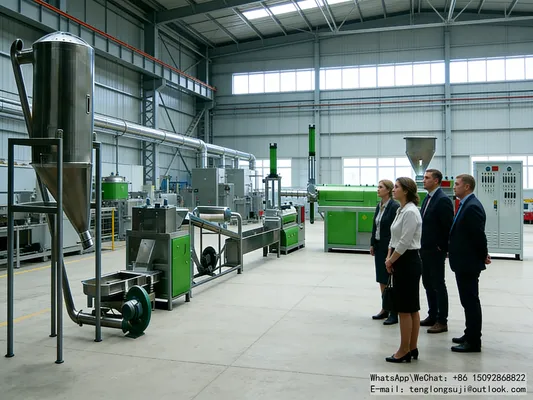
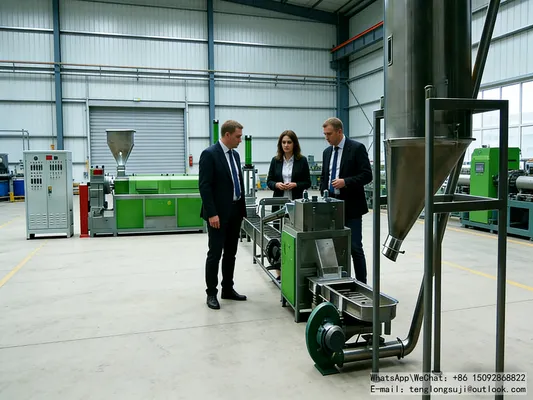
Die Face Hot Cutting of plastic pelletizing machine: Pellets Cut Before Cooling, Fast and Uniform
Everyone in the plastic recycling industry knows that pellet cutting may seem simple, but it involves many tricks.
Stretching the material into strips and then cutting them is the oldest method, which everyone can do. However, if you look at factories that produce high-end materials and large-capacity production lines, most of them do not use strip cutting, but another method — die face hot cutting.
Today we will talk about this. No empty words, just how it works, its advantages, and who it is suitable for.
- What is the difference between die face hot cutting and strip cutting?
Everyone has seen strip cutting: molten material is extruded from the die, turned into strips like noodles, cooled in water, and then cut into sections by a pelletizer.
Die face hot cutting is different. The material is cut on the die face before it cools down.
The process is as follows: molten material is extruded from the small holes of the die, and as soon as it comes out, a high-speed rotating cutter cuts it off. The cut small pellets immediately fall into water or air and cool down in an instant.
One step in place, no strip link.
You may think this is not a big deal. But those who have worked know how many troubles can be saved by omitting the “strip stretching” step.
- The four core components of die face hot cutting
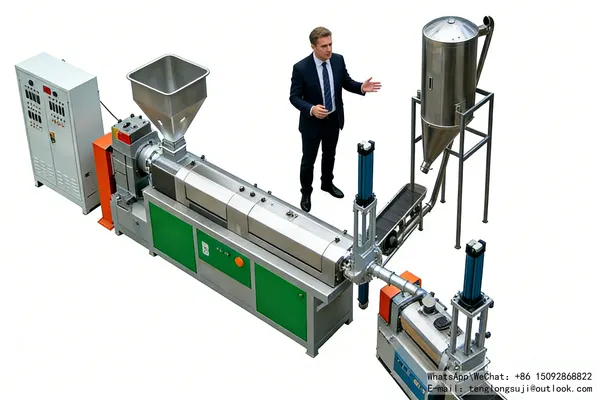
A complete die face hot cutting system mainly consists of four things:
Die — there are many small holes on it, and molten material is extruded from the holes. The diameter of the holes determines the thickness of the pellets.
Cutter — rotating at high speed close to the die face to cut the extruded material. The blade must be sharp and fit tightly.
Cooling system — the cut pellets immediately fall into water or air ducts to cool down quickly.
Dehydration and screening — dry the water and screen out irregular pellets.
When these four work well together, the resulting pellets are uniform, good-looking, non-sticky and non-caking.
III. What are its advantages over strip cutting?
First, save space.
Strip cutting requires a long water tank where the strips have to soak for several meters to cool completely. Die face hot cutting does not need this; the pellets cool down on the spot after being cut. The equipment footprint can be reduced by more than 30%.
Second, save labor.
Strip cutting requires someone to watch — connect broken strips, sort out tangled ones, and separate piled ones. Die face hot cutting runs fully automatically, and one person is more than enough to watch one machine.
Third, uniform pellets.
The size of pellets in strip cutting depends on the speed of the cutter and the speed of the strips. If the strips are stretched a little faster or slower, the pellets will change.
Die face hot cutting is different. When the cutter speed is matched with the extrusion volume, the pellet size is the same from start to finish. The resulting pellets are full, burr-free, and low in dust.
Fourth, high production capacity.
For a plastic pelletizing machine of the same size, converting to die face hot cutting can increase production capacity by more than 30%, because the bottleneck link of strip stretching is eliminated.
- What materials can it process?
Die face hot cutting is not picky and can basically process all general-purpose plastics:
PE (films, bottles)
PP (woven bags, ton bags)
PVC (pipes, cable materials) — this is especially suitable because PVC is heat-sensitive and easy to burn when stretched into strips
EVA (shoe materials, foaming materials)
ABS (electrical enclosures)
TPR, TPE (elastomers)
It can also make masterbatches: color masterbatches, filler masterbatches, flame-retardant masterbatches, etc.
But there is a premise: the melt index (fluidity) of the material must be sufficient. Materials that are too sticky and have poor fluidity are not suitable for die face hot cutting. You have to ask the manufacturer and test your material.
- Different configurations: Europe & America vs. Southeast Asia
Even for the same die face hot cutting, the configuration is different when sold to different places.
European and American markets:
High requirements.
Precise temperature control, high degree of automation
Low energy consumption, meeting environmental protection standards
Stable pellet quality, able to compete with new materials
Closed design, no dust leakage
Therefore, the plastic pelletizing machines sold to Europe and America use high-quality servo motors, high-precision cutters, and closed-loop control systems. They are expensive, but the market recognizes this.
Southeast Asian market:
Practical requirements.
Durable, no frequent breakdowns
Easy to operate, no need for a doctoral degree
Cheap accessories, can be replaced by yourself
Not too expensive
Therefore, the machines sold to Southeast Asia have a simplified structure, using ordinary motors with frequency converters and pneumatic instead of servo. It is enough to be usable and easy to repair.
Before buying the machine, figure out who you are selling your pellets to. If selling to Europe and America, don’t skimp on configuration; if for local consumption, it’s enough to be usable.
- The most common problems with die face hot cutting
Problem 1: Pellets stick together
Phenomenon: The cut pellets are clumpy and cannot be separated.
Cause: Insufficient cooling. The pellets are piled up before they cool down completely.
Solution: Check the cooling water temperature. If the water is too hot, cool it down or increase the water flow.
Problem 2: Uneven pellet size
Phenomenon: Some pellets are large and some are small, even cannot be separated by screening.
Cause: Poor fit between the cutter and the die face, or unstable extrusion pressure.
Solution:
Check the cutter to see if the blade is worn flat
Check the die face for wear
Adjust the blade fit
Problem 3: Pellets have tails
Phenomenon: One end of the pellet has a small tip, like a tadpole.
Cause: The knife is not sharp; when cutting, it is not “cutting” but “scratching”.
Solution: Replace the blade or sharpen it. The blades of die face hot cutting are generally replaced every few days to a week, depending on the output.
Problem 4: Die hole clogging
Phenomenon: Less and less material is discharged, and the pellets are getting thinner and thinner.
Cause: The small holes of the die are blocked by impurities.
Solution: Stop the machine, disassemble the die and clean it. For severe cases, burn it with fire before cleaning.
Note: Do not force extrusion if the die is blocked; the pressure will break the die.
VII. Daily maintenance: remember four things
Although die face hot cutting is automatic, you cannot be lazy in maintenance.
First, check the cutter every day.
Listen to the sound; the normal cutting sound is a uniform “swishing” sound. If there is abnormal noise, the knife may be loose or the blade may be chipped.
Second, clean the die before changing materials every time.
Different materials have different melting properties, and residual materials will block the holes.
Third, check the cooling water.
Change the water if it is dirty, and replenish it if it is low. Control the water temperature, generally 30-40℃.
Fourth, replace the blade regularly.
The blade is a consumable. Do not wait until it cannot cut to replace it, which will affect the pellet quality.
VIII. Who is die face hot cutting suitable for?
To be honest, die face hot cutting is not for everyone.
Suitable for:
High production capacity requirements, more than several hundred kilograms per hour
Producing high-end materials with strict requirements on pellet appearance
Producing heat-sensitive materials that are afraid of degradation during strip stretching (such as PVC)
High labor costs, wanting to reduce the number of workers
Not suitable for:
Small factories that only work a few hundred kilograms a day (the equipment is expensive, not worth it)
Frequent changes in material types (troublesome to change the die and adjust parameters)
Processing materials that are too sticky (poor fluidity, cannot be cut by hot cutting)
Die face hot cutting equipment is much more expensive than strip cutting. You have to calculate: how long it will take to recover the price difference with the increased production capacity and reduced labor.
- Advantages in energy conservation and environmental protection
Now environmental protection supervision is strict, and die face hot cutting has inherent advantages in this regard:
Closed design — no dust or smoke during production, making it easy to pass environmental inspections.
Frequency conversion speed regulation — use electricity and rotate at a speed according to needs, more energy-saving than fixed-speed ones.
No water or less water — some air-cooled models do not use water at all, saving the trouble of wastewater treatment.
This is a hard requirement for the European and American markets, and a bonus for the Southeast Asian market.
We have been in this industry for 20 years and have sold thousands of plastic pelletizing machines. Die face hot cutting is one of the most mature technologies in the current mainstream processes.
If you are not sure whether your material is suitable for die face hot cutting ——
Add WeChat and tell us what material you use, what your production capacity is, and what process you are using now.
WhatsApp / WeChat: +86 15092868822
We will help you figure out which process is the most suitable, or send you a configuration list of die face hot cutting.