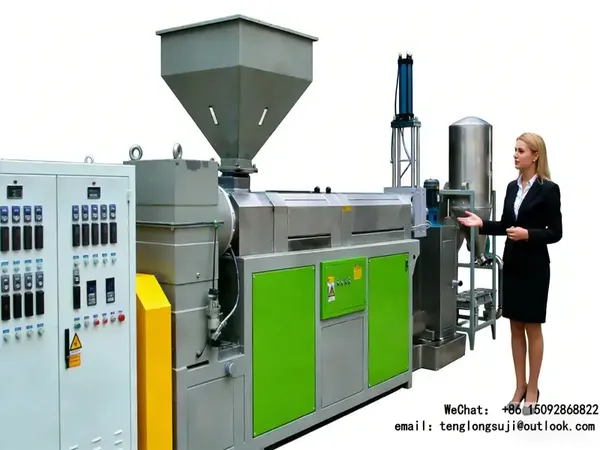
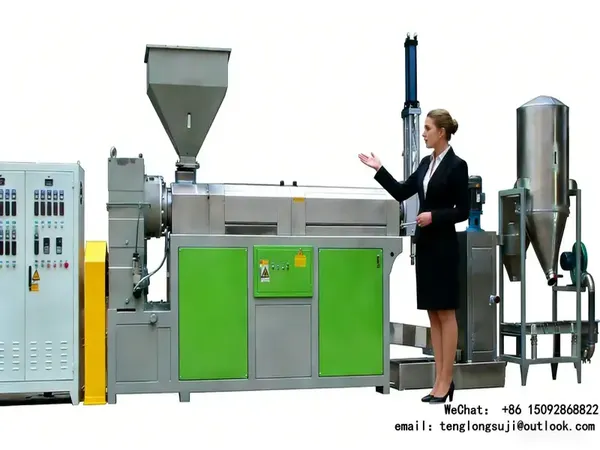
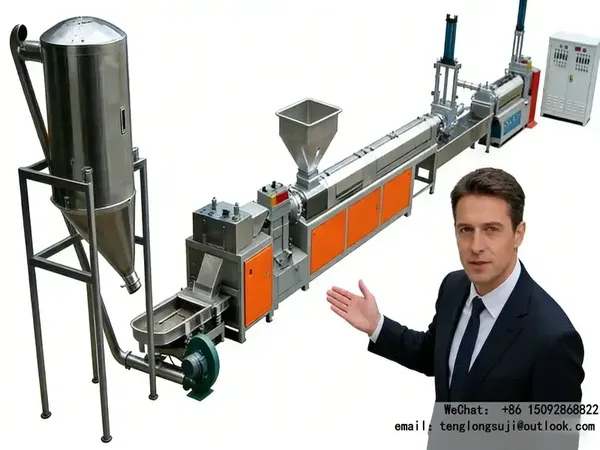
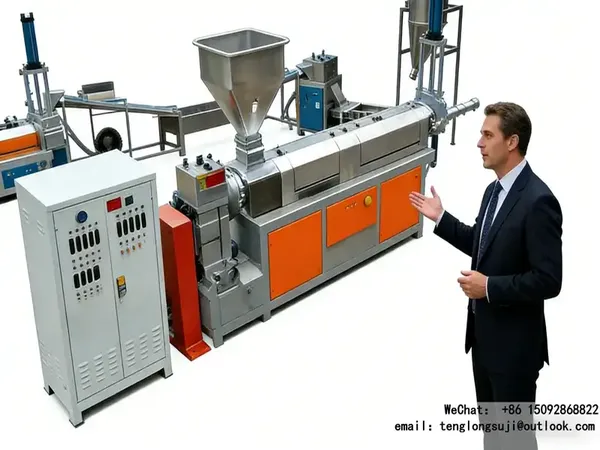
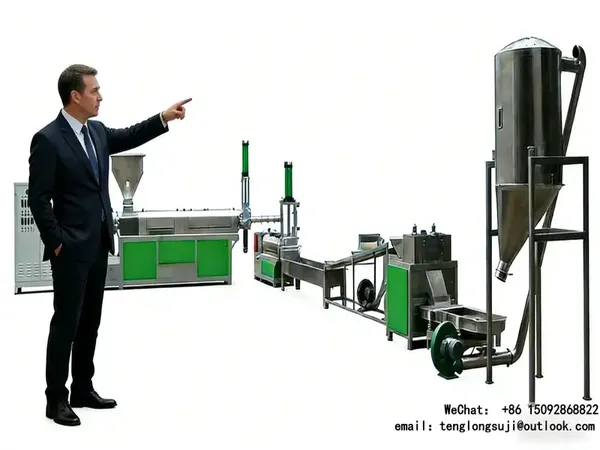
Black Spots on Pellets & High Energy Consumption of Plastic Granulator? The Problem May Lie in Heating and Cooling

Everyone in the plastic recycling industry knows a fundamental truth: excessively high temperatures will burn the material, while excessively low temperatures will prevent it from being drawn into strips. Many business owners, when purchasing a plastic granulator, focus intensely on motor power and screw diameter, believing that “sufficient power guarantees good results”. However, after running the equipment for two to three months, they often find the pellets are yellowish, dotted with black spots, or the output fluctuates unpredictably.
Despite thorough checks, the root cause often eludes them. In reality, the problem typically lies in an overlooked component—the heating and cooling system of the plastic granulator. Simply put, granulation is the process of “melting waste material and then shaping it”: heating melts the material, while cooling sets its shape. If either process is poorly controlled, the resulting pellets will fail to meet quality standards. Today, we’ll break down the heating and cooling of plastic granulators from a practical production perspective, making it easy to understand and apply.
- Heating: It’s Not About Maximum Heat, But Reliable Control
You’ve likely experienced this scenario: the set temperature of your plastic granulator is 200℃, but the actual temperature in a local area of the barrel spikes to 250℃. This is what’s known as a “hot spot”.
What are the consequences of hot spots? Yellowing and blackening of pellets. Local overheating breaks the polymer chains in the material, altering its color—downstream customers will immediately reject blackened pellets. Hot spots also cause frequent screen clogging: carbonized impurities block the filter screen, reducing screen replacement intervals from once every 2 hours to once every 30 minutes. Additionally, over-burned plastic emits a pungent odor that will fail environmental protection inspections.
So, how do you fix this? The key lies in two core elements of a plastic granulator’s heating system: the heating method and sectioned temperature control.
1.1 Electromagnetic Heating vs. Resistance Heating: What’s the Difference?
Older plastic granulators rely on resistance heating coils—iron rings wrapped with resistance wire. While affordable, they have significant drawbacks: low thermal efficiency (only around 60%), meaning 40% of electricity is wasted as dissipated heat; slow heating and cooling, making it hard to correct temperature deviations once they occur.
Modern plastic granulators use electromagnetic induction heating, which works like an induction cooker: the barrel heats itself, rather than being heated externally. The advantages are clear: electromagnetic heating boasts over 95% thermal efficiency, cutting plastic granulator electricity consumption by 30%-40% for the same output; it heats up quickly, reaching the set temperature in 3-5 minutes after startup; most importantly, it offers precise temperature control with minimal fluctuations.
A reliable plastic granulator now comes standard with electromagnetic heating. If your machine still uses resistance coils, upgrading is a worthwhile investment—you’ll typically recoup the upgrade cost within six months.
1.2 Sectioned Temperature Control: One Temperature Doesn’t Fit All
Different materials, and even different stages of the same material, require different temperatures. This means a plastic granulator’s heating system must have sectioned temperature control. Take PP woven bags as an example: the feeding section needs a lower temperature (160-180℃) to prevent the material from melting prematurely and blocking the feed port; the compression section requires higher temperatures (200-220℃) to ensure full melting; the homogenization section temperature drops slightly (190-200℃) to maintain fluidity without over-burning.
This is called a “multi-section temperature gradient”. A high-quality plastic granulator independently controls each temperature zone, with a dedicated thermocouple and heating module for every section. How to test your plastic granulator’s sectioned temperature control? Use a handheld infrared thermometer to measure temperatures at different barrel positions and compare them to the instrument’s readings. A deviation exceeding 10℃ indicates poor temperature control.
- Cooling System: An Undervalued Critical Component
While heating gets plenty of attention, cooling is often overlooked—yet it determines the final appearance of the pellets and is critical to the plastic granulator’s normal operation. When material is extruded from the die head, it’s soft like noodles and must be quickly hardened and cut into pellets. Poor cooling leads to deformed, stuck-together pellets or those with internal bubbles.
2.1 Water Cooling: It’s Not Just About Having Water
Many small factories take a simplistic approach: connect a water pipe and let water flow through a tank. This causes three main issues: unstable water temperature (high summer temperatures reduce cooling efficiency, resulting in soft pellets); uneven water flow (strips float on the water, with some submerged and others not, leading to inconsistent cooling); and risk of pump damage if the tank runs dry.
A proper plastic granulator cooling system should include: a circulating water tank with an effective volume of 10-15 cubic meters, maintained at 25-35℃; uniform immersion (strips are pressed underwater via guide wheels to ensure consistent cooling time for every strip); and automatic water level control to prevent pump burnout.
2.2 Both Too Fast and Too Slow Cooling Are Detrimental
This is a common oversight: excessively fast cooling causes the pellet surface to shrink rapidly, creating high internal stress that leads to cracking after storage. Excessively slow cooling means pellets are cut before they’re fully shaped, resulting in irregular forms and adhesion.
The ideal cooling time depends on the material and strip thickness. A simple rule of thumb: when strips exit the water, they should feel warm (not hot) but slightly soft—this is the perfect state for pelletizing. How to adjust this in practice? Modify the length of the strips in the water tank. For longer tanks, add or remove submerged guide wheels to adjust cooling time, matching your plastic granulator’s production needs.
III. Energy Recovery: What You Save Becomes Profit
Heating consumes electricity, and cooling uses water—together, these account for 30%-40% of a plastic granulator’s operating costs. The good news: you can reuse the heat lost in cooling water to preheat the feed.
The principle is simple: after cooling water absorbs heat from the barrel and die head, its temperature rises to 40-50℃. Redirect this hot water to the feed port area, where a heat exchanger preheats the cold material entering the barrel. This dual benefit reduces plastic granulator energy consumption (the main heating zone works less hard) and allows water recycling (cooled water is reused, saving water).
The result: a well-designed heat recovery system cuts overallplastic granulator energy consumption by an additional 10%-15%. Over a year, these savings can cover the salary of one operator.
- Three Most Common Heating & Cooling Faults in Daily Production
After 20 years in the industry, these are the most frequent issues our customers face. By checking against these, you can resolve most problems yourself and avoid plastic granulator downtime due to heating or cooling failures.
Fault 1: Temperature continues rising after reaching the set value. Possible cause: A broken or poorly connected thermocouple. Troubleshooting: Replace the thermocouple (only tens of yuan). Note: If the thyristor is damaged, contact an electrician for replacement.
Fault 2: Pellet surfaces are rough with ripples. Possible cause: Fluctuating cooling water temperature or insufficient flow. Troubleshooting: Check if the water pump is running normally and the tank level is adequate. Solution: Install a simple constant temperature control (e.g., cooling tower or coil) to stabilize the plastic granulator’s cooling system.
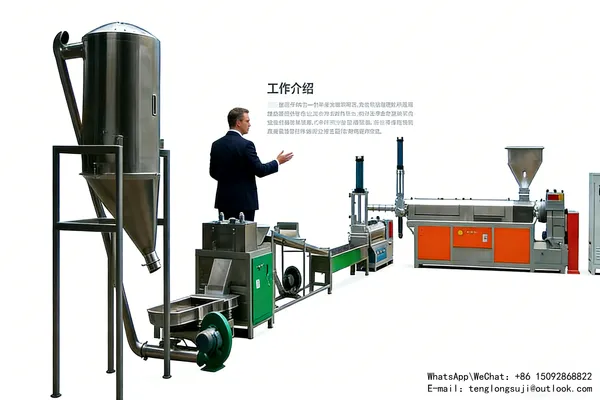
Fault 3: Pellets are fine one day but burned the next with the same temperature setting. Possible cause: Raw material changed but temperature wasn’t adjusted. Troubleshooting: Confirm differences between the current and previous raw material batches (e.g., moisture content, impurity type). Solution: Test a small batch first to find the optimal temperature before mass production, avoiding plastic granulator heating system mismatches.
- Summary: What Makes a Plastic Granulator’s Heating & Cooling System Reliable?
If you’re buying or replacing a plastic granulator, remember three non-negotiable indicators for its heating and cooling system: electromagnetic heating + sectioned temperature control (both are essential); a circulating water cooling system with controllable temperature and sufficient flow; and heat recovery design (not mandatory, but highly cost-effective).
With 20 years of experience, we’ve delivered thousands of plastic granulators worldwide. Each plastic granulator’s heating and cooling system is customized—not copied from drawings—based on local factors like raw materials, climate, and electricity prices, ensuring optimal performance, stable output, and high-quality pellets.
If you want to learn how to match heating and cooling to your specific material, or resolve temperature fluctuations in your existing plastic granulator, add our WeChat to share your details: what material you’re processing, your plastic granulator model, and the specific issues you’re facing.
WhatsApp / WeChat: +86 15092868822
We’ll send you a free copy of our “Heating & Cooling System Common Faults Checklist” (3 pages)—a practical guide to resolving most plastic granulator temperature control issues quickly.